







Question: a) Re-derive Eq. 2 macroscopically by insisting that the net force on each layer of air is zero, as follows: i. Consider a cylindrical slab
a) Re-derive Eq. 2 macroscopically by insisting that the net force on each layer of air is zero, as follows: i. Consider a cylindrical slab of air, extending from height z to height z + dz with horizontal cross section A, so the volume of the slab is A dz. Compute the mass M of all of the air in this slab. ii. Write the net vertical force on this slab as the sum of three terms, coming from (a) the weight of the air in the slab, (b) the pressure p(z) which can be used to calculate the force on the bottom face of the slab, and (c) the pressure p(z + dz) which can be used to calculate the force on the top face of the slab. Be careful about signs, drawing a diagram if necessary. iii. Show that setting this net force equal to zero gives an equation for dp/dz, the solution of which is Eq. 2

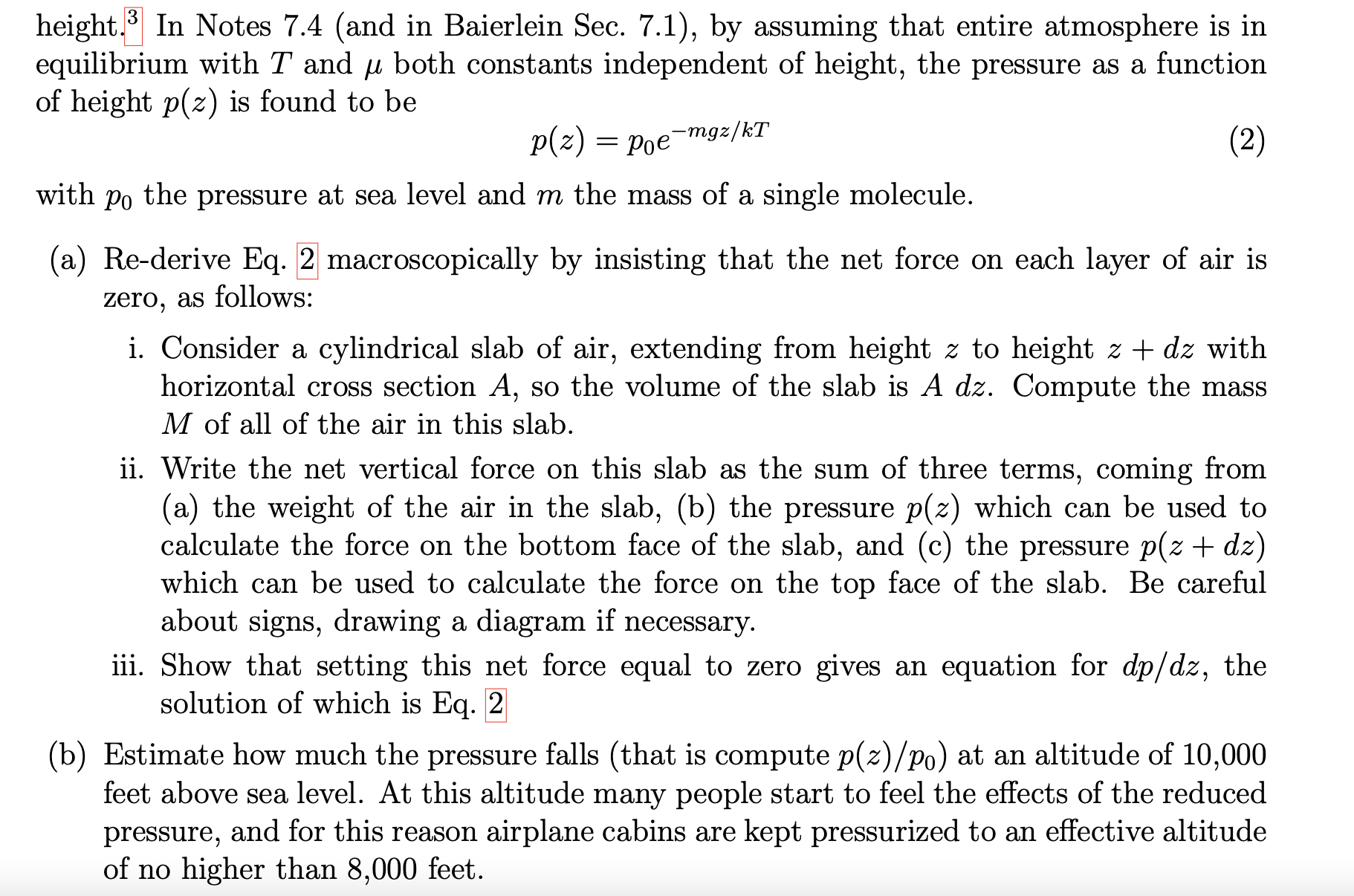
3. (10 pts) The isothermal atmosphere. For this problem consider the atmosphere to be pure nitrogen gas and to be at uniform temperature T (room temperature) independent of height. 3 In Notes 7.4 (and in Baierlein Sec. 7.1 ), by assuming that entire atmosphere is in equilibrium with T and both constants independent of height, the pressure as a function of height p(z) is found to be p(z)=p0emgz/kT with p0 the pressure at sea level and m the mass of a single molecule. (a) Re-derive Eq. 2 macroscopically by insisting that the net force on each layer of air is zero, as follows: i. Consider a cylindrical slab of air, extending from height z to height z+dz with horizontal cross section A, so the volume of the slab is Adz. Compute the mass M of all of the air in this slab. ii. Write the net vertical force on this slab as the sum of three terms, coming from (a) the weight of the air in the slab, (b) the pressure p(z) which can be used to calculate the force on the bottom face of the slab, and (c) the pressure p(z+dz) which can be used to calculate the force on the top face of the slab. Be careful about signs, drawing a diagram if necessary. iii. Show that setting this net force equal to zero gives an equation for dp/dz, the solution of which is Eq. 2 (b) Estimate how much the pressure falls (that is compute p(z)/p0 ) at an altitude of 10,000 feet above sea level. At this altitude many people start to feel the effects of the reduced pressure, and for this reason airplane cabins are kept pressurized to an effective altitude of no higher than 8,000 feet. 3. (10 pts) The isothermal atmosphere. For this problem consider the atmosphere to be pure nitrogen gas and to be at uniform temperature T (room temperature) independent of height. 3 In Notes 7.4 (and in Baierlein Sec. 7.1 ), by assuming that entire atmosphere is in equilibrium with T and both constants independent of height, the pressure as a function of height p(z) is found to be p(z)=p0emgz/kT with p0 the pressure at sea level and m the mass of a single molecule. (a) Re-derive Eq. 2 macroscopically by insisting that the net force on each layer of air is zero, as follows: i. Consider a cylindrical slab of air, extending from height z to height z+dz with horizontal cross section A, so the volume of the slab is Adz. Compute the mass M of all of the air in this slab. ii. Write the net vertical force on this slab as the sum of three terms, coming from (a) the weight of the air in the slab, (b) the pressure p(z) which can be used to calculate the force on the bottom face of the slab, and (c) the pressure p(z+dz) which can be used to calculate the force on the top face of the slab. Be careful about signs, drawing a diagram if necessary. iii. Show that setting this net force equal to zero gives an equation for dp/dz, the solution of which is Eq. 2 (b) Estimate how much the pressure falls (that is compute p(z)/p0 ) at an altitude of 10,000 feet above sea level. At this altitude many people start to feel the effects of the reduced pressure, and for this reason airplane cabins are kept pressurized to an effective altitude of no higher than 8,000 feet
Step by Step Solution
There are 3 Steps involved in it

Get step-by-step solutions from verified subject matter experts
 Study Help