







Question: A refrigerant at -20C is flowing through a 4 schedule 40 carbon steel pipe (inner diameter 102 mm, outer diameter 114 mm); the heat
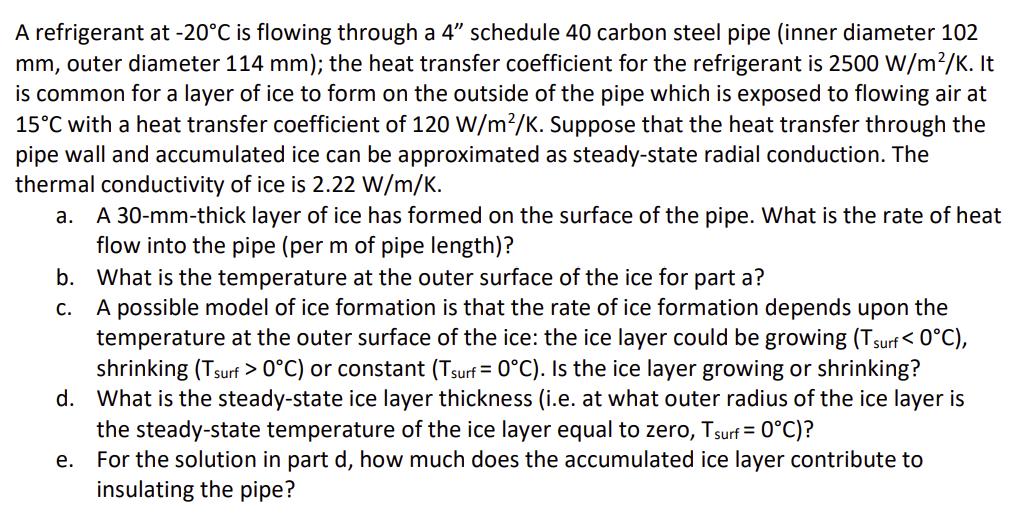
A refrigerant at -20C is flowing through a 4" schedule 40 carbon steel pipe (inner diameter 102 mm, outer diameter 114 mm); the heat transfer coefficient for the refrigerant is 2500 W/m/K. It is common for a layer of ice to form on the outside of the pipe which is exposed to flowing air at 15C with a heat transfer coefficient of 120 W/m/K. Suppose that the heat transfer through the pipe wall and accumulated ice can be approximated as steady-state radial conduction. The thermal conductivity of ice is 2.22 W/m/K. a. A 30-mm-thick layer of ice has formed on the surface of the pipe. What is the rate of heat flow into the pipe (per m of pipe length)? b. What is the temperature at the outer surface of the ice for part a? c. A possible model of ice formation is that the rate of ice formation depends upon the temperature at the outer surface of the ice: the ice layer could be growing (T surf 0C) or constant (Tsurf = 0C). Is the ice layer growing or shrinking? d. What is the steady-state ice layer thickness (i.e. at what outer radius of the ice layer is the steady-state temperature of the ice layer equal to zero, Tsurf = 0C)? e. For the solution in part d, how much does the accumulated ice layer contribute to insulating the pipe?
Step by Step Solution
There are 3 Steps involved in it
To solve this problem we can use the principles of steadystate radial conduction and apply them to the pipe and ice layer system Well follow the steps outlined below a The rate of heat flow into the p... View full answer

Get step-by-step solutions from verified subject matter experts
 Study Help