







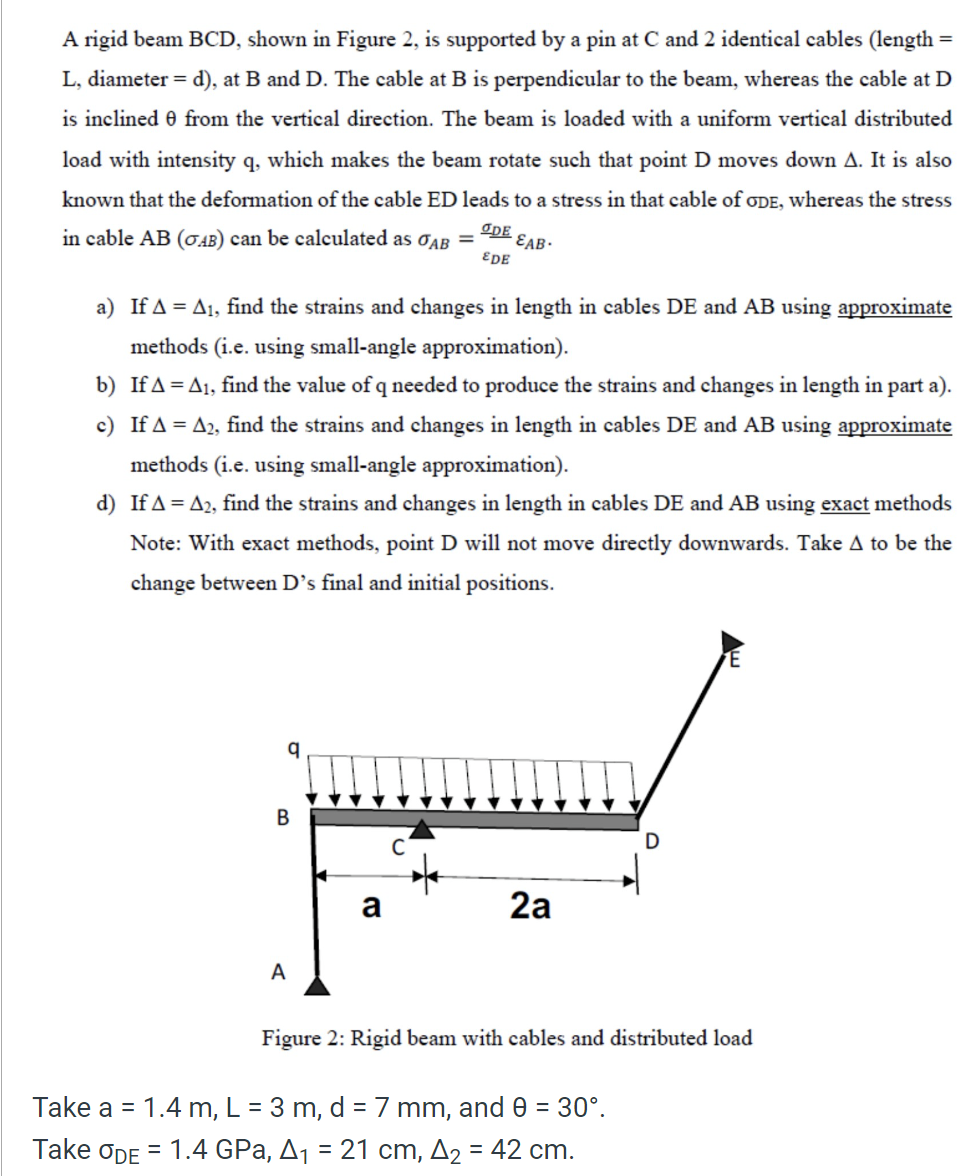
Question: A rigid beam BCD , shown in Figure 2 , is supported by a pin at C and 2 identical cables ( length = L
A rigid beam BCD shown in Figure is supported by a pin at C and identical cables length
diameter at and The cable at is perpendicular to the beam, whereas the cable at
is inclined from the vertical direction. The beam is loaded with a uniform vertical distributed
load with intensity q which makes the beam rotate such that point D moves down It is also
known that the deformation of the cable ED leads to a stress in that cable of ODE, whereas the stress
in cable can be calculated as
a If find the strains and changes in length in cables DE and AB using approximate
methods ie using smallangle approximation
b If find the value of needed to produce the strains and changes in length in part a
c If find the strains and changes in length in cables DE and AB using approximate
methods ie using smallangle approximation
d If find the strains and changes in length in cables DE and AB using exact methods
Note: With exact methods, point D will not move directly downwards. Take to be the
change between s final and initial positions.
Figure : Rigid beam with cables and distributed load
Take and
Take GPa,
Step by Step Solution
There are 3 Steps involved in it
1 Expert Approved Answer
Step: 1 Unlock

Question Has Been Solved by an Expert!
Get step-by-step solutions from verified subject matter experts
Step: 2 Unlock
Step: 3 Unlock
 Study Help