







Question: A sample question with its solution has been provided below. Please answer the question in the same format and exact steps as the sample questions
A sample question with its solution has been provided below.
Please answer the question in the same format and exact steps as the sample questions - both questions are very similar. A typed answer is preferable for clarity.
PS: This seems very long but in actual fact, it is short.
Sample Question:
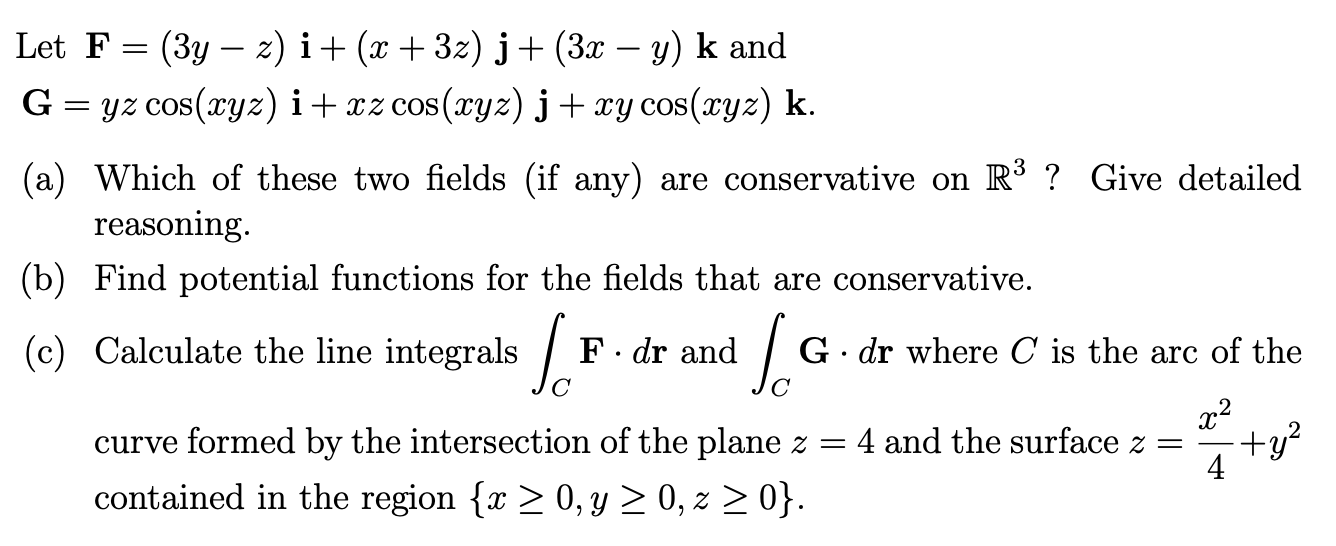
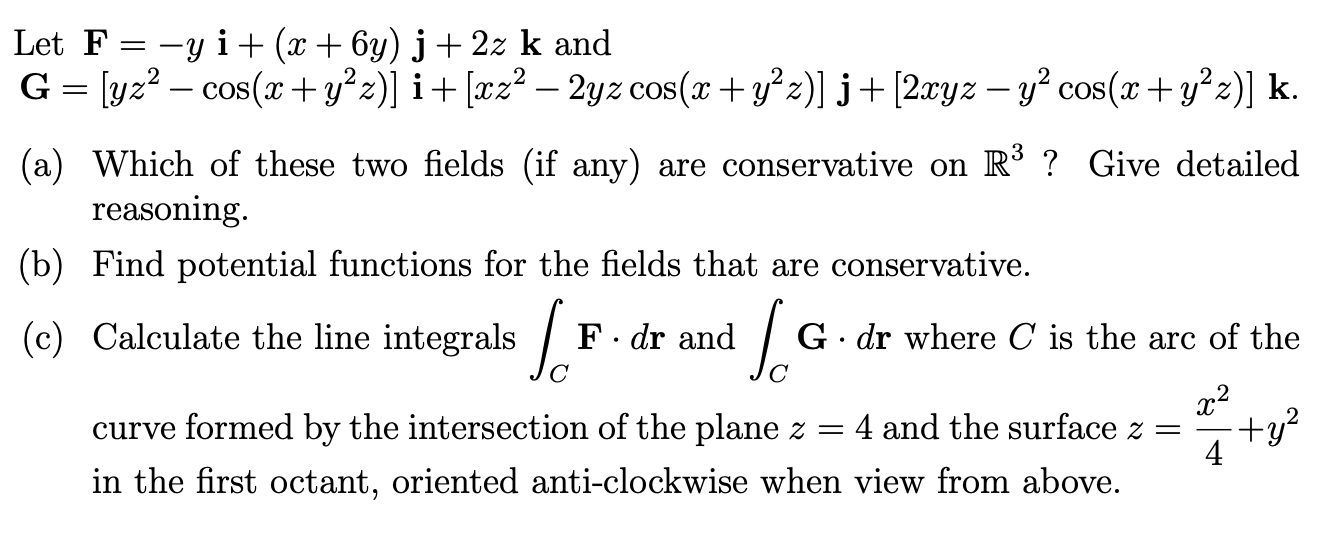
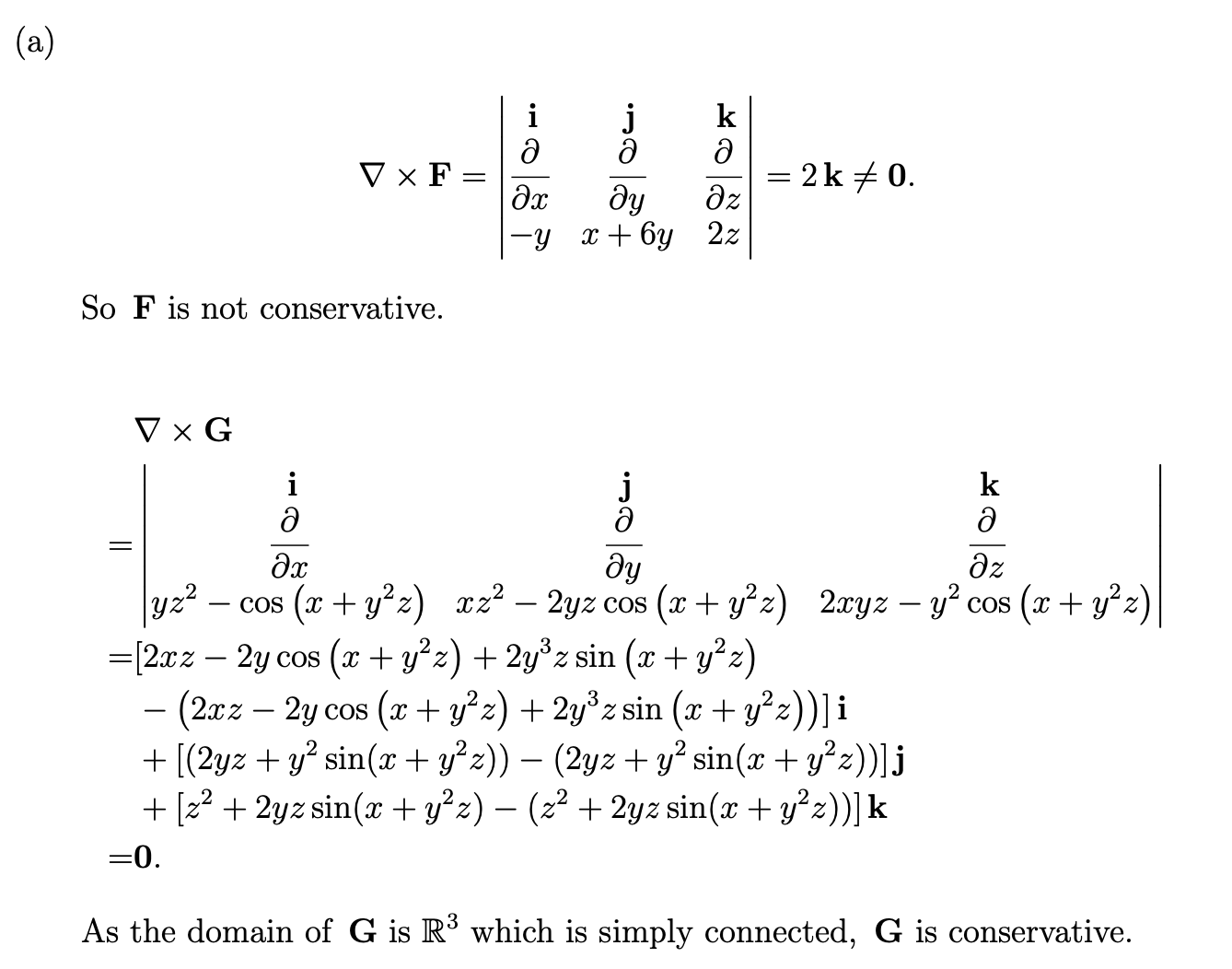
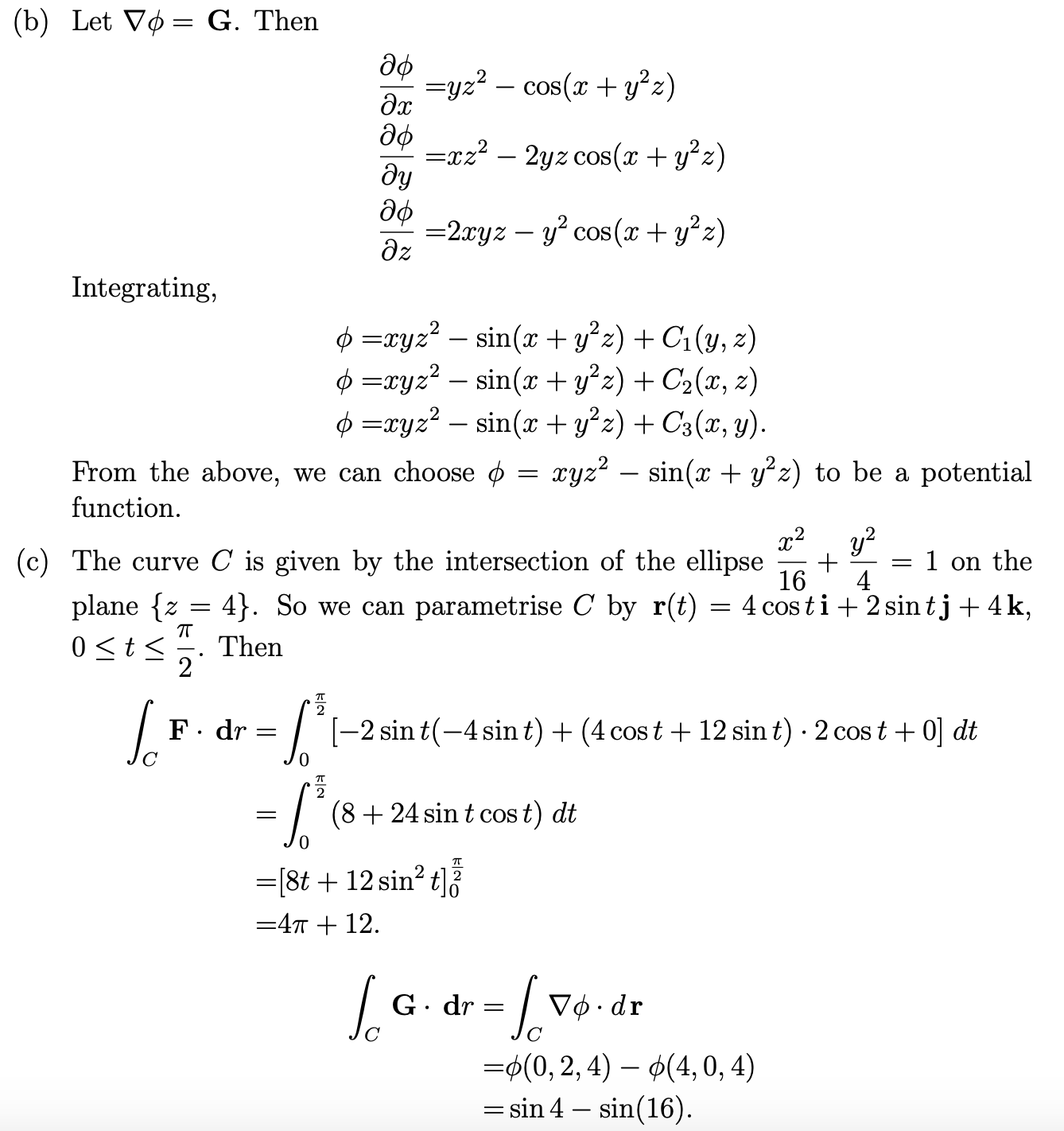
Let F = (3y - z) i+ (x + 3z) j + (3x - y) k and G = yz cos(xyz) i + xzcos(xyz) j + xy cos(xyz) k. (a) Which of these two fields (if any) are conservative on RS ? Give detailed reasoning. (b) Find potential functions for the fields that are conservative. (c) Calculate the line integrals C F . dr and G . dr where C is the arc of the C curve formed by the intersection of the plane z = 4 and the surface z = 2-2 4 ty2 contained in the region {x 2 0, y 2 0, z 2 0}.Let F = -yi+ (x + 6y) j + 2z k and G = [yz2 - cos(x + y z)] i+ [xz2 -2yz cos(x +yz)] j+ [2xyz -y cos(x + yz)] k. (a) Which of these two fields (if any ) are conservative on RS ? Give detailed reasoning. (b) Find potential functions for the fields that are conservative. (c) Calculate the line integrals F . dr and G . dr where C is the arc of the C C curve formed by the intersection of the plane z = 4 and the surface z = 22 4 in the first octant, oriented anti-clockwise when view from above.(a) V x F = ay az = 2k # 0. -y x+ by 2z So F is not conservative. V X G ou. k a = Ox ay Oz yz2 - cos (x ty z z2 - 2yz cos (x+ y z) 2xyz -y cos (x+ 2z) =[2xz - 2y cos (x + y2z) + 2y3z sin (x + y2z) - (2xz - 2y cos (x + yz) + 2y3 z sin (x + 2z) )li + [(2yz + 2 sin(x + y z)) - (2yz + y sin(x + yz))lj + [22 + 2yz sin(x + yz) - (22 + 2yz sin(x + yz) )] k =0. As the domain of G is R' which is simply connected, G is conservative.(b) Let Vo = G. Then =yz2 - cos(x + y?z) ay =xz2 - 2yz cos(x + y"z) az =2xyz - y' cos(x + yz) Integrating, o =xyz" - sin(x + y'z) + Ci(y, z) p =xyz2 - sin(x + yz) + C2(2, z) o =xyz2 - sin(x + yz) + C3(2, y). From the above, we can choose o = xyz2 - sin(x + yz) to be a potential function. (c) The curve C is given by the intersection of the ellipse 20 2 y2 16 = 1 on the plane {z = 4}. So we can parametrist C by r(t) = 4costi + 2sintj + 4k, 4 0
Step by Step Solution
There are 3 Steps involved in it

Get step-by-step solutions from verified subject matter experts
 Study Help