







Question: A scientific large-scale application that performs weather pattern prediction is deployed on a 100-core machine i.e., a machine with 100 CPUs. To save power,
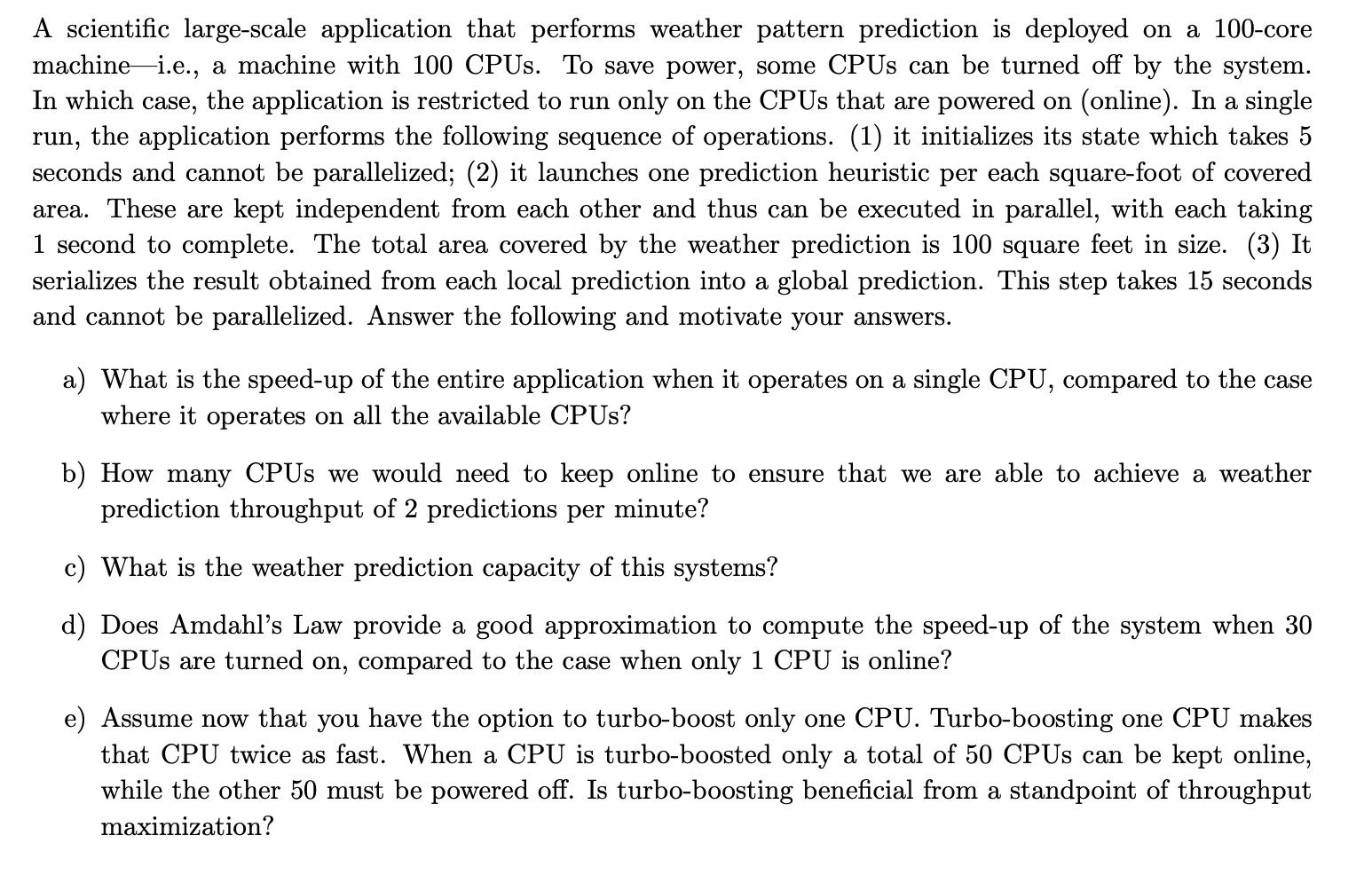
A scientific large-scale application that performs weather pattern prediction is deployed on a 100-core machine i.e., a machine with 100 CPUs. To save power, some CPUs can be turned off by the system. In which case, the application is restricted to run only on the CPUs that are powered on (online). In a single run, the application performs the following sequence of operations. (1) it initializes its state which takes 5 seconds and cannot be parallelized; (2) it launches one prediction heuristic per each square-foot of covered area. These are kept independent from each other and thus can be executed in parallel, with each taking 1 second to complete. The total area covered by the weather prediction is 100 square feet in size. (3) It serializes the result obtained from each local prediction into a global prediction. This step takes 15 seconds and cannot be parallelized. Answer the following and motivate your answers. a) What is the speed-up of the entire application when it operates on a single CPU, compared to the case where it operates on all the available CPUs? b) How many CPUs we would need to keep online to ensure that we are able to achieve a weather prediction throughput of 2 predictions per minute? c) What is the weather prediction capacity of this systems? d) Does Amdahl's Law provide a good approximation to compute the speed-up of the system when 30 CPUs are turned on, compared to the case when only 1 CPU is online? e) Assume now that you have the option to turbo-boost only one CPU. Turbo-boosting one CPU makes that CPU twice as fast. When a CPU is turbo-boosted only a total of 50 CPUs can be kept online, while the other 50 must be powered off. Is turbo-boosting beneficial from a standpoint of throughput maximization? A scientific large-scale application that performs weather pattern prediction is deployed on a 100-core machine i.e., a machine with 100 CPUs. To save power, some CPUs can be turned off by the system. In which case, the application is restricted to run only on the CPUs that are powered on (online). In a single run, the application performs the following sequence of operations. (1) it initializes its state which takes 5 seconds and cannot be parallelized; (2) it launches one prediction heuristic per each square-foot of covered area. These are kept independent from each other and thus can be executed in parallel, with each taking 1 second to complete. The total area covered by the weather prediction is 100 square feet in size. (3) It serializes the result obtained from each local prediction into a global prediction. This step takes 15 seconds and cannot be parallelized. Answer the following and motivate your answers. a) What is the speed-up of the entire application when it operates on a single CPU, compared to the case where it operates on all the available CPUs? b) How many CPUs we would need to keep online to ensure that we are able to achieve a weather prediction throughput of 2 predictions per minute? c) What is the weather prediction capacity of this systems? d) Does Amdahl's Law provide a good approximation to compute the speed-up of the system when 30 CPUs are turned on, compared to the case when only 1 CPU is online? e) Assume now that you have the option to turbo-boost only one CPU. Turbo-boosting one CPU makes that CPU twice as fast. When a CPU is turbo-boosted only a total of 50 CPUs can be kept online, while the other 50 must be powered off. Is turbo-boosting beneficial from a standpoint of throughput maximization?
Step by Step Solution
There are 3 Steps involved in it

Get step-by-step solutions from verified subject matter experts
 Study Help