







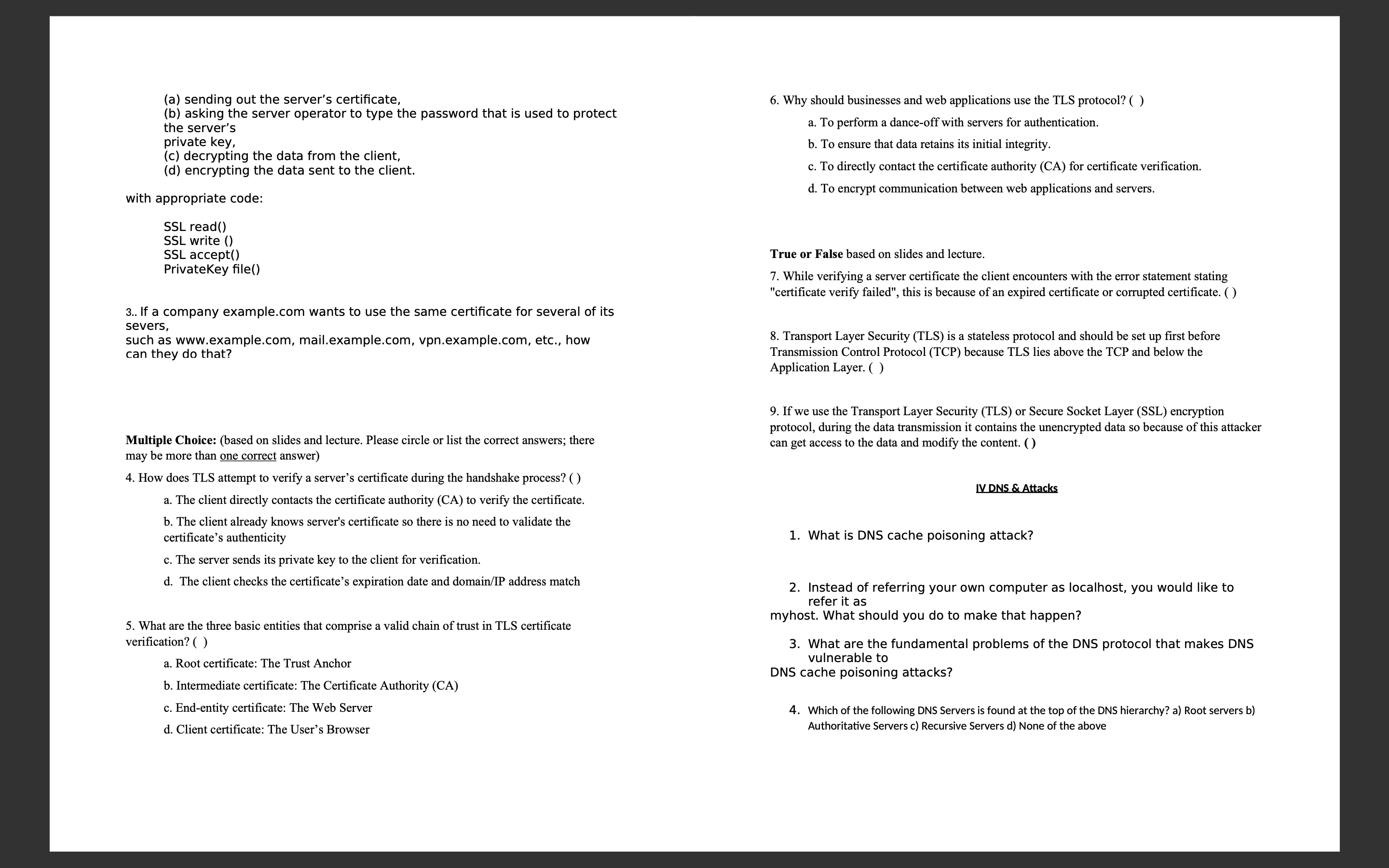
Question: ( a ) sending out the server's certificate, ( b ) asking the server operator to type the password that is used to protect the
a sending out the server's certificate,
b asking the server operator to type the password that is used to protect
the server's
private key
c decrypting the data from the client,
d encrypting the data sent to the client.
with appropriate code:
SSL read
SSL write
SSL accept
PrivateKey file
If a company
example.com wants to use the same certificate for several of its
severs,
such as
wwwexample.com,
mail.example.com,
vpnexample.com, etc., how
can they do that?
Multiple Choice: based on slides and lecture. Please circle or list the correct answers; there
may be more than one correct answer
How does TLS attempt to verify a server's certificate during the handshake process?
a The client directly contacts the certificate authority CA to verify the certificate.
b The client already knows server's certificate so there is no need to validate the
certificate's authenticity
c The server sends its private key to the client for verification.
d The client checks the certificate's expiration date and domainIP address match
What are the three basic entities that comprise a valid chain of trust in TLS certificate
verification?
a Root certificate: The Trust Anchor
b Intermediate certificate: The Certificate Authority CA
c Endentity certificate: The Web Server
d Client certificate: The User's Browser
Why should businesses and web applications use the TLS protocol?
a To perform a danceoff with servers for authentication.
b To ensure that data retains its initial integrity.
c To directly contact the certificate authority CA for certificate verification.
d To encrypt communication between web applications and servers.
True or False based on slides and lecture.
While verifying a server certificate the client encounters with the error statement stating
"certificate verify failed", this is because of an expired certificate or corrupted certificate.
Transport Layer Security TLS is a stateless protocol and should be set up first before
Transmission Control Protocol TCP because TLS lies above the TCP and below the
Application Layer.
If we use the Transport Layer Security TLS or Secure Socket Layer SSL encryption
protocol, during the data transmission it contains the unencrypted data so because of this attacker
can get access to the data and modify the content.
IVDNS & Attacks
What is DNS cache poisoning attack?
Instead of referring your own computer as localhost, you would like to
refer it as
myhost. What should you do to make that happen?
What are the fundamental problems of the DNS protocol that makes DNS
vulnerable to
DNS cache poisoning attacks?
Which of the following DNS Servers is found at the top of the DNS hierarchy? a Root servers b
Authoritative Servers c Recursive Servers d None of the above
Step by Step Solution
There are 3 Steps involved in it
1 Expert Approved Answer
Step: 1 Unlock

Question Has Been Solved by an Expert!
Get step-by-step solutions from verified subject matter experts
Step: 2 Unlock
Step: 3 Unlock
 Study Help