







Question: A sequential circuit has one input (K) and two outputs (H1, H2). An output H1-1 occurs every time the input sequence 011 is completed provided
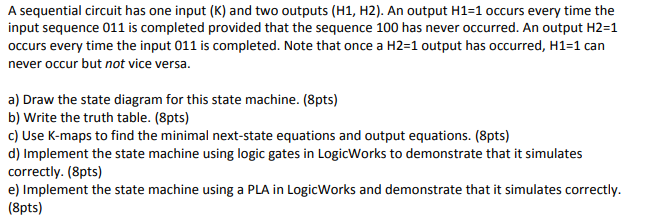
A sequential circuit has one input (K) and two outputs (H1, H2). An output H1-1 occurs every time the input sequence 011 is completed provided that the sequence 100 has never occurred. An output H2-1 occurs every time the input 011 is completed. Note that once a H2-1 output has occurred, H1-1 can never occur but not vice versa. a) Draw the state diagram for this state machine. (8pts) b) Write the truth table. (8pts) c) Use K-maps to find the minimal next-state equations and output equations. (8pts) d) Implement the state machine using logic gates in LogicWorks to demonstrate that it simulates correctly. (8pts) e) Implement the state machine using a PLA in LogicWorks and demonstrate that it simulates correctly. (8pts) A sequential circuit has one input (K) and two outputs (H1, H2). An output H1-1 occurs every time the input sequence 011 is completed provided that the sequence 100 has never occurred. An output H2-1 occurs every time the input 011 is completed. Note that once a H2-1 output has occurred, H1-1 can never occur but not vice versa. a) Draw the state diagram for this state machine. (8pts) b) Write the truth table. (8pts) c) Use K-maps to find the minimal next-state equations and output equations. (8pts) d) Implement the state machine using logic gates in LogicWorks to demonstrate that it simulates correctly. (8pts) e) Implement the state machine using a PLA in LogicWorks and demonstrate that it simulates correctly. (8pts)
Step by Step Solution
There are 3 Steps involved in it

Get step-by-step solutions from verified subject matter experts
 Study Help