







Question: A simple graph G = (V, E) is composed of a set V of vertices and a set E of edges. The set E
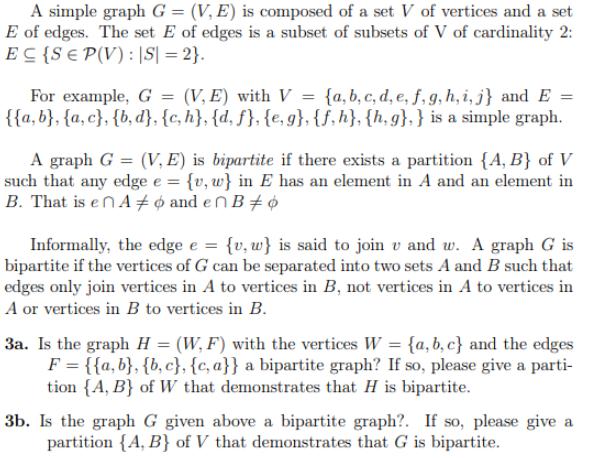
A simple graph G = (V, E) is composed of a set V of vertices and a set E of edges. The set E of edges is a subset of subsets of V of cardinality 2: EC {SEP(V): |S| = 2}. For example, G = (V, E) with V = {a,b,c,d, e, f, g, h, i, j} and E = {{a,b}, {a,c}, {b,d}, {c, h}, {d, f}, {e,g}, {f, h}, {h,g},} is a simple graph. A graph G = (V, E) is bipartite if there exists a partition {A, B} of V such that any edge e = {v, w} in E has an element in A and an element in B. That is en Ao and en Bo Informally, the edge e = {v, w} is said to join u and w. A graph G is bipartite if the vertices of G can be separated into two sets A and B such that edges only join vertices in A to vertices in B, not vertices in A to vertices in A or vertices in B to vertices in B. 3a. Is the graph H = (W, F) with the vertices W = {a,b,c} and the edges F = {{a,b}, {b,c}, {c, a}} a bipartite graph? If so, please give a parti- tion {A, B} of W that demonstrates that H is bipartite. 3b. Is the graph G given above a bipartite graph?. If so, please give a partition {A, B} of V that demonstrates that G is bipartite.
Step by Step Solution
3.27 Rating (156 Votes )
There are 3 Steps involved in it

Get step-by-step solutions from verified subject matter experts
 Study Help