







Question: A simple random sample of size n is drawn from a population that is normally distributed. The sample mean, x , is found to be
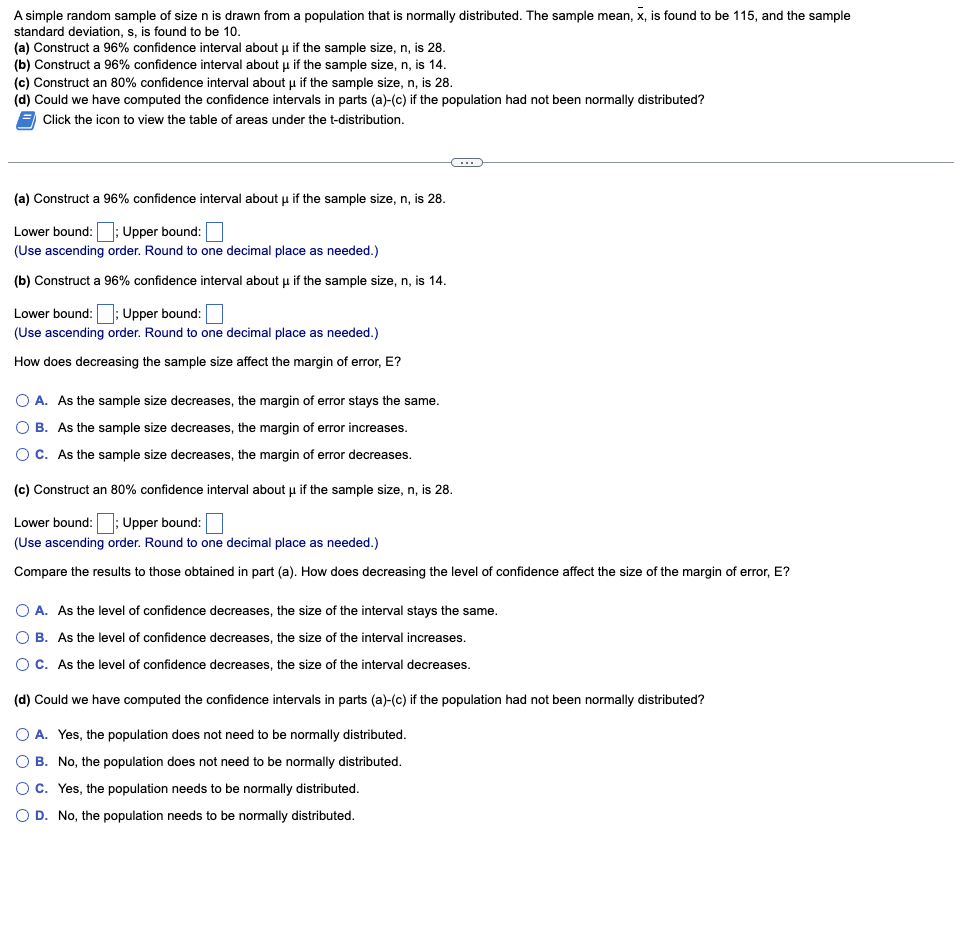
A simple random sample of size is drawn from a population that is normally distributed. The sample mean, is found to be and the sample
standard deviation, s is found to be
a Construct a confidence interval about if the sample size, is
b Construct a confidence interval about if the sample size, is
c Construct an confidence interval about if the sample size, is
d Could we have computed the confidence intervals in parts ac if the population had not been normally distributed?
Click the icon to view the table of areas under the tdistribution.
a Construct a confidence interval about if the sample size, is
Lower bound: ; Upper bound:
Use ascending order. Round to one decimal place as needed.
b Construct a confidence interval about if the sample size, is
Lower bound: ; Upper bound:
Use ascending order. Round to one decimal place as needed.
How does decreasing the sample size affect the margin of error, E
A As the sample size decreases, the margin of error stays the same.
B As the sample size decreases, the margin of error increases.
C As the sample size decreases, the margin of error decreases.
c Construct an confidence interval about if the sample size, is
Lower bound: ; Upper bound:
Use ascending order. Round to one decimal place as needed.
Compare the results to those obtained in part a How does decreasing the level of confidence affect the size of the margin of error, E
A As the level of confidence decreases, the size of the interval stays the same.
B As the level of confidence decreases, the size of the interval increases.
C As the level of confidence decreases, the size of the interval decreases.
d Could we have computed the confidence intervals in parts ac if the population had not been normally distributed?
A Yes, the population does not need to be normally distributed.
B No the population does not need to be normally distributed.
C Yes, the population needs to be normally distributed.
D No the population needs to be normally distributed.
Step by Step Solution
There are 3 Steps involved in it
1 Expert Approved Answer
Step: 1 Unlock

Question Has Been Solved by an Expert!
Get step-by-step solutions from verified subject matter experts
Step: 2 Unlock
Step: 3 Unlock
 Study Help