



Question: A simple random sample of size n is drawn from a population that is normally distributed. The sample mean, x, is found to be 111,
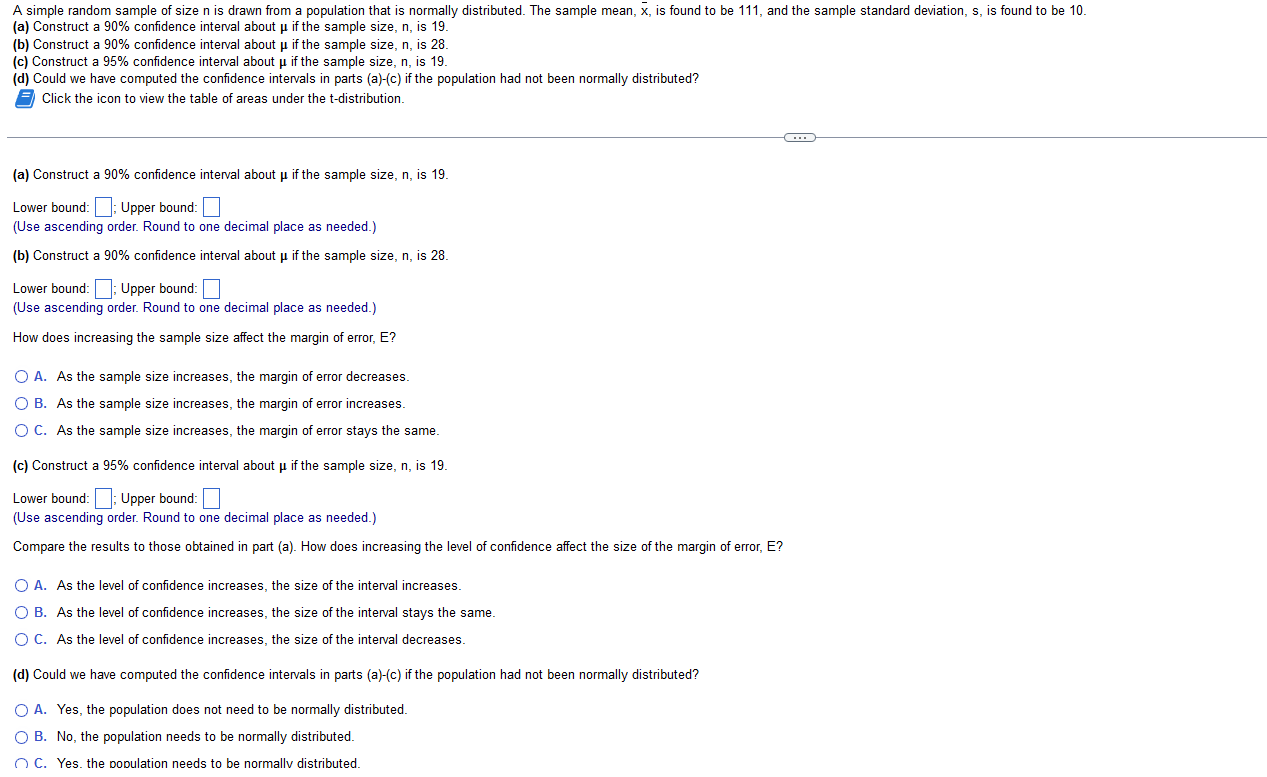
A simple random sample of size n is drawn from a population that is normally distributed. The sample mean, x, is found to be 111, and the sample standard deviation, s, is found to be 10. (a) Construct a 90% confidence interval about u if the sample size, n, is 19. (b) Construct a 90% confidence interval about u if the sample size, n, is 28. (c) Construct a 95% confidence interval about u if the sample size, n, is 19. (d) Could we have computed the confidence intervals in parts (a)-(c) if the population had not been normally distributed? Click the icon to view the table of areas under the t-distribution. (a) Construct a 90% confidence interval about u if the sample size, n, is 19. Lower bound: ; Upper bound: (Use ascending order. Round to one decimal place as needed.) (b) Construct a 90% confidence interval about u if the sample size, n, is 28. Lower bound: ; Upper bound: (Use ascending order. Round to one decimal place as needed.) How does increasing the sample size affect the margin of error, E? O A. As the sample size increases, the margin of error decreases. O B. As the sample size increases, the margin of error increases. O C. As the sample size increases, the margin of error stays the same. (c) Construct a 95% confidence interval about u if the sample size, n, is 19. Lower bound: ; Upper bound: (Use ascending order. Round to one decimal place as needed.) Compare the results to those obtained in part (a). How does increasing the level of confidence affect the size of the margin of error, E? O A. As the level of confidence increases, the size of the interval increases. O B. As the level of confidence increases, the size of the interval stays the same. O C. As the level of confidence increases, the size of the interval decreases. (d) Could we have computed the confidence intervals in parts (a)-(c) if the population had not been normally distributed? O A. Yes, the population does not need to be normally distributed. O B. No, the population needs to be normally distributed. O C. Yes. the population needs to be normally distributed
Step by Step Solution
There are 3 Steps involved in it

Get step-by-step solutions from verified subject matter experts