







Question: A simple turbojet engine ( zero bypass, no afterburner ) is designed for flight at 1 0 km above sea level and Mach 0 .
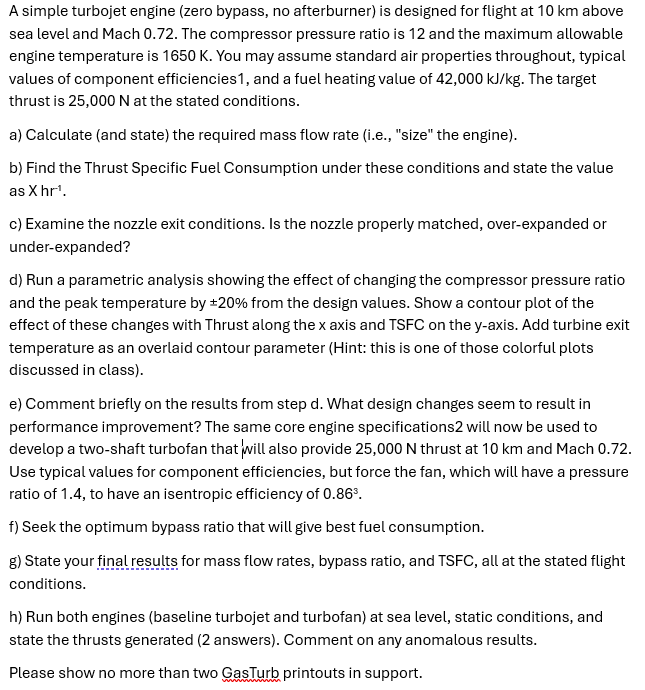
A simple turbojet engine zero bypass, no afterburner is designed for flight at km above sea level and Mach The compressor pressure ratio is and the maximum allowable engine temperature is K You may assume standard air properties throughout, typical values of component efficiencies and a fuel heating value of mathrm~kJmathrmkg The target thrust is mathrm~N at the stated conditions.
a Calculate and state the required mass flow rate ie "size" the engine
b Find the Thrust Specific Fuel Consumption under these conditions and state the value as mathrmXmathrmhr
c Examine the nozzle exit conditions. Is the nozzle properly matched, overexpanded or underexpanded?
d Run a parametric analysis showing the effect of changing the compressor pressure ratio and the peak temperature by pm from the design values. Show a contour plot of the effect of these changes with Thrust along the x axis and TSFC on the y axis. Add turbine exit temperature as an overlaid contour parameter Hint: this is one of those colorful plots discussed in class
e Comment briefly on the results from step d What design changes seem to result in performance improvement? The same core engine specifications will now be used to develop a twoshaft turbofan that 'will also provide mathrm~N thrust at km and Mach Use typical values for component efficiencies, but force the fan, which will have a pressure ratio of to have an isentropic efficiency of
f Seek the optimum bypass ratio that will give best fuel consumption.
g State your final results for mass flow rates, bypass ratio, and TSFC all at the stated flight conditions.
h Run both engines baseline turbojet and turbofan at sea level, static conditions, and state the thrusts generated answers Comment on any anomalous results.
Please show no more than two GasTurb printouts in support.
Step by Step Solution
There are 3 Steps involved in it
1 Expert Approved Answer
Step: 1 Unlock

Question Has Been Solved by an Expert!
Get step-by-step solutions from verified subject matter experts
Step: 2 Unlock
Step: 3 Unlock
 Study Help