







Question: (A simplified bedging example) In the early 20oo's, there was a casino boom in Macao. To compete with other players in the market, some casinos
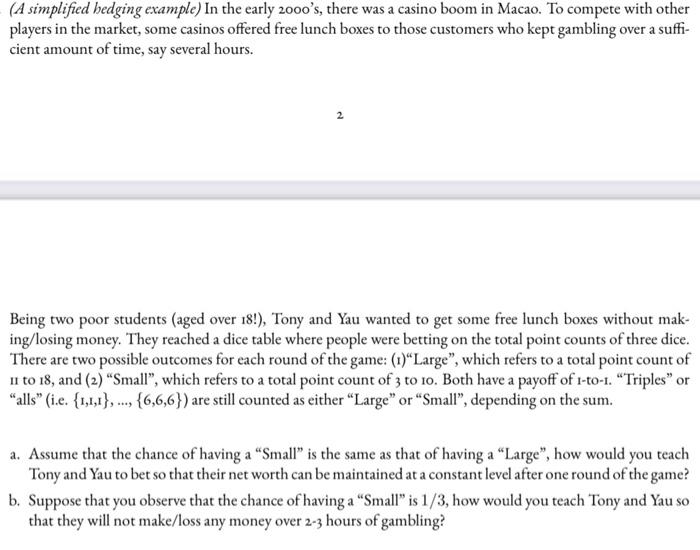
(A simplified bedging example) In the early 20oo's, there was a casino boom in Macao. To compete with other players in the market, some casinos offered free lunch boxes to those customers who kept gambling over a sufficient amount of time, say several hours. Being two poor students (aged over 18!), Tony and Yau wanted to get some free lunch boxes without making/losing money. They reached a dice table where people were betting on the total point counts of three dice. There are two possible outcomes for each round of the game: (1) "Large", which refers to a total point count of II to 18 , and (2) "Small", which refers to a total point count of 3 to io. Both have a payoff of 1-to-1. "Triples" or "alls" (i.e. {I,1,r},,{6,6,6}) are still counted as either "Large" or "Small", depending on the sum. a. Assume that the chance of having a "Small" is the same as that of having a "Large", how would you teach Tony and Yau to bet so that their net worth can be maintained at a constant level after one round of the game? b. Suppose that you observe that the chance of having a "Small" is 1/3, how would you teach Tony and Yau so that they will not make/loss any money over 23 hours of gambling
Step by Step Solution
There are 3 Steps involved in it

Get step-by-step solutions from verified subject matter experts
 Study Help