



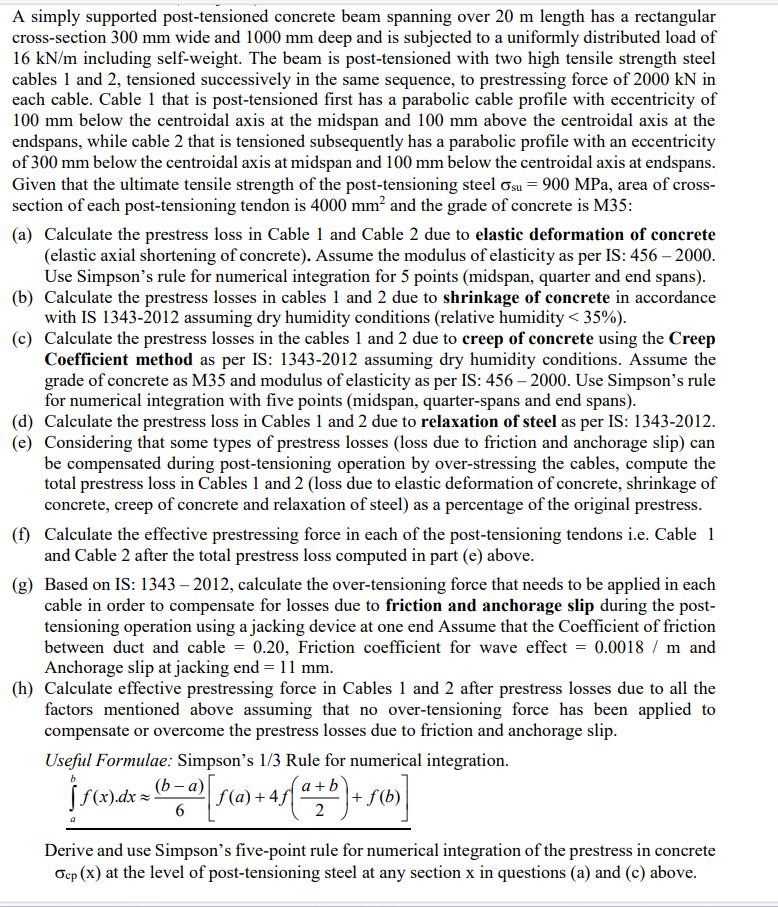
Question: A simply supported post - tensioned concrete beam spanning over 2 0 m length has a rectangular cross - section 3 0 0 m m
A simply supported posttensioned concrete beam spanning over length has a rectangular
crosssection wide and deep and is subjected to a uniformly distributed load of
including selfweight. The beam is posttensioned with two high tensile strength steel
cables and tensioned successively in the same sequence, to prestressing force of in
each cable. Cable that is posttensioned first has a parabolic cable profile with eccentricity of
below the centroidal axis at the midspan and above the centroidal axis at the
endspans, while cable that is tensioned subsequently has a parabolic profile with an eccentricity
of below the centroidal axis at midspan and below the centroidal axis at endspans.
Given that the ultimate tensile strength of the posttensioning steel MPa, area of cross
section of each posttensioning tendon is and the grade of concrete is M:
a Calculate the prestress loss in Cable and Cable due to elastic deformation of concrete
elastic axial shortening of concrete Assume the modulus of elasticity as per IS:
Use Simpson's rule for numerical integration for points midspan quarter and end spans
b Calculate the prestress losses in cables and due to shrinkage of concrete in accordance
with IS assuming dry humidity conditions relative humidity
c Calculate the prestress losses in the cables and due to creep of concrete using the Creep
Coefficient method as per IS: assuming dry humidity conditions. Assume the
grade of concrete as M and modulus of elasticity as per IS: Use Simpson's rule
for numerical integration with five points midspan quarterspans and end spans
d Calculate the prestress loss in Cables and due to relaxation of steel as per IS:
e Considering that some types of prestress losses loss due to friction and anchorage slip can
be compensated during posttensioning operation by overstressing the cables, compute the
total prestress loss in Cables and loss due to elastic deformation of concrete, shrinkage of
concrete, creep of concrete and relaxation of steel as a percentage of the original prestress.
f Calculate the effective prestressing force in each of the posttensioning tendons ie Cable
and Cable after the total prestress loss computed in part e above.
g Based on IS: calculate the overtensioning force that needs to be applied in each
cable in order to compensate for losses due to friction and anchorage slip during the post
tensioning operation using a jacking device at one end Assume that the Coefficient of friction
between duct and cable Friction coefficient for wave effect and
Anchorage slip at jacking end
h Calculate effective prestressing force in Cables and after prestress losses due to all the
factors mentioned above assuming that no overtensioning force has been applied to
compensate or overcome the prestress losses due to friction and anchorage slip.
Useful Formulae: Simpson's Rule for numerical integration.
~~
Derive and use Simpson's fivepoint rule for numerical integration of the prestress in concrete
at the level of posttensioning steel at any section in questions a and c above.
Step by Step Solution
There are 3 Steps involved in it
1 Expert Approved Answer
Step: 1 Unlock

Question Has Been Solved by an Expert!
Get step-by-step solutions from verified subject matter experts
Step: 2 Unlock
Step: 3 Unlock