



Question: A small 42 g ball strikes the ground at a speed of 22 m/s. It rebounds from the surface at a speed of 17
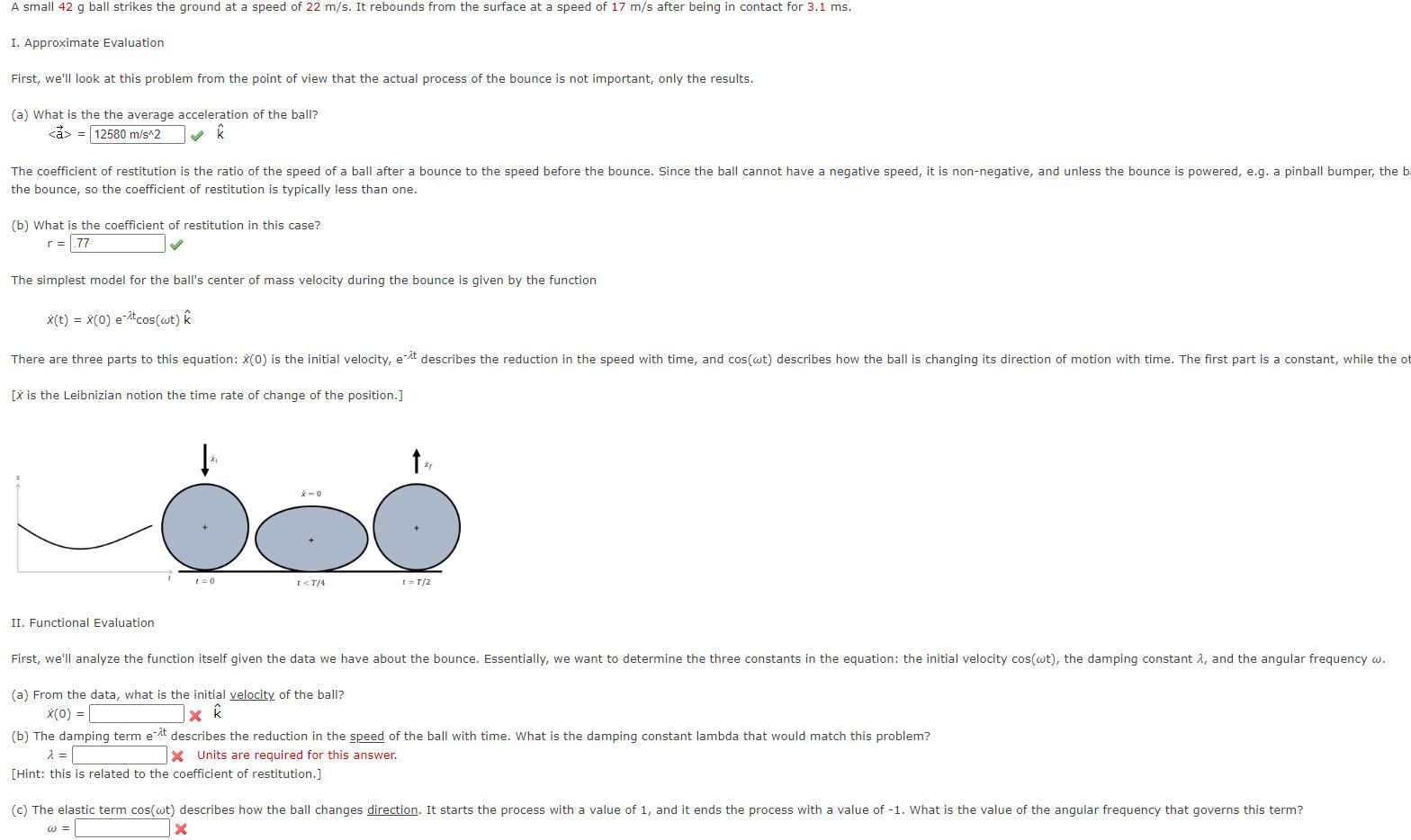
A small 42 g ball strikes the ground at a speed of 22 m/s. It rebounds from the surface at a speed of 17 m/s after being in contact for 3.1 ms. I. Approximate Evaluation First, we'll look at this problem from the point of view that the actual process of the bounce is not important, only the results. (a) What is the the average acceleration of the ball? = 12580 m/s^2 The coefficient of restitution is the ratio of the speed of a ball after a bounce to the speed before the bounce. Since the ball cannot have a negative speed, it is non-negative, and unless the bounce is powered, e.g. a pinball bumper, the b the bounce, so the coefficient of restitution is typically less than one. (b) What is the coefficient of restitution in this case? r = .77 The simplest model for the ball's center of mass velocity during the bounce is given by the function X(t) = x(0) etcos(wt) k There are three parts to this equation: x(0) is the initial velocity, et describes the reduction in the speed with time, and cos(wt) describes how the ball is changing its direction of motion with time. The first part is a constant, while the ot [X is the Leibnizian notion the time rate of change of the position.] II. Functional Evaluation t=0 t
Step by Step Solution
There are 3 Steps involved in it

Get step-by-step solutions from verified subject matter experts