







Question: A solution with an initial solid concentration of 8% is fed to a single-effect evaporator at 53 C at a rate of 1350 kg hr.
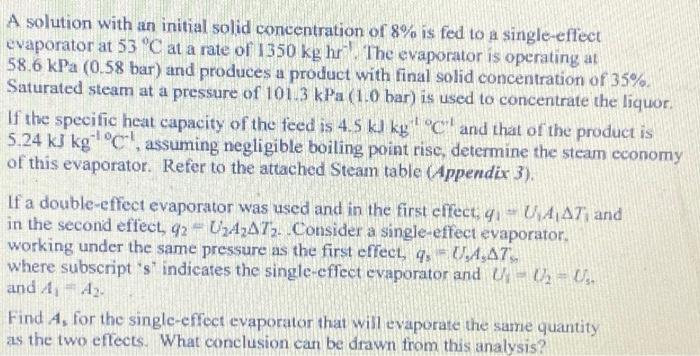
A solution with an initial solid concentration of 8% is fed to a single-effeet evaporator at 53C at a rate of 1350kghr1. The evaporator is operating at 58.6kPa(0.58 bar ) and produces a product with final solid concentration of 35%. Saturated steam at a pressure of 101.3kPa (1.0 bar) is used to concentrate the liquor. If the specific heat capacity of the teed is 4.5kJkgtC1 and that of the product is 5.24kJkg1C1, assuming negligible boiling point risc, determine the steam cconomy of this evaporator. Refer to the attached Steam table (Appendix 3). If a double-effect evaporator was used and in the first effect, q:U1A1Ti and in the second effect, q2=U2A2T2. Consider a single-effect svaporator. working under the same pressure as the first effeet, q,UsAsTs where subscript 's' indicates the single-cffect evaporator and U1=U2=Us. and A1=A2 Find As for the single-effect cvaporator that will evaporate the same quantity as the two eftects. What conclusion can be drawn from this analysis
Step by Step Solution
There are 3 Steps involved in it

Get step-by-step solutions from verified subject matter experts
 Study Help