







Question: A. SPEED OF THE WAVE. 1. Open the simulation (https://phet.colorado.edu/sims/html/wave-on-a-string/latest/wave-on-a-string_en.html). Run the simulation and select Pulse from the top left corner. Have on a Sting
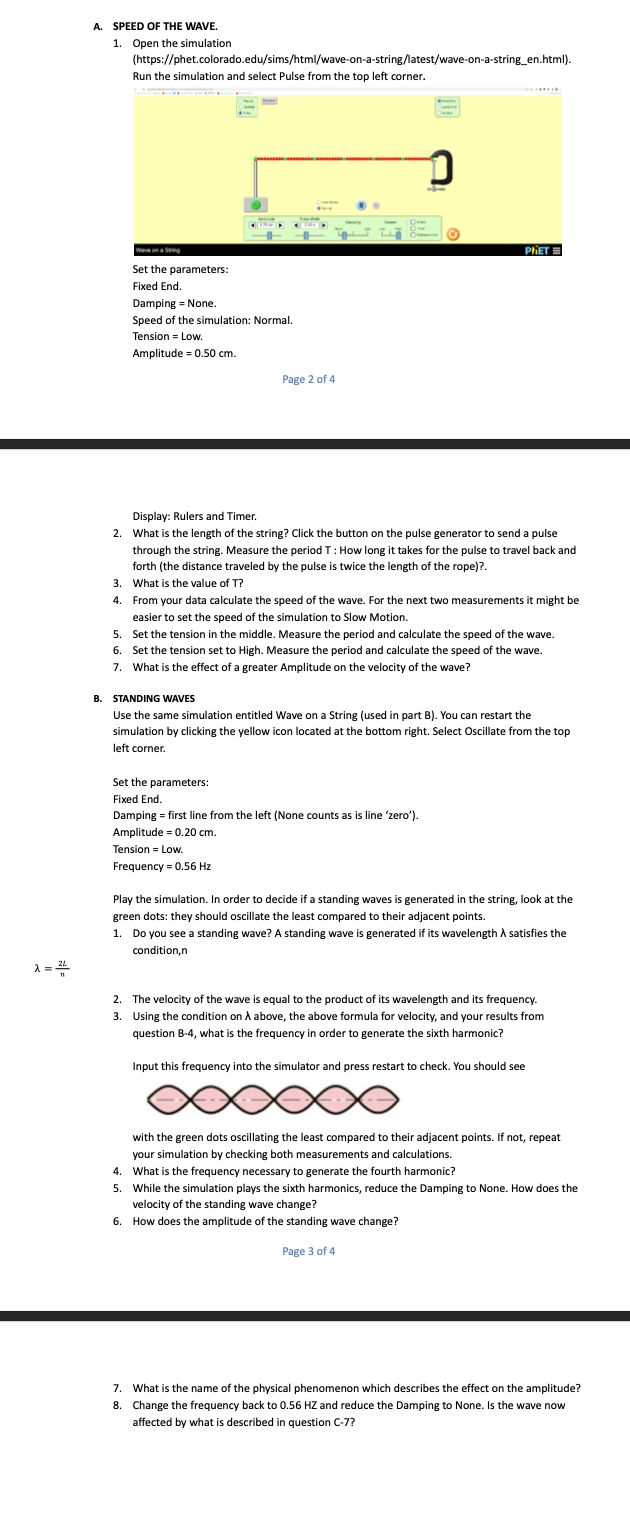
A. SPEED OF THE WAVE. 1. Open the simulation (https://phet.colorado.edu/sims/html/wave-on-a-string/latest/wave-on-a-string_en.html). Run the simulation and select Pulse from the top left corner. Have on a Sting PHET Set the parameters: Fixed End. Damping = None. Speed of the simulation: Normal. Tension = Low. tude = 0.50 cm. Page 2 of 4 Display: Rulers and Timer. 2. What is the length of the string? Click the button on the pulse generator to send a pulse through the string. Measure the period T : How long it takes for the pulse to travel back and forth (the distance traveled by the pulse is twice the length of the rope)?. 3. What is the value of T? From your data calculate the speed of the wave. For the next two measurements it might be easier to set the speed of the simulation to Slow Motion. 5. Set the tension in the middle. Measure the period and calculate the speed of the wave. 6. Set the tension set to High. Measure the period and calculate the speed of the wave. 7. What is the effect of a greater Amplitude on the velocity of the wave? B. STANDING WAVES Use the same simulation entitled Wave on a String (used in part B). You can restart the simulation by clicking the yellow icon located at the bottom right. Select Oscillate from the top left corner. Set the parameters: Fixed End. Damping = first line from the left (None counts as is line 'zero'). Amplitude = 0.20 cm. Tension = Low. Frequency = 0.56 Hz Play the simulation. In order to decide if a standing waves is generated in the string, look at the green dots: they should oscillate the least compared to their adjacent points. 1. Do you see a standing wave? A standing wave is generated if its wavelength A satisfies the condition,n 2. The velocity of the wave is equal to the product of its wavelength and its frequency. 3. Using the condition on A above, the above formula for velocity, and your results from question B-4, what is the frequency in order to generate the sixth harmonic? Input this frequency into the simulator and press restart to check. You should see with the green dots oscillating the least compared to their adjacent points. If not, repeat your simulation by checking both measurements and calculations. 4. What is the frequency necessary to generate the fourth harmonic? 5. While the simulation plays the sixth harmonics, reduce the Damping to None. How does the velocity of the standing wave change? 6. How does the amplitude of the standing wave change? Page 3 of 4 7. What is the name of the physical phenomenon which describes the effect on the amplitude? B. Change the frequency back to 0.56 HZ and reduce the Damping to None. Is the wave now affected by what is described in question C-7
Step by Step Solution
There are 3 Steps involved in it

Get step-by-step solutions from verified subject matter experts
 Study Help