







Question: A spherical radioactive particle is encased in a large solid body. In this problem, you can assume steady-state radial conduction in both the radioactive
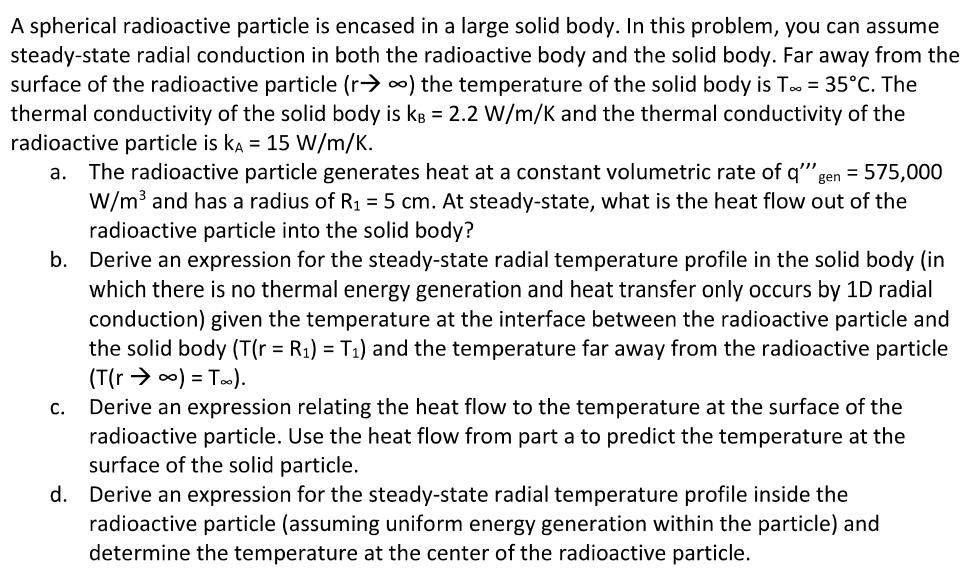
A spherical radioactive particle is encased in a large solid body. In this problem, you can assume steady-state radial conduction in both the radioactive body and the solid body. Far away from the surface of the radioactive particle (r) the temperature of the solid body is T. = 35C. The thermal conductivity of the solid body is kB = 2.2 W/m/K and the thermal conductivity of the radioactive particle is kA = 15 W/m/K. a. The radioactive particle generates heat at a constant volumetric rate of q' """ gen = 575,000 W/m and has a radius of R = 5 cm. At steady-state, what is the heat flow out of the radioactive particle into the solid body? b. Derive an expression for the steady-state radial temperature profile in the solid body (in which there is no thermal energy generation and heat transfer only occurs by 1D radial conduction) given the temperature at the interface between the radioactive particle and the solid body (T(r = R) = T) and the temperature far away from the radioactive particle (T(r ) = T). C. Derive an expression relating the heat flow to the temperature at the surface of the radioactive particle. Use the heat flow from part a to predict the temperature at the surface of the solid particle. d. Derive an expression for the steady-state radial temperature profile inside the radioactive particle (assuming uniform energy generation within the particle) and determine the temperature at the center of the radioactive particle.
Step by Step Solution
3.42 Rating (161 Votes )
There are 3 Steps involved in it
To solve these problems lets break them down step by step a Determine the Heat Flow Out of the Radioactive Particle into the Solid Body Given Volumetr... View full answer

Get step-by-step solutions from verified subject matter experts
 Study Help