







Question: A square-shaped electronic device (ke = 20 Wm 'K) 4.5 cm on each side and 5.0 mm in thickness is encased in a large
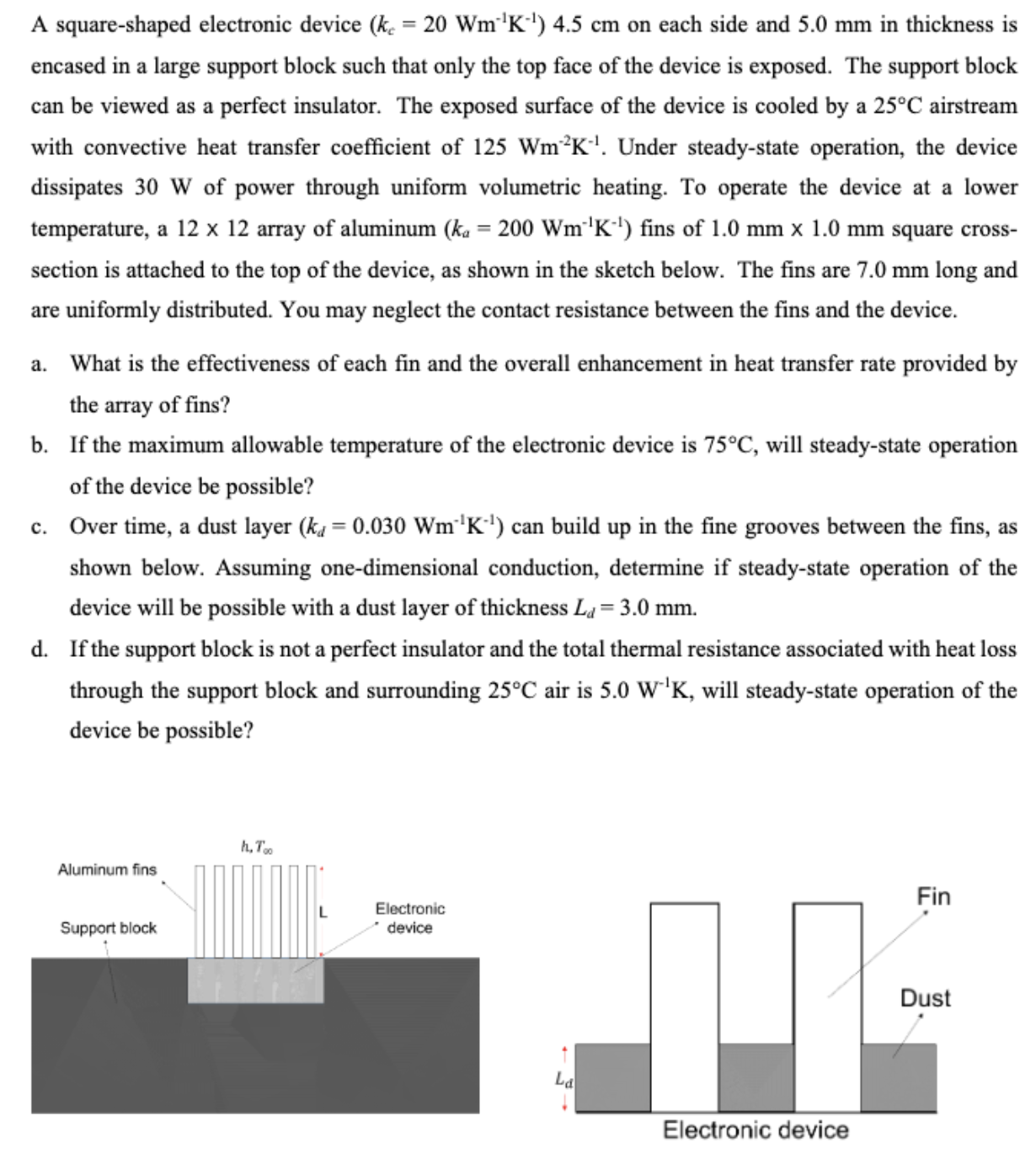
A square-shaped electronic device (ke = 20 Wm 'K) 4.5 cm on each side and 5.0 mm in thickness is encased in a large support block such that only the top face of the device is exposed. The support block can be viewed as a perfect insulator. The exposed surface of the device is cooled by a 25C airstream with convective heat transfer coefficient of 125 WmK. Under steady-state operation, the device dissipates 30 W of power through uniform volumetric heating. To operate the device at a lower temperature, a 12 x 12 array of aluminum (ka = 200 Wm 'K) fins of 1.0 mm x 1.0 mm square cross- section is attached to the top of the device, as shown in the sketch below. The fins are 7.0 mm long and are uniformly distributed. You may neglect the contact resistance between the fins and the device. a. What is the effectiveness of each fin and the overall enhancement in heat transfer rate provided by the array of fins? b. If the maximum allowable temperature of the electronic device is 75C, will steady-state operation of the device be possible? c. Over time, a dust layer (k = 0.030 Wm 'K') can build up in the fine grooves between the fins, as shown below. Assuming one-dimensional conduction, determine if steady-state operation of the device will be possible with a dust layer of thickness La = 3.0 mm. d. If the support block is not a perfect insulator and the total thermal resistance associated with heat loss through the support block and surrounding 25C air is 5.0 W-'K, will steady-state operation of the device be possible? h. To Aluminum fins Support block L Electronic device La Electronic device Fin Dust
Step by Step Solution
There are 3 Steps involved in it

Get step-by-step solutions from verified subject matter experts
 Study Help