







Question: A stationary point in an interference pattern where a super trough occurs. O anti-nodal point O central maximum coherency constructive interference destructive interference diffraction dispersion
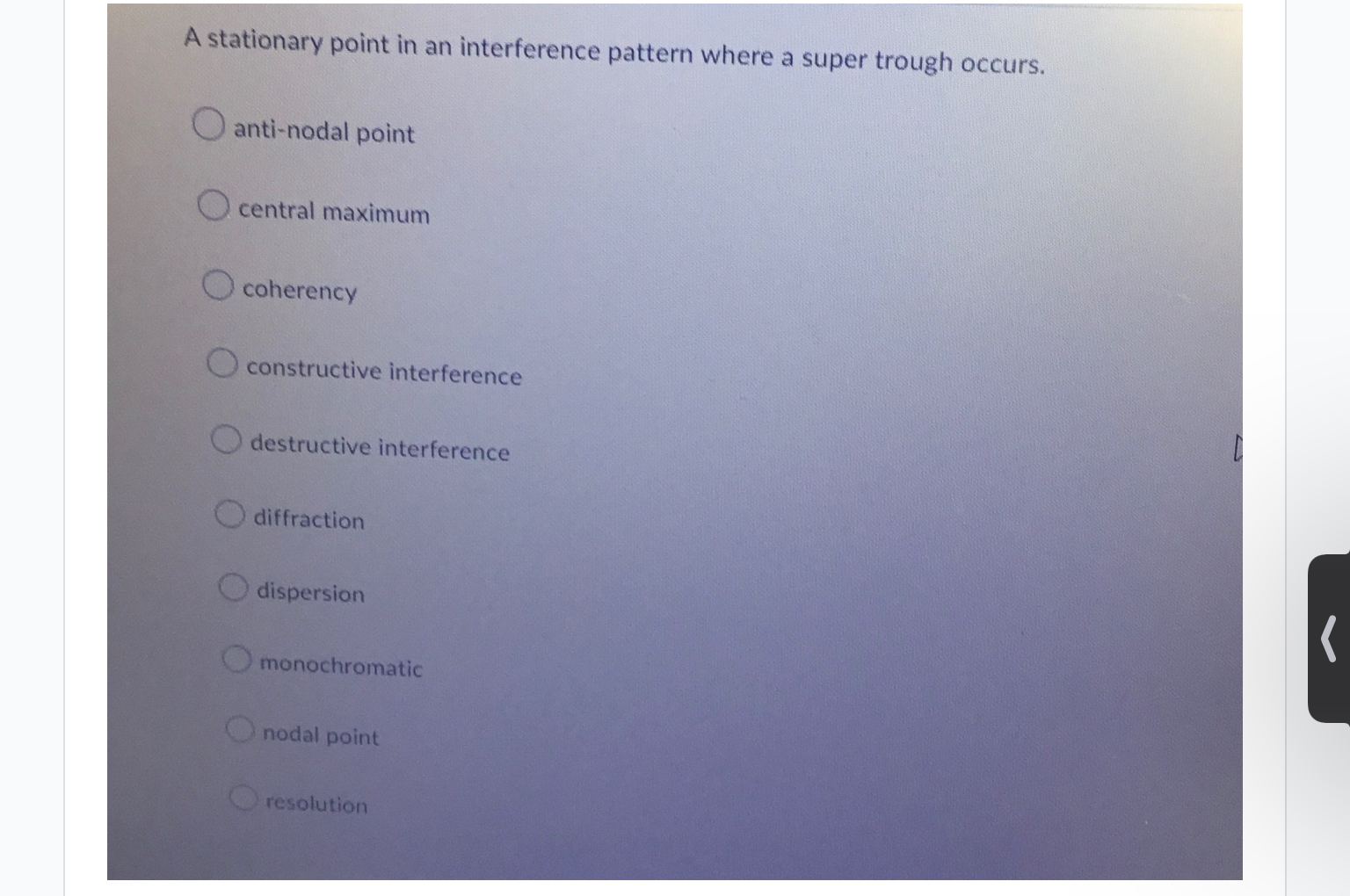


A stationary point in an interference pattern where a super trough occurs. O anti-nodal point O central maximum coherency constructive interference destructive interference diffraction dispersion monochromatic nodal point resolution24% . . . 6:53 PM Wed May 11 coursehero.com a An interaction between waves where the amplitude of a resultant wave is less than the amplitude of one of its component waves. anti-nodal point central maximum coherency constructive interference destructive interference diffraction dispersion monochromatic nodal point resolution The phenomenon that explains how waves bend around a barrier. anti-nodal point central maximum coherency constructive interference destructive interference diffraction dispersion monochromatic nodal point resolutionWhen holding an object close to your eyes, the image may appear blurry. This blurriness disappears when the object is moved further away. What phenomenon is being demonstrated? anti-nodal point central maximum coherency constructive interference destructive interference diffraction dispersion monochromatic nodal point resolution Exhibited by light that has a fixed phase difference. anti-nodal point central maximum coherency constructive interference destructive interference diffraction dispersion monochromatic nodal point resolution
Step by Step Solution
There are 3 Steps involved in it

Get step-by-step solutions from verified subject matter experts
 Study Help