







Question: A steady, laminar flow occurs in the space between two fixed parallel, circular disks separated by a small gap of thickness 2, shown in Figure
A steady, laminar flow occurs in the space between two fixed parallel, circular disks separated by a small gap of thickness 2, shown in Figure 1 below. The fluid flows radially outwards owing to a dynamic pressure difference P1 P2 between the inner and outer radii R1 and R2. Consider the region R1 r R2 only, and neglect end effects. Such a flow occurs when a lubricant flows in certain lubrication systems. Assume creeping flow conditions (this means that the Reynolds number is vanishingly small) and that the fluid has constant density and constant viscosity .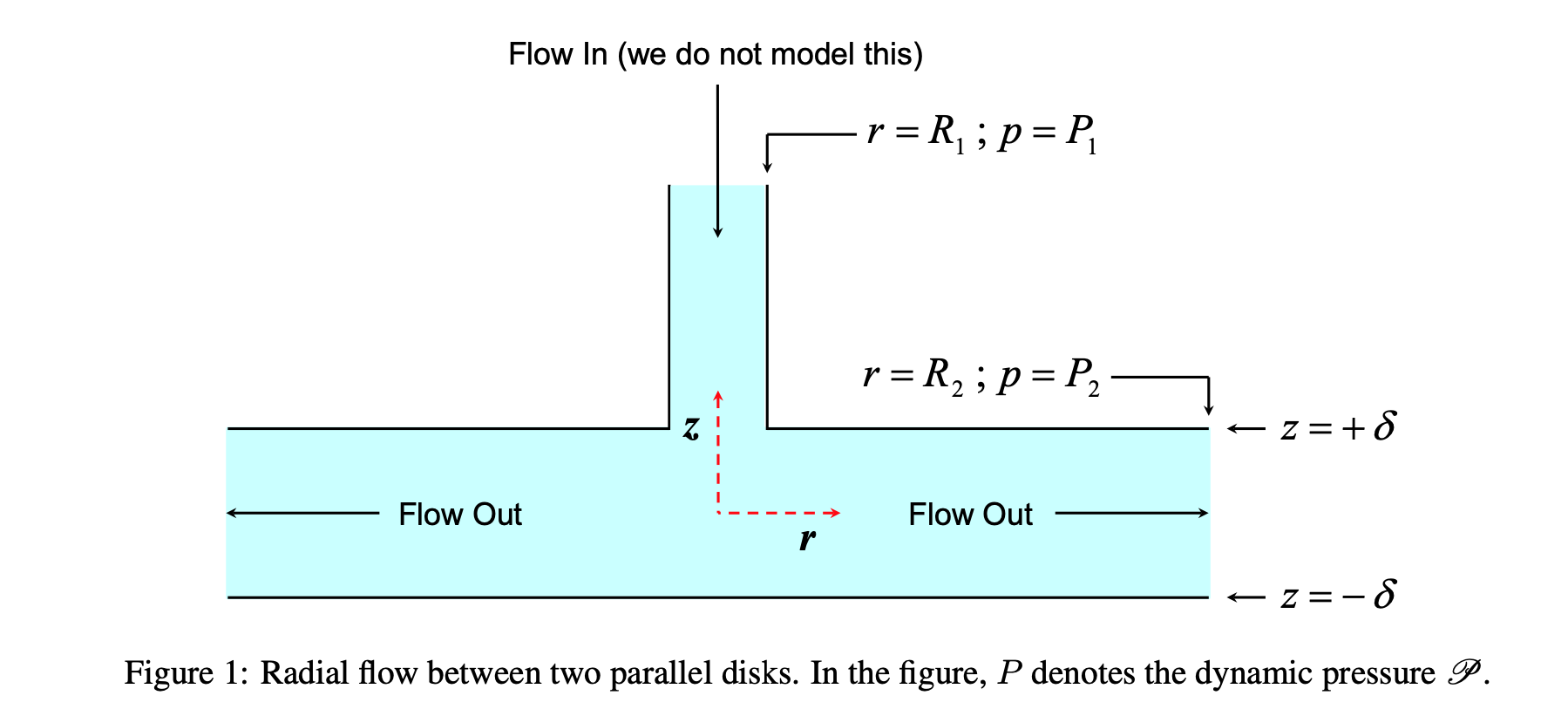
- Calculate the magnitude of the viscous force per unit area vector exerted by the fluid on the upper disk at the location r =R. Use the following data: P1 P2 =4 bar ; R1 =2 cm ; R2 =8 cm ; =3 mm ; R=3cm
Flow In (we do not model this) r=R, ; p= P, = r=R2; p = P2 = = z=+8 Flow Out Flow Out r z=-8 Figure 1: Radial flow between two parallel disks. In the figure, P denotes the dynamic pressure P
Step by Step Solution
There are 3 Steps involved in it

Get step-by-step solutions from verified subject matter experts
 Study Help