







Question: A stock price evolves in a standard binomial tree. Each period it can either go up to u=1.20 times its previous price or down to
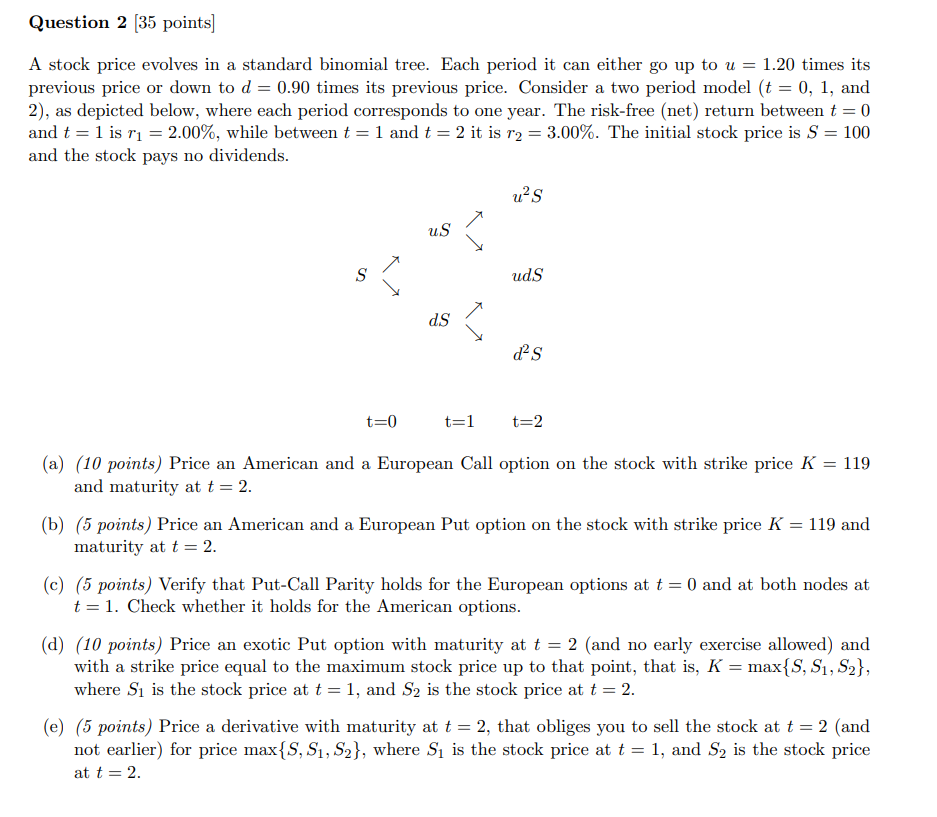
A stock price evolves in a standard binomial tree. Each period it can either go up to u=1.20 times its previous price or down to d=0.90 times its previous price. Consider a two period model (t=0,1, and 2), as depicted below, where each period corresponds to one year. The risk-free (net) return between t=0 and t=1 is r1=2.00%, while between t=1 and t=2 it is r2=3.00%. The initial stock price is S=100 and the stock pays no dividends. t=0t=1t=2 (a) (10 points) Price an American and a European Call option on the stock with strike price K=119 and maturity at t=2. (b) (5 points) Price an American and a European Put option on the stock with strike price K=119 and maturity at t=2. (c) (5 points) Verify that Put-Call Parity holds for the European options at t=0 and at both nodes at t=1. Check whether it holds for the American options. (d) (10 points) Price an exotic Put option with maturity at t=2 (and no early exercise allowed) and with a strike price equal to the maximum stock price up to that point, that is, K=max{S,S1,S2}, where S1 is the stock price at t=1, and S2 is the stock price at t=2. (e) (5 points) Price a derivative with maturity at t=2, that obliges you to sell the stock at t=2 (and not earlier) for price max{S,S1,S2}, where S1 is the stock price at t=1, and S2 is the stock price at t=2. A stock price evolves in a standard binomial tree. Each period it can either go up to u=1.20 times its previous price or down to d=0.90 times its previous price. Consider a two period model (t=0,1, and 2), as depicted below, where each period corresponds to one year. The risk-free (net) return between t=0 and t=1 is r1=2.00%, while between t=1 and t=2 it is r2=3.00%. The initial stock price is S=100 and the stock pays no dividends. t=0t=1t=2 (a) (10 points) Price an American and a European Call option on the stock with strike price K=119 and maturity at t=2. (b) (5 points) Price an American and a European Put option on the stock with strike price K=119 and maturity at t=2. (c) (5 points) Verify that Put-Call Parity holds for the European options at t=0 and at both nodes at t=1. Check whether it holds for the American options. (d) (10 points) Price an exotic Put option with maturity at t=2 (and no early exercise allowed) and with a strike price equal to the maximum stock price up to that point, that is, K=max{S,S1,S2}, where S1 is the stock price at t=1, and S2 is the stock price at t=2. (e) (5 points) Price a derivative with maturity at t=2, that obliges you to sell the stock at t=2 (and not earlier) for price max{S,S1,S2}, where S1 is the stock price at t=1, and S2 is the stock price at t=2
Step by Step Solution
There are 3 Steps involved in it

Get step-by-step solutions from verified subject matter experts
 Study Help