







Question: A string of length L has zero initial velocity and an initial displacement y (x, 0) as shown in the figure below. The ends of
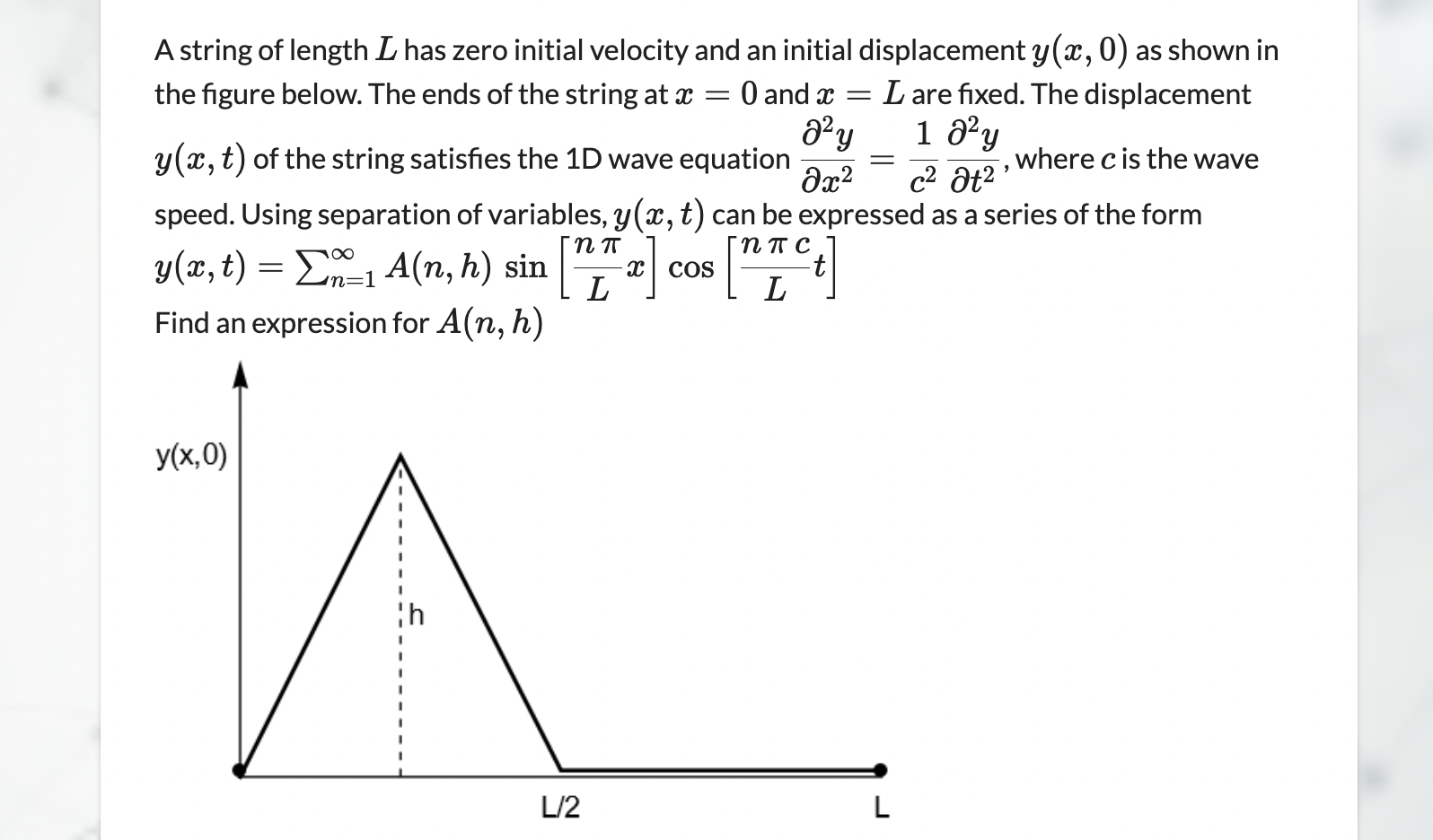
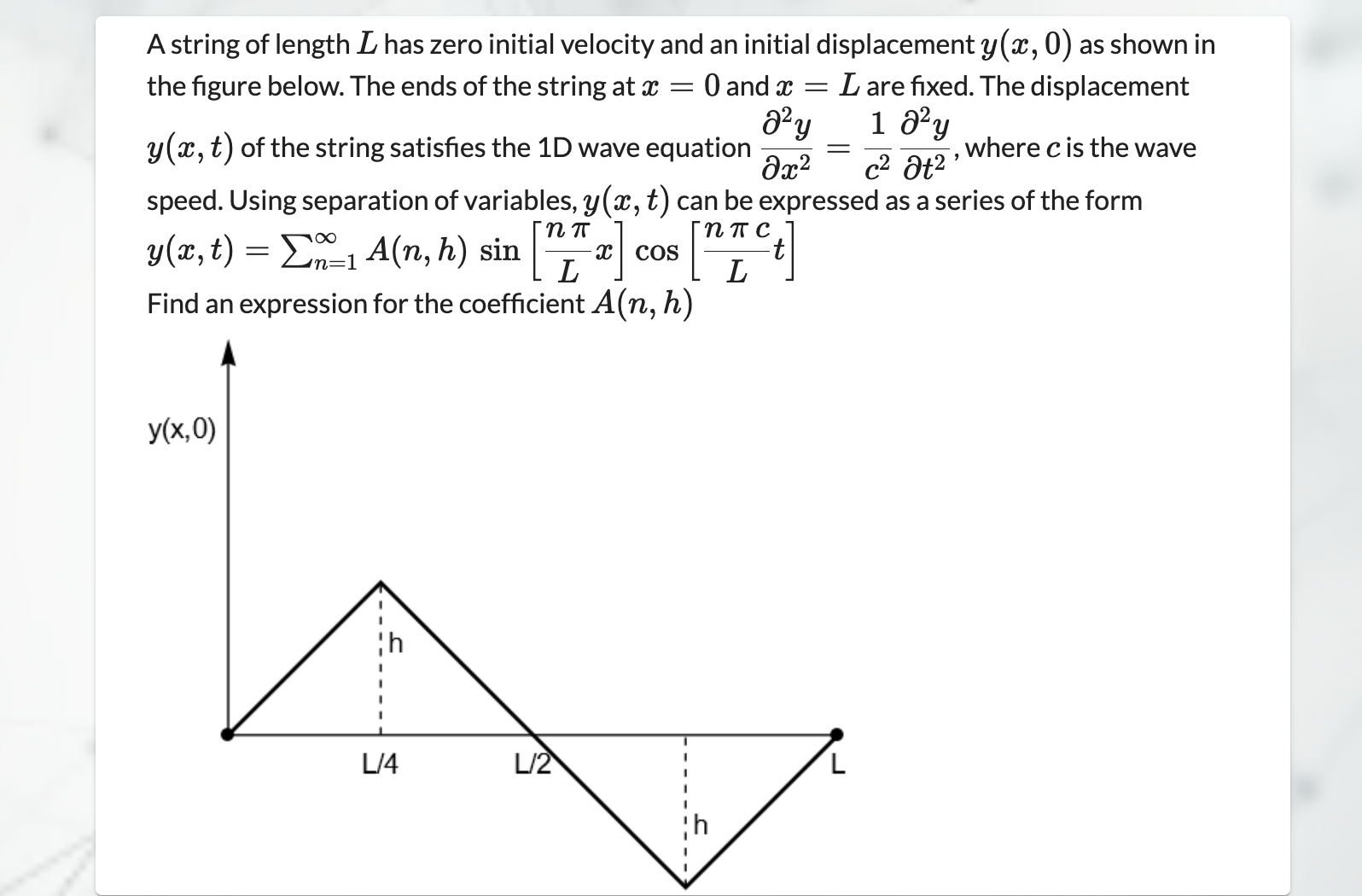
A string of length L has zero initial velocity and an initial displacement y (x, 0) as shown in the figure below. The ends of the string at a = 0 and x = L are fixed. The displacement y(, t) of the string satisfies the 1D wave equation c2 2+2 , where c is the wave speed. Using separation of variables, y (@, t) can be expressed as a series of the form n TT y(x, t) = En l A(n, h) sin L a cos " t Find an expression for A(n, h) y(x, 0) 5 L/2 FA string of length L has zero initial velocity and an initial displacement y (x, 0) as shown in the figure below. The ends of the string at a = 0 and x = L are fixed. The displacement y(, t) of the string satisfies the 1D wave equation day _ 12y ax2 -c2 2+2 , Where c is the wave speed. Using separation of variables, y (@, t) can be expressed as a series of the form y(x, t) = En=] A(n, h) sin N TT nTC] x cos t Find an expression for the coefficient A(n, h) y(x, 0) ih L/4 L/2
Step by Step Solution
There are 3 Steps involved in it

Get step-by-step solutions from verified subject matter experts
 Study Help