







Question: What can you conclude about my experiment data? I need help understanding Theory A standing wave is one that oscillates with time but remains fixed
What can you conclude about my experiment data? I need help understanding
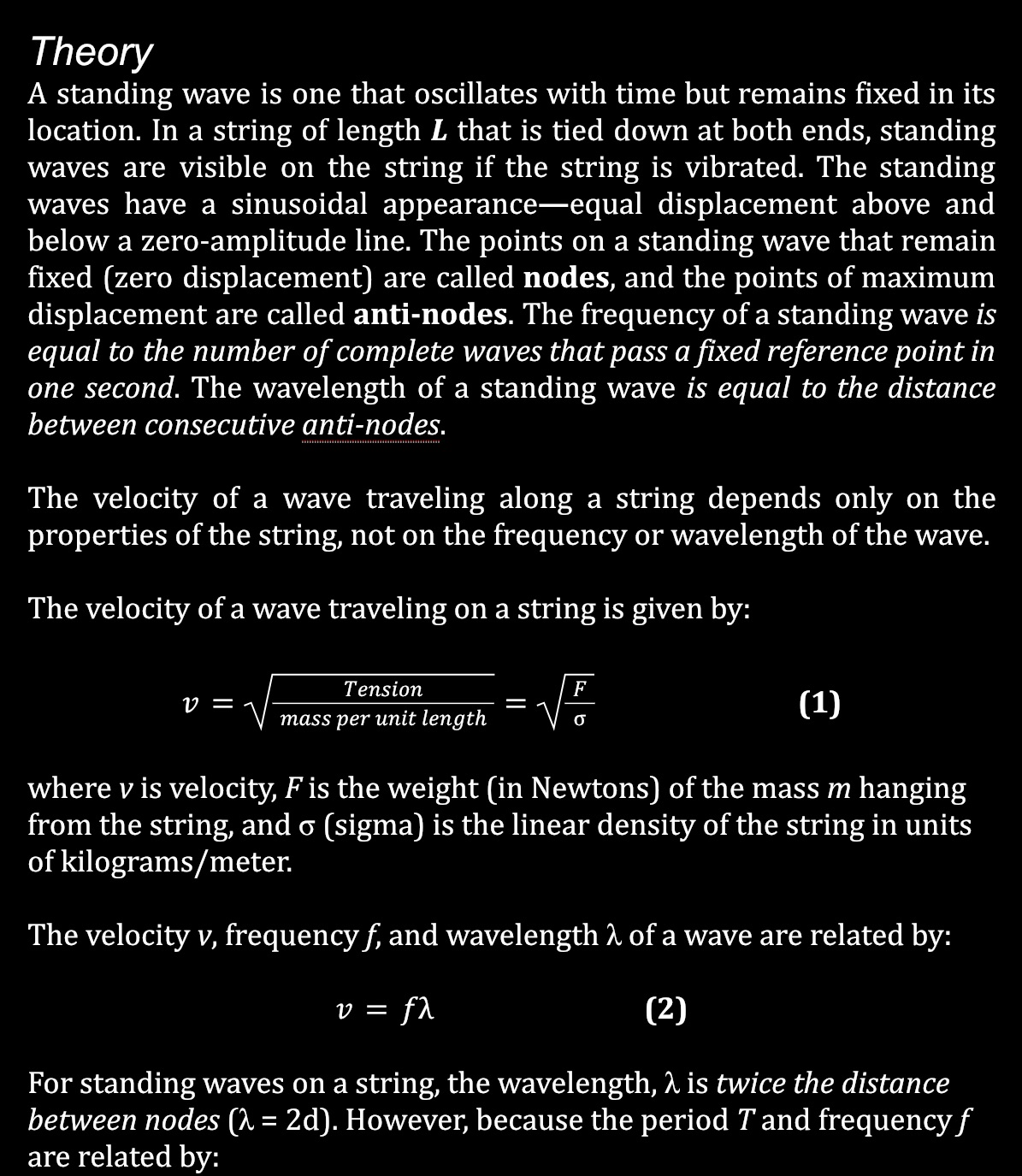
Theory A standing wave is one that oscillates with time but remains fixed in its location. In a string of length L that is tied down at both ends, standing waves are visible on the string if the string is vibrated. The standing waves have a sinusoidal appearance-equal displacement above and below a zero-amplitude line. The points on a standing wave that remain fixed (zero displacement) are called nodes, and the points of maximum displacement are called anti-nodes. The frequency of a standing wave is equal to the number of complete waves that pass a fixed reference point in one second. The wavelength of a standing wave is equal to the distance between consecutive anti-nodes. The velocity of a wave traveling along a string depends only on the properties of the string, not on the frequency or wavelength of the wave. The velocity of a wave traveling on a string is given by: V Tension mass per unit length (1) where v is velocity, F is the weight (in Newtons) of the mass m hanging from the string, and o (sigma) is the linear density of the string in units of kilograms/meter. The velocity v, frequency f, and wavelength 2 of a wave are related by: v = fx (2) For standing waves on a string, the wavelength, 2 is twice the distance between nodes (2 = 2d). However, because the period T and frequency f are related by
Step by Step Solution
There are 3 Steps involved in it

Get step-by-step solutions from verified subject matter experts
 Study Help