







Question: A study was done to evaluate selenium intake in young women in the years of puberty. One of the outcome variables was the selenium intake
A study was done to evaluate selenium intake in young women in the years of puberty. One of the outcome variables was the selenium intake per day. The researchers examined dietary journals of a cohort of 16 women over the course of 2 weeks and then computed the average daily selenium intake (in ?g/d) in years 1, 2, and 3 of the study. Test the claim of equal means at ? = 0.01.
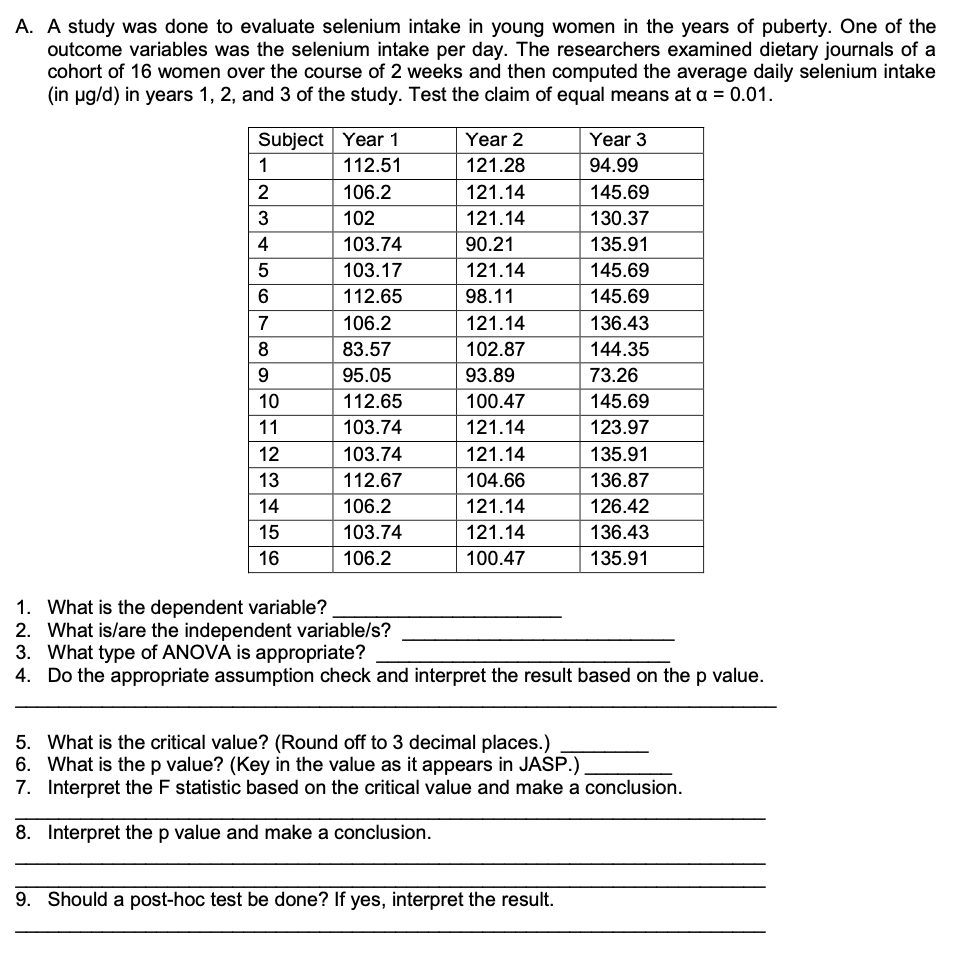
A. A study was done to evaluate selenium intake in young women in the years of puberty. One of the outcome variables was the selenium intake per day. The researchers examined dietary journals of a cohort of 16 women over the course of 2 weeks and then computed the average daily selenium intake (in pgfd) in years 1, 2, and 3 of the study. Test the claim of equal means at a = 0.01. Subject Year 1 Year 2 Year 3 1 112.51 121.26 94.99 2 106.2 121.14 145.69 3 102 121.14 130.37 4 135.91 5 145.69 6 145.69 7 136.43 8 144.35 9 73.26 10 145.69 11 123.97 12 135.91 13 136.87 14 106.2 121.14 126.42 15 103.74 121.14 136.43 16 106.2 100.47 135.91 What is the dependent variable? What isfare the independent variablefs? What type of ANOVA is appropriate? Do the appropriate assumption check and interpret the result based on the p value. PPM\"? What is the critical value? (Round off to 3 decimal places.) What is the p value? (Key in the value as it appears in JASP.) Interpret the F statistic based on the critical value and make a conclusion. 74.539" 8. Interpret the p value and make a conclusion. 9. Should a post-hoc test be done? If yes, interpret the result
Step by Step Solution
There are 3 Steps involved in it

Get step-by-step solutions from verified subject matter experts
 Study Help