







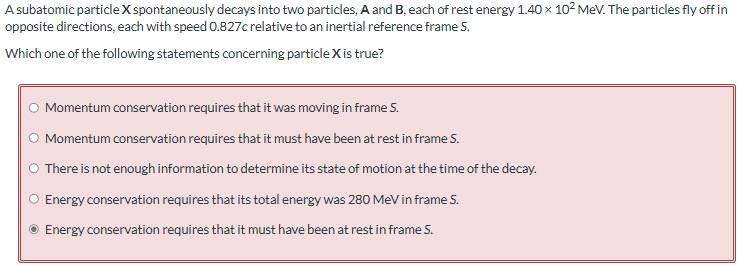
Question: A subatomic particle ( mathbf { X } ) spontaneously decays into two particles, ( mathbf { A }
A subatomic particle mathbfX spontaneously decays into two particles, mathbfA and mathbfB each of rest energy times mathrmMeV The particles fly off in opposite directions, each with speed c relative to an inertial reference frame
Which one of the following statements concerning particle mathbfX is true?Momentum conservation requires that it was moving in frame S Momentum conservation requires that it must have been at rest in frame S There is not enough information to determine its state of motion at the time of the decay.Energy conservation requires that its total energy was MeV in frame Energy conservation requires that it must have been at rest in frame S
Step by Step Solution
There are 3 Steps involved in it
1 Expert Approved Answer
Step: 1 Unlock

Question Has Been Solved by an Expert!
Get step-by-step solutions from verified subject matter experts
Step: 2 Unlock
Step: 3 Unlock
 Study Help