


Question: A supplier whose production cost is $2 per unit sells to a retailer at a wholesale price of $5 per unit. The retailer purchases products
A supplier whose production cost is $2 per unit
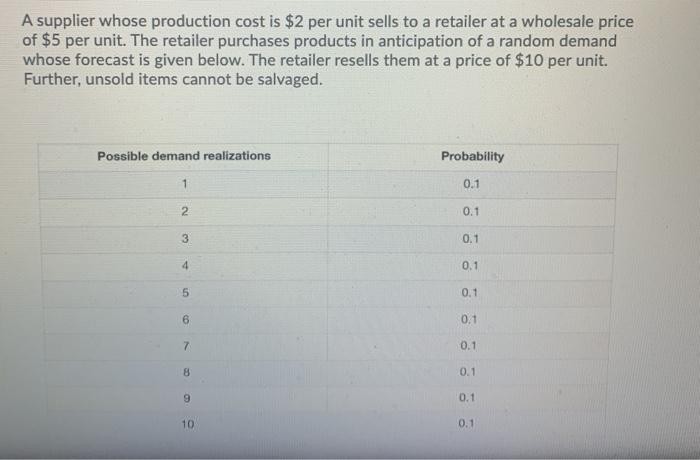
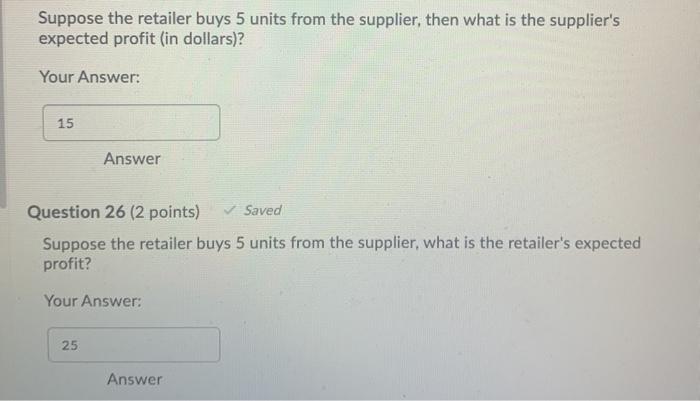
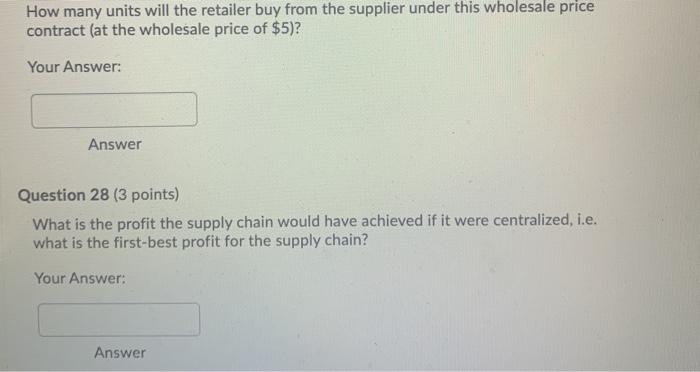
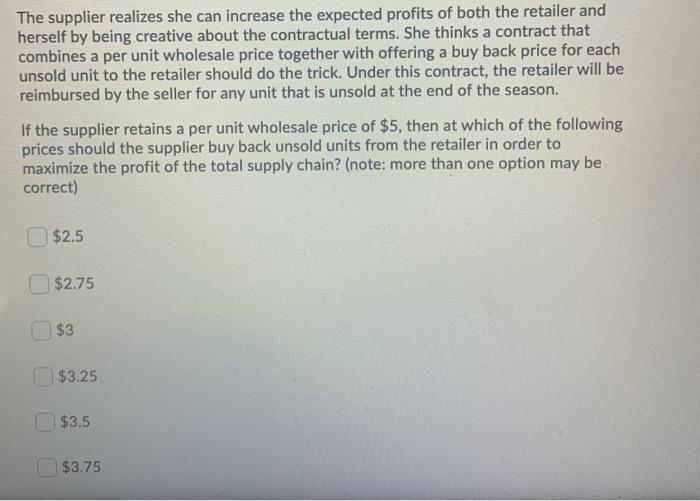
A supplier whose production cost is $2 per unit sells to a retailer at a wholesale price of $5 per unit. The retailer purchases products in anticipation of a random demand whose forecast is given below. The retailer resells them at a price of $10 per unit. Further, unsold items cannot be salvaged. Possible demand realizations Probability 1 0.1 2 0.1 3 0.1 4 0.1 5 0.1 6 0.1 7 0.1 8 0.1 9 0.1 10 0.1 Suppose the retailer buys 5 units from the supplier, then what is the supplier's expected profit (in dollars)? Your Answer: 15 Answer Question 26 (2 points) Saved Suppose the retailer buys 5 units from the supplier, what is the retailer's expected profit? Your Answer: 25 Answer How many units will the retailer buy from the supplier under this wholesale price contract (at the wholesale price of $5)? Your Answer: Answer Question 28 (3 points) What is the profit the supply chain would have achieved if it were centralized, i.e. what is the first-best profit for the supply chain? Your Answer: Answer The supplier realizes she can increase the expected profits of both the retailer and herself by being creative about the contractual terms. She thinks a contract that combines a per unit wholesale price together with offering a buy back price for each unsold unit to the retailer should do the trick. Under this contract, the retailer will be reimbursed by the seller for any unit that is unsold at the end of the season. If the supplier retains a per unit wholesale price of $5, then at which of the following prices should the supplier buy back unsold units from the retailer in order to maximize the profit of the total supply chain? (note: more than one option may be correct) $2.5 $2.75 $3 $3.25 $3.5 $3.75 A supplier whose production cost is $2 per unit sells to a retailer at a wholesale price of $5 per unit. The retailer purchases products in anticipation of a random demand whose forecast is given below. The retailer resells them at a price of $10 per unit. Further, unsold items cannot be salvaged. Possible demand realizations Probability 1 0.1 2 0.1 3 0.1 4 0.1 5 0.1 6 0.1 7 0.1 8 0.1 9 0.1 10 0.1 Suppose the retailer buys 5 units from the supplier, then what is the supplier's expected profit (in dollars)? Your Answer: 15 Answer Question 26 (2 points) Saved Suppose the retailer buys 5 units from the supplier, what is the retailer's expected profit? Your Answer: 25 Answer How many units will the retailer buy from the supplier under this wholesale price contract (at the wholesale price of $5)? Your Answer: Answer Question 28 (3 points) What is the profit the supply chain would have achieved if it were centralized, i.e. what is the first-best profit for the supply chain? Your Answer: Answer The supplier realizes she can increase the expected profits of both the retailer and herself by being creative about the contractual terms. She thinks a contract that combines a per unit wholesale price together with offering a buy back price for each unsold unit to the retailer should do the trick. Under this contract, the retailer will be reimbursed by the seller for any unit that is unsold at the end of the season. If the supplier retains a per unit wholesale price of $5, then at which of the following prices should the supplier buy back unsold units from the retailer in order to maximize the profit of the total supply chain? (note: more than one option may be correct) $2.5 $2.75 $3 $3.25 $3.5 $3.75
Step by Step Solution

There are 3 Steps involved in it

1 Expert Approved Answer
Step: 1 Unlock blur-text-image

Question Has Been Solved by an Expert!

Get step-by-step solutions from verified subject matter experts

Step: 2 Unlock
Step: 3 Unlock

Students Have Also Explored These Related General Management Questions!