







Question: (a) Suppose h is a function with a continuous second derivative that satisfies h(3) = -5, h(8) = 3, h'(3) = 1, h'(8) =
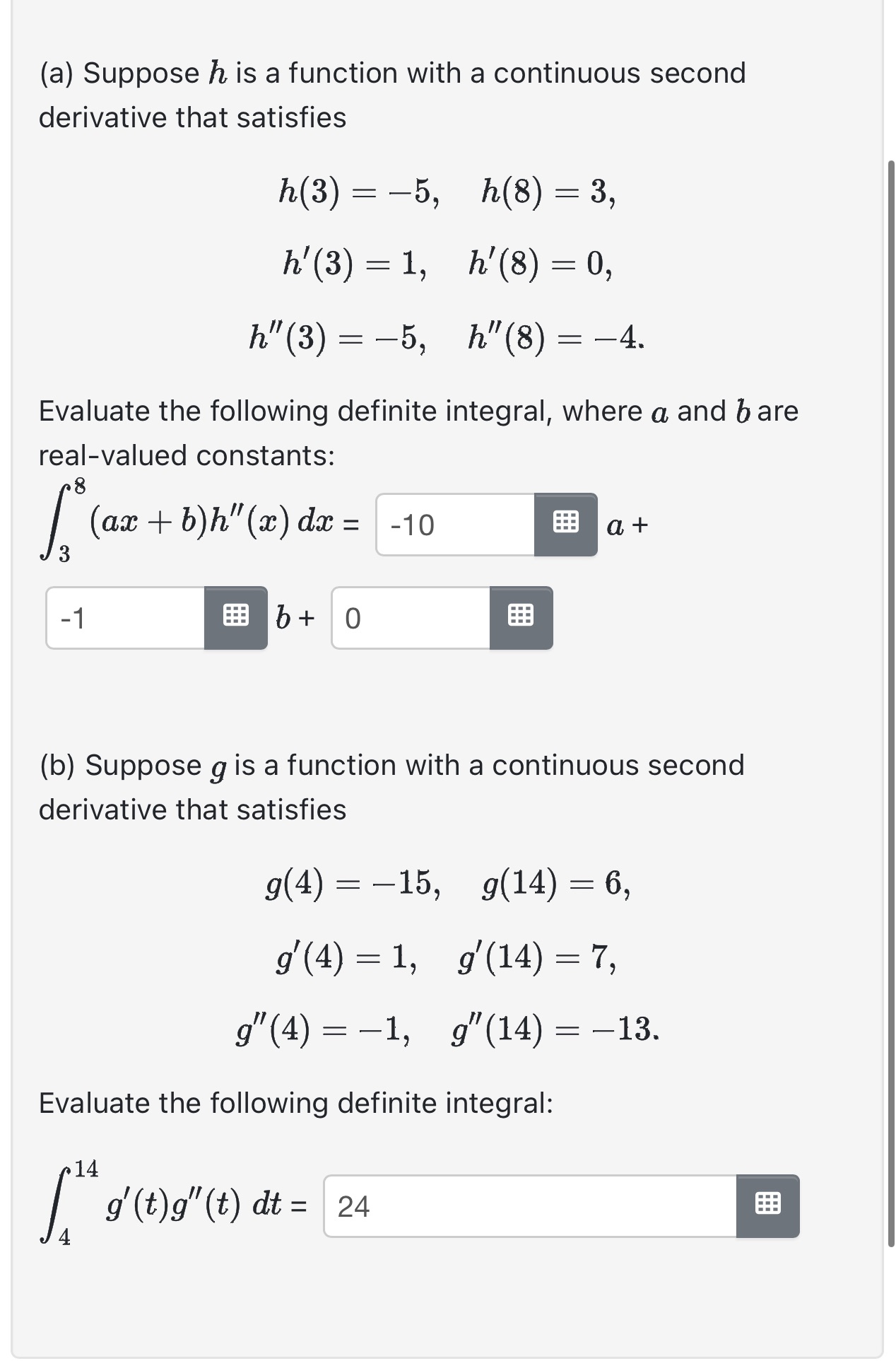
(a) Suppose h is a function with a continuous second derivative that satisfies h(3) = -5, h(8) = 3, h'(3) = 1, h'(8) = 0, h"(3) = -5, h" (8) = 4. Evaluate the following definite integral, where a and b are real-valued constants: .8 (ax+b)h" (x) dx = -10 a+ 3 -1 b + 0 (b) Suppose g is a function with a continuous second. derivative that satisfies g(4) = 15, g(14) = 6, g'(4) = 1, g'(14) = 7, g"(4) = 1, g (14) = 13. Evaluate the following definite integral: 14 [** g'(t)g" (t) dt = 24
Step by Step Solution
There are 3 Steps involved in it
a To evaluate the definite integral ax bhx dx we can use integration by parts Lets apply the integra... View full answer

Get step-by-step solutions from verified subject matter experts
 Study Help