







Question: (a) Suppose the initial divisor is 1, i.e. D0=1, construct a price-weighted index using the two stocks. What are the index level Ip,0, and Ip,1
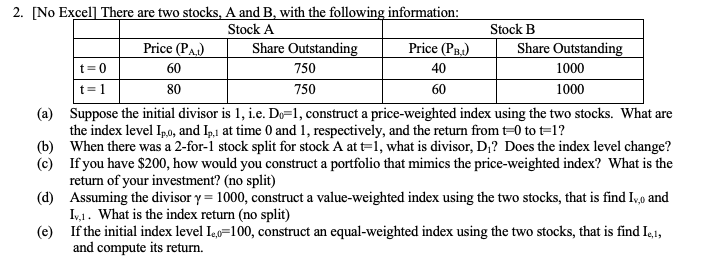
(a) Suppose the initial divisor is 1, i.e. D0=1, construct a price-weighted index using the two stocks. What are the index level Ip,0, and Ip,1 at time 0 and 1, respectively, and the return from t=0 to t=1 ? (b) When there was a 2-for-1 stock split for stock A at t=1, what is divisor, D1 ? Does the index level change? (c) If you have $200, how would you construct a portfolio that mimics the price-weighted index? What is the return of your investment? (no split) (d) Assuming the divisor =1000, construct a value-weighted index using the two stocks, that is find Iv,0 and Iv,1. What is the index return (no split) (e) If the initial index level Ie,0=100, construct an equal-weighted index using the two stocks, that is find Ie,1, and compute its return. (a) Suppose the initial divisor is 1, i.e. D0=1, construct a price-weighted index using the two stocks. What are the index level Ip,0, and Ip,1 at time 0 and 1, respectively, and the return from t=0 to t=1 ? (b) When there was a 2-for-1 stock split for stock A at t=1, what is divisor, D1 ? Does the index level change? (c) If you have $200, how would you construct a portfolio that mimics the price-weighted index? What is the return of your investment? (no split) (d) Assuming the divisor =1000, construct a value-weighted index using the two stocks, that is find Iv,0 and Iv,1. What is the index return (no split) (e) If the initial index level Ie,0=100, construct an equal-weighted index using the two stocks, that is find Ie,1, and compute its return
Step by Step Solution
There are 3 Steps involved in it

Get step-by-step solutions from verified subject matter experts
 Study Help