



Question: A thin layer of liquid flows down a long inclined plate (Fig. H7.3). The plate is at an angle from the horizotal. The coordinate
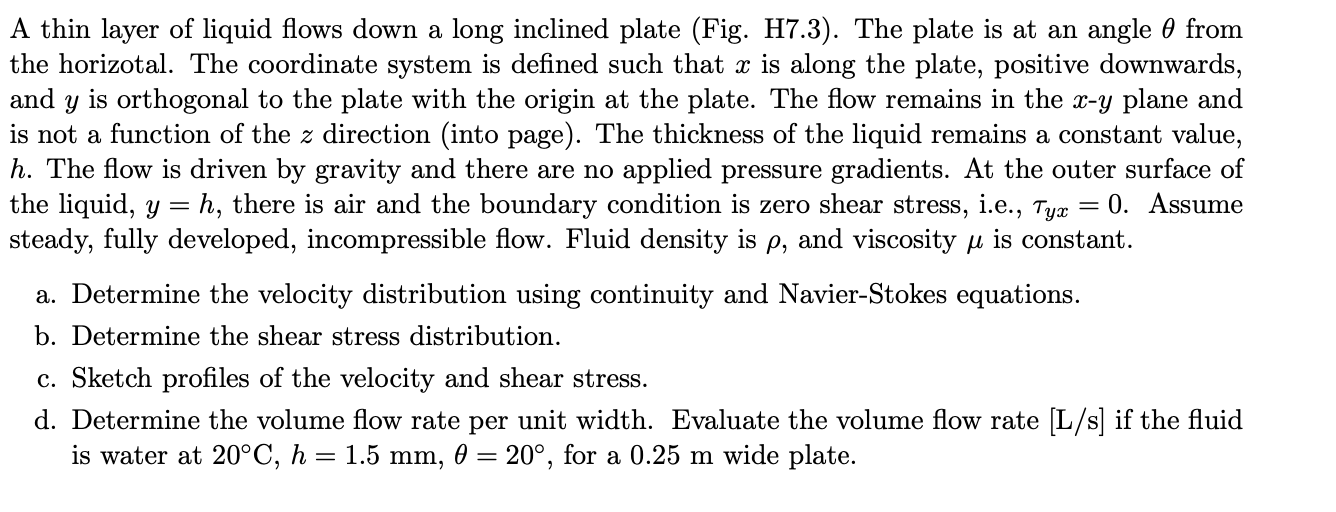
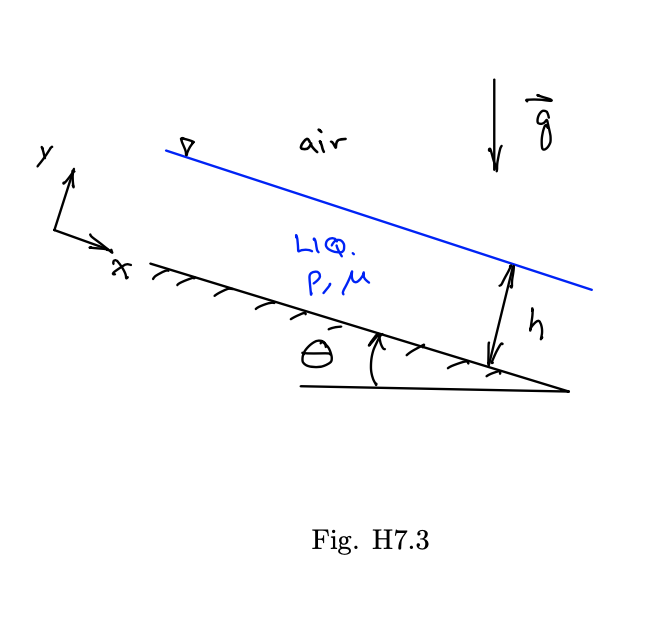
A thin layer of liquid flows down a long inclined plate (Fig. H7.3). The plate is at an angle from the horizotal. The coordinate system is defined such that x is along the plate, positive downwards, and y is orthogonal to the plate with the origin at the plate. The flow remains in the x-y plane and is not a function of the z direction (into page). The thickness of the liquid remains a constant value, h. The flow is driven by gravity and there are no applied pressure gradients. At the outer surface of the liquid, y = h, there is air and the boundary condition is zero shear stress, i.e., Tyx = 0. Assume steady, fully developed, incompressible flow. Fluid density is p, and viscosity is constant. a. Determine the velocity distribution using continuity and Navier-Stokes equations. b. Determine the shear stress distribution. c. Sketch profiles of the velocity and shear stress. d. Determine the volume flow rate per unit width. Evaluate the volume flow rate [L/s] if the fluid is water at 20C, h = 1.5 mm, 0 = 20, for a 0.25 m wide plate. air LIQ. P, M Fig. H7.3 h
Step by Step Solution
There are 3 Steps involved in it

Get step-by-step solutions from verified subject matter experts