







Question: A through D. 4 Two professors at a local college developed a new teaching curriculum designed to increase students' grades in math classes. In a
A through D. 4
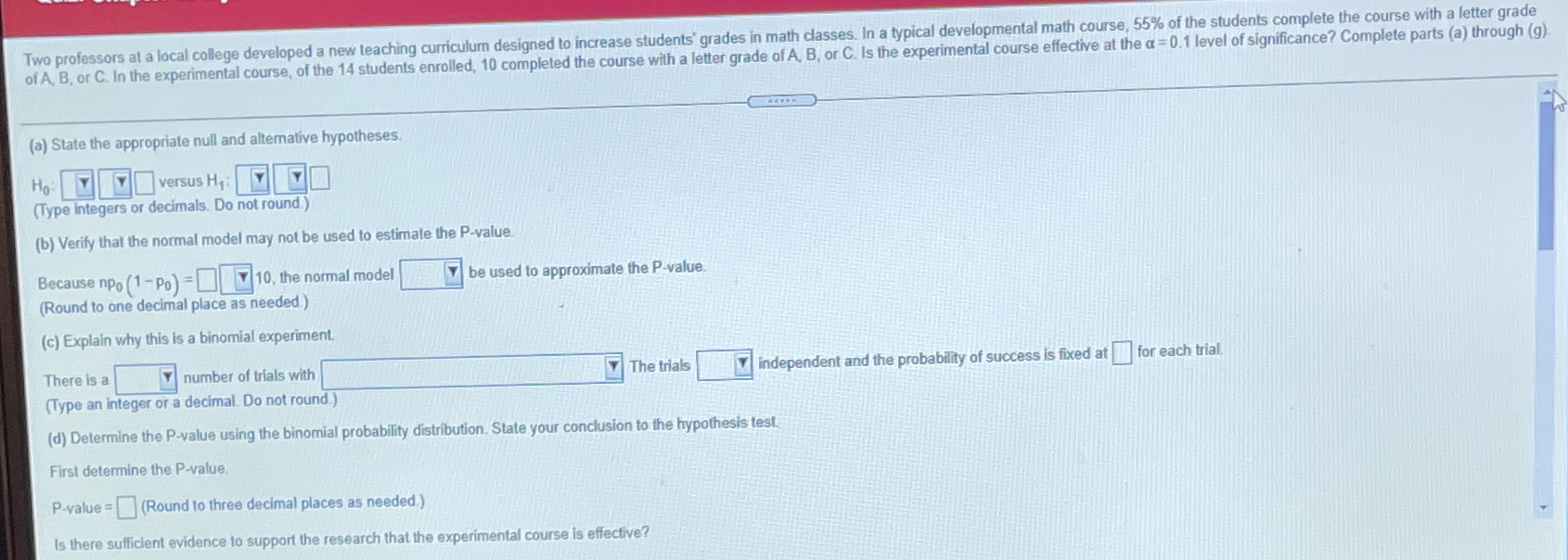
Two professors at a local college developed a new teaching curriculum designed to increase students' grades in math classes. In a typical developmental math course, 55% of the students complete the course with a letter grade of A, B, or C. In the experimental course, of the 14 students enrolled, 10 completed the course with a letter grade of A, B, or C. Is the experimental course effective at the a = 0.1 level of significance? Complete parts (a) through (g) (a) State the appropriate null and alternative hypotheses. HO T V versus Hy: TV (Type integers or decimals. Do not round.) (b) Verify that the normal model may not be used to estimate the P-value Because npo (1- Po) = 10, the normal model be used to approximate the P-value (Round to one decimal place as needed.) (c) Explain why this is a binomial experiment. There is a number of trials with The trials independent and the probability of success is fixed at for each trial. (Type an integer or a decimal. Do not round.) (d) Determine the P-value using the binomial probability distribution. State your conclusion to the hypothesis test First determine the P-value. P-value =(Round to three decimal places as needed.) Is there sufficient evidence to support the research that the experimental course is effective
Step by Step Solution
There are 3 Steps involved in it

Get step-by-step solutions from verified subject matter experts
 Study Help