







Question: A tsunami (commonly called a tidal wave because its effect is rapid change in tide) is a fast-moving ocean wave caused by an underwater
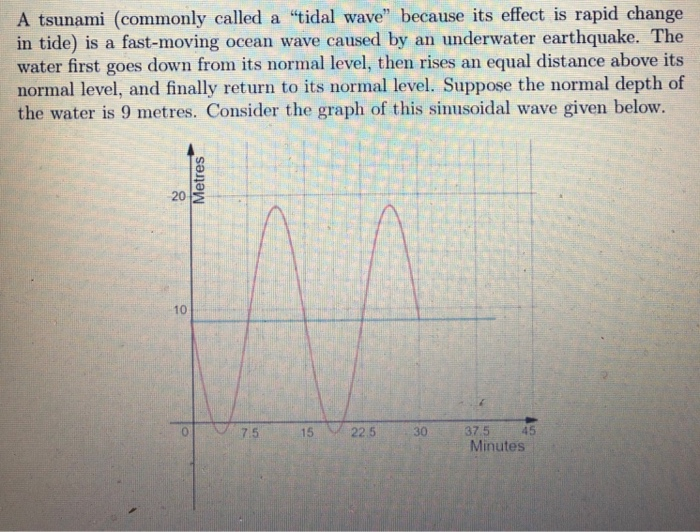
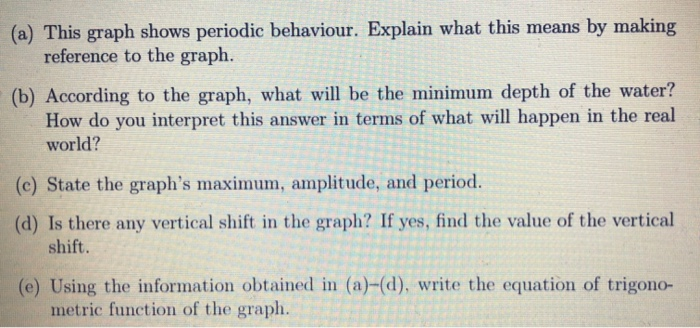
A tsunami (commonly called a "tidal wave" because its effect is rapid change in tide) is a fast-moving ocean wave caused by an underwater earthquake. The water first goes down from its normal level, then rises an equal distance above its normal level, and finally return to its normal level. Suppose the normal depth of the water is 9 metres. Consider the graph of this sinusoidal wave given below. 20 10 0 Metres 7.5 15 22.5 30 45 37.5 Minutes (a) This graph shows periodic behaviour. Explain what this means by making reference to the graph. (b) According to the graph, what will be the minimum depth of the water? How do you interpret this answer in terms of what will happen in the real world? (c) State the graph's maximum, amplitude, and period. (d) Is there any vertical shift in the graph? If yes, find the value of the vertical shift. (e) Using the information obtained in (a)-(d), write the equation of trigono- metric function of the graph.
Step by Step Solution
3.38 Rating (157 Votes )
There are 3 Steps involved in it
a A graph is being periodic means a particular part of the graph is repeated again and again consecu... View full answer

Get step-by-step solutions from verified subject matter experts
Document Format (2 attachments)

635d945885110_176942.pdf
180 KBs PDF File

635d945885110_176942.docx
120 KBs Word File
 Study Help