



Question: A twin-engine aircraft is taking off from a runway at sea-level height, after reaching the required screen height of 35 ft at its safety
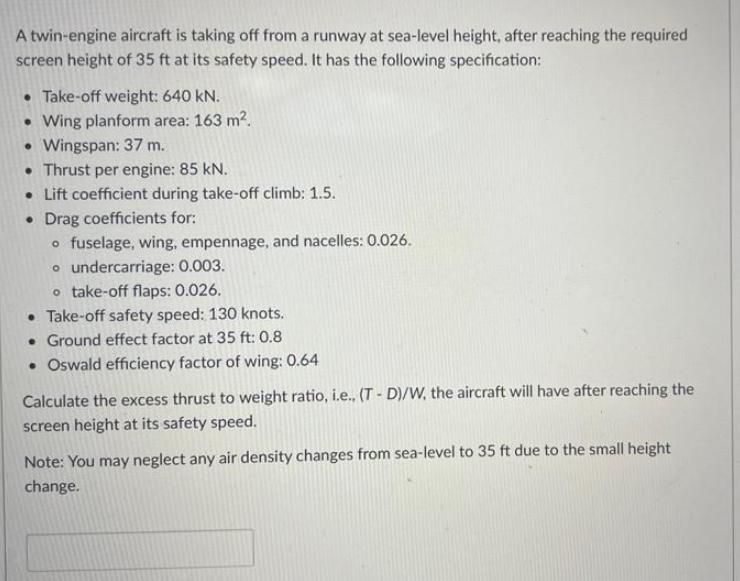
A twin-engine aircraft is taking off from a runway at sea-level height, after reaching the required screen height of 35 ft at its safety speed. It has the following specification: Take-off weight: 640 kN. Wing planform area: 163 m. Wingspan: 37 m. Thrust per engine: 85 kN. Lift coefficient during take-off climb: 1.5. Drag coefficients for: o fuselage, wing, empennage, and nacelles: 0.026. o undercarriage: 0.003. o take-off flaps: 0.026. Take-off safety speed: 130 knots. Ground effect factor at 35 ft: 0.8 Oswald efficiency factor of wing: 0.64 Calculate the excess thrust to weight ratio, i.e., (T-D)/W, the aircraft will have after reaching the screen height at its safety speed. Note: You may neglect any air density changes from sea-level to 35 ft due to the small height change. A twin-engine aircraft is taking off from a runway at sea-level height, after reaching the required screen height of 35 ft at its safety speed. It has the following specification: Take-off weight: 640 kN. Wing planform area: 163 m. Wingspan: 37 m. Thrust per engine: 85 kN. Lift coefficient during take-off climb: 1.5. Drag coefficients for: o fuselage, wing, empennage, and nacelles: 0.026. o undercarriage: 0.003. o take-off flaps: 0.026. Take-off safety speed: 130 knots. Ground effect factor at 35 ft: 0.8 Oswald efficiency factor of wing: 0.64 Calculate the excess thrust to weight ratio, i.e., (T-D)/W, the aircraft will have after reaching the screen height at its safety speed. Note: You may neglect any air density changes from sea-level to 35 ft due to the small height change.
Step by Step Solution
There are 3 Steps involved in it
WT 690 KN 640 10N 8163m b 37m Tpor engine 85 KN 85 x 10 N G115 CP 00... View full answer

Get step-by-step solutions from verified subject matter experts