







Question: ?A typical vertical section of a 2 3 - cm - thick and 3 - m - high wall is shown in the figure below.
?A typical vertical section of a cmthick and mhigh wall is shown in the figure below. The wall extends ?m into the page.
The wall consists of cm times cm bricks kB ?WmK ?separated vertically by cmthick plaster layers kA ?WmK ?There are also cmthick plaster layers on each side of the bricks t ?cm ?and a layer of cmthick foam kC ?WmK ?on the right hand side of the wall.
The inside right ?surface of the wall is maintained at a uniform temperature of deg C Tdeg C ?and the convective heat transfer coefficient on the outside left ?surface is ?WmK
The outside left ?temperature is deg C i ?Sketch the thermal resistance network for the wall, defining and labelling the resistances and the endpoint temperatures, Tinfty and T ?If you have sketched this in your working solution, answer yes: Answer
?
ii ?Write the equation for the total thermal resistance Rtotal in terms of the individual resistances. If you have written the equation in your working solution, answer yes: Answer
?
iii ?Calculate the numerical value of each resistance, and hence the total thermal resistance. Answer
CW
iii ?Determine the total rate of heat transfer through the wall in W ?AnswerAssume onedimensional steady heat transfer and disregard radiation.
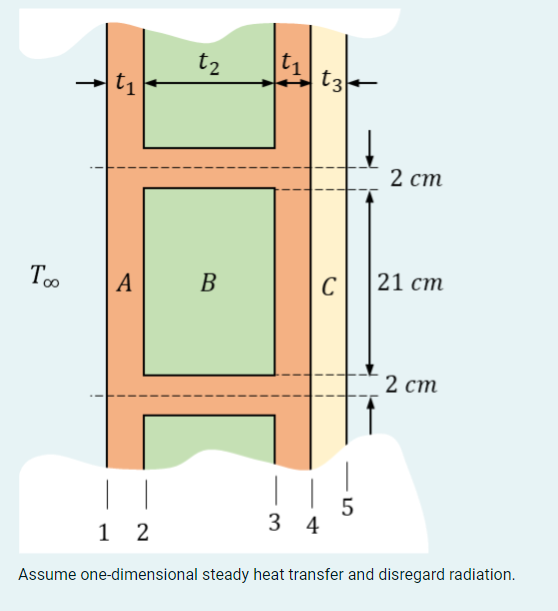
t1 t2 t3 2 cm Too A B C 21 cm 5 34 2 cm 12 Assume one-dimensional steady heat transfer and disregard radiation.
Step by Step Solution
There are 3 Steps involved in it

Get step-by-step solutions from verified subject matter experts
 Study Help