







Question: In this problem we consider the heat transfer that takes place between a travel mug featuring vacuum insulation and its surrounding. We can model the
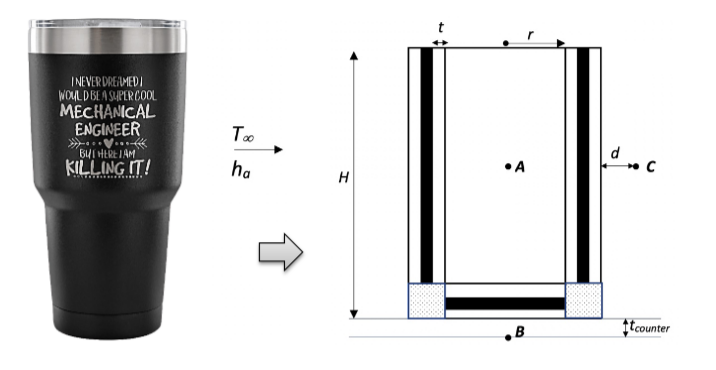
In this problem we consider the heat transfer that takes place between a travel mug featuring vacuum insulation and its surrounding. We can model the mug as shown in the below figure. Given that point A is located in the volumetric center of the travel mug, point B located at the at the bottom of the countertop vertically from A and point C a distance d from the outer layer of the mug horizontally from A Your travel mug, made with a polymer of thermal conductivity k has a radius r height H and a wall thickness t that is the same for the inner, vacuum, and outer layers. Additionally, assume that the lid of your mug is perfectly insulating. The air surrounding the bucket has a temperature Tinfty and a heat transfer coefficient of ha The countertop is cm thick and has a uniform temperature Tcounter as well as a thermal conductivity of kcounter. If there is steady state heat transfer, assume for the purpose of the problem, that there is no heat transfer or activity in the corner patterned areas
a Draw two resistance diagrams for A B and A C
b List the BCs and ICs and set up the mathematical equations to find the rate of heat transfer into the bucket.
c Now given that the mixture is water and ice, as well as the numerical values of the variables stated in the problem, what is the total rate of energy absorption into the bucket?
r cm
H cm
k WmK
k counter WmK
t cm
T counter C
tcounter cm
T infinity C
ha WmK
d cm
Step by Step Solution
There are 3 Steps involved in it
1 Expert Approved Answer
Step: 1 Unlock

Question Has Been Solved by an Expert!
Get step-by-step solutions from verified subject matter experts
Step: 2 Unlock
Step: 3 Unlock
 Study Help