



Question: (a) Use Newton's laws and the drag force stated above to derive the following model, where E is the applied electric field strength, and
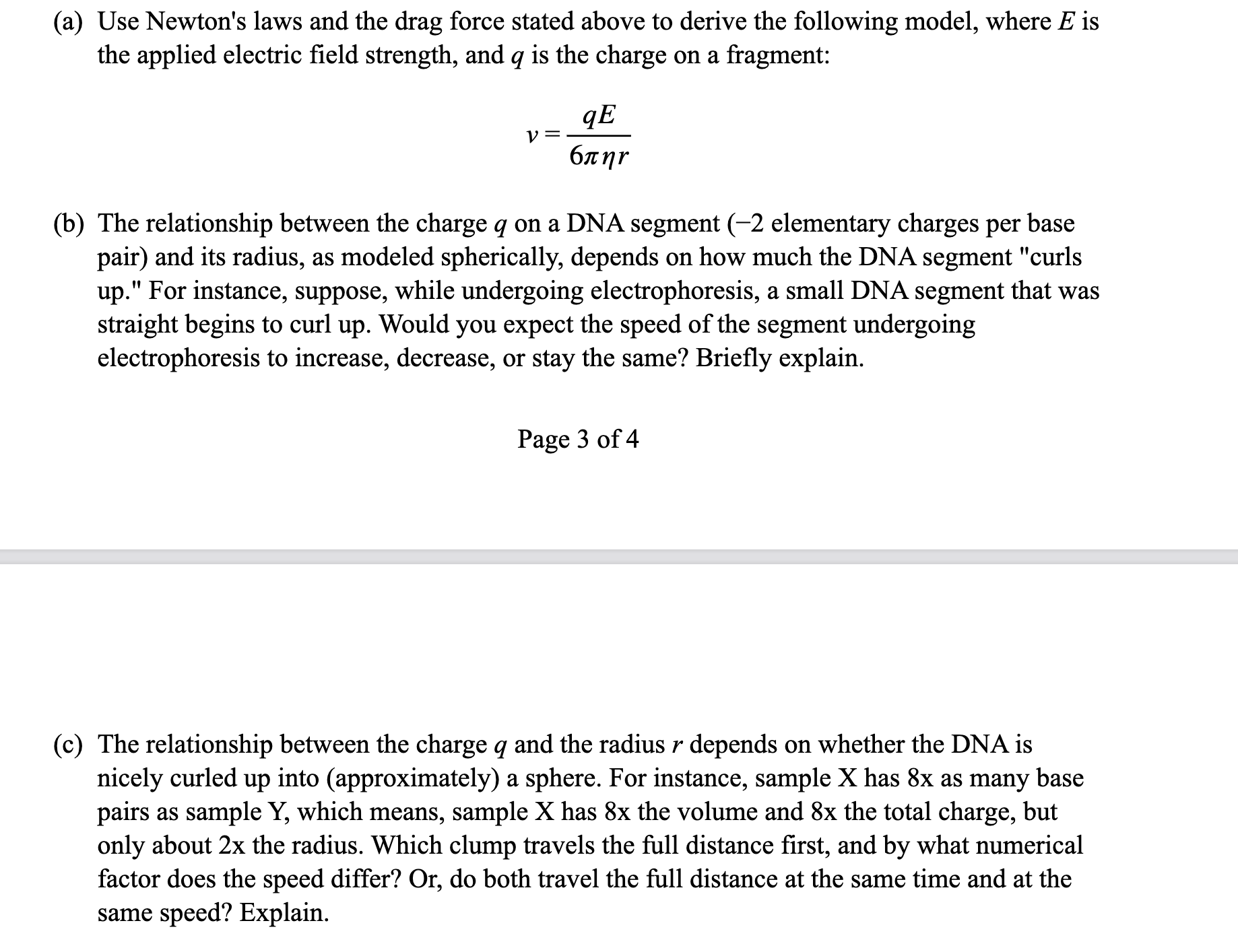
(a) Use Newton's laws and the drag force stated above to derive the following model, where E is the applied electric field strength, and q is the charge on a fragment: v = qE (b) The relationship between the charge q on a DNA segment (-2 elementary charges per base pair) and its radius, as modeled spherically, depends on how much the DNA segment "curls up." For instance, suppose, while undergoing electrophoresis, a small DNA segment that was straight begins to curl up. Would you expect the speed of the segment undergoing electrophoresis to increase, decrease, or stay the same? Briefly explain. Page 3 of 4 (c) The relationship between the charge q and the radius r depends on whether the DNA is nicely curled up into (approximately) a sphere. For instance, sample X has 8x as many base pairs as sample Y, which means, sample X has 8x the volume and 8x the total charge, but only about 2x the radius. Which clump travels the full distance first, and by what numerical factor does the speed differ? Or, do both travel the full distance at the same time and at the same speed? Explain.
Step by Step Solution
There are 3 Steps involved in it

Get step-by-step solutions from verified subject matter experts