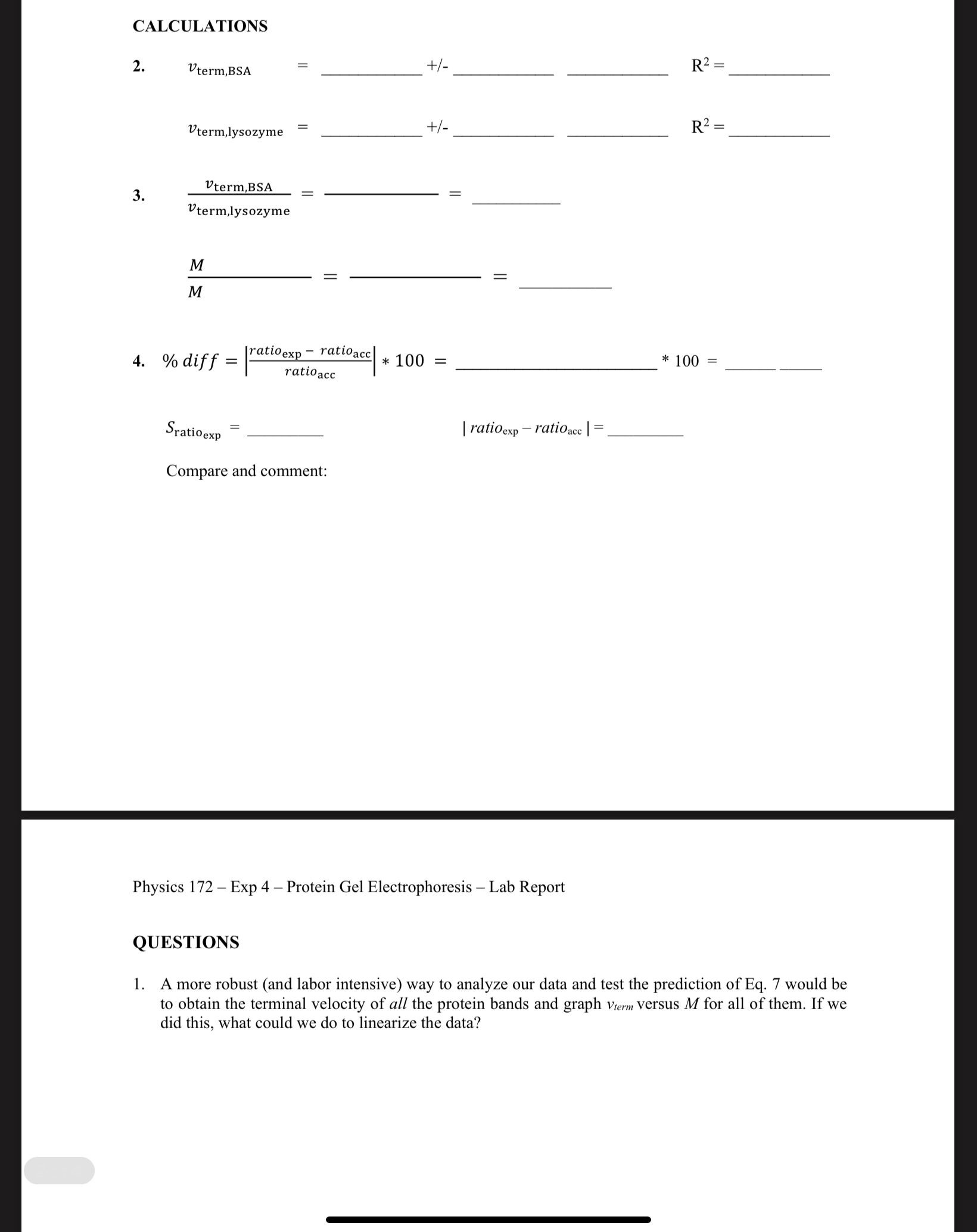
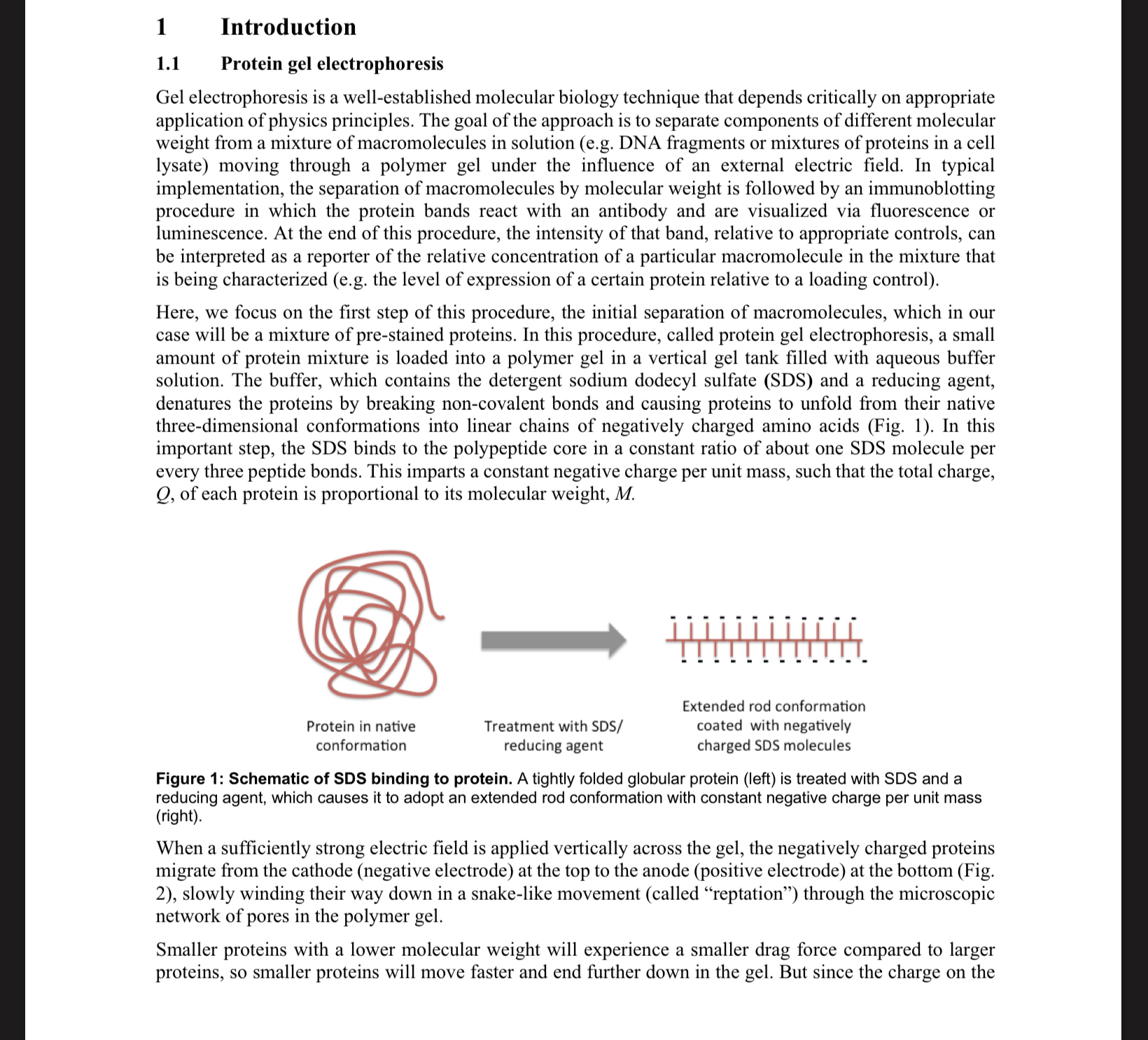
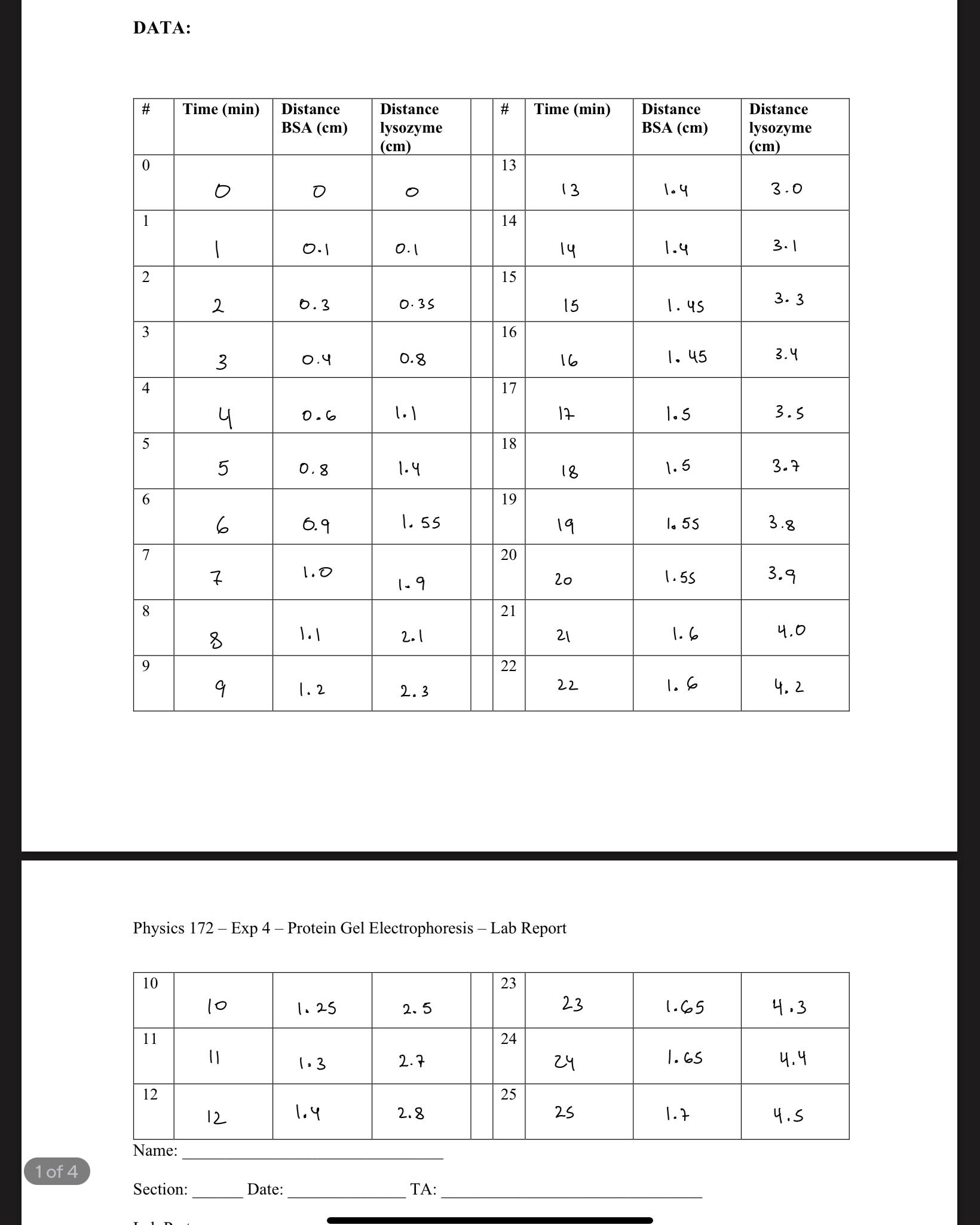
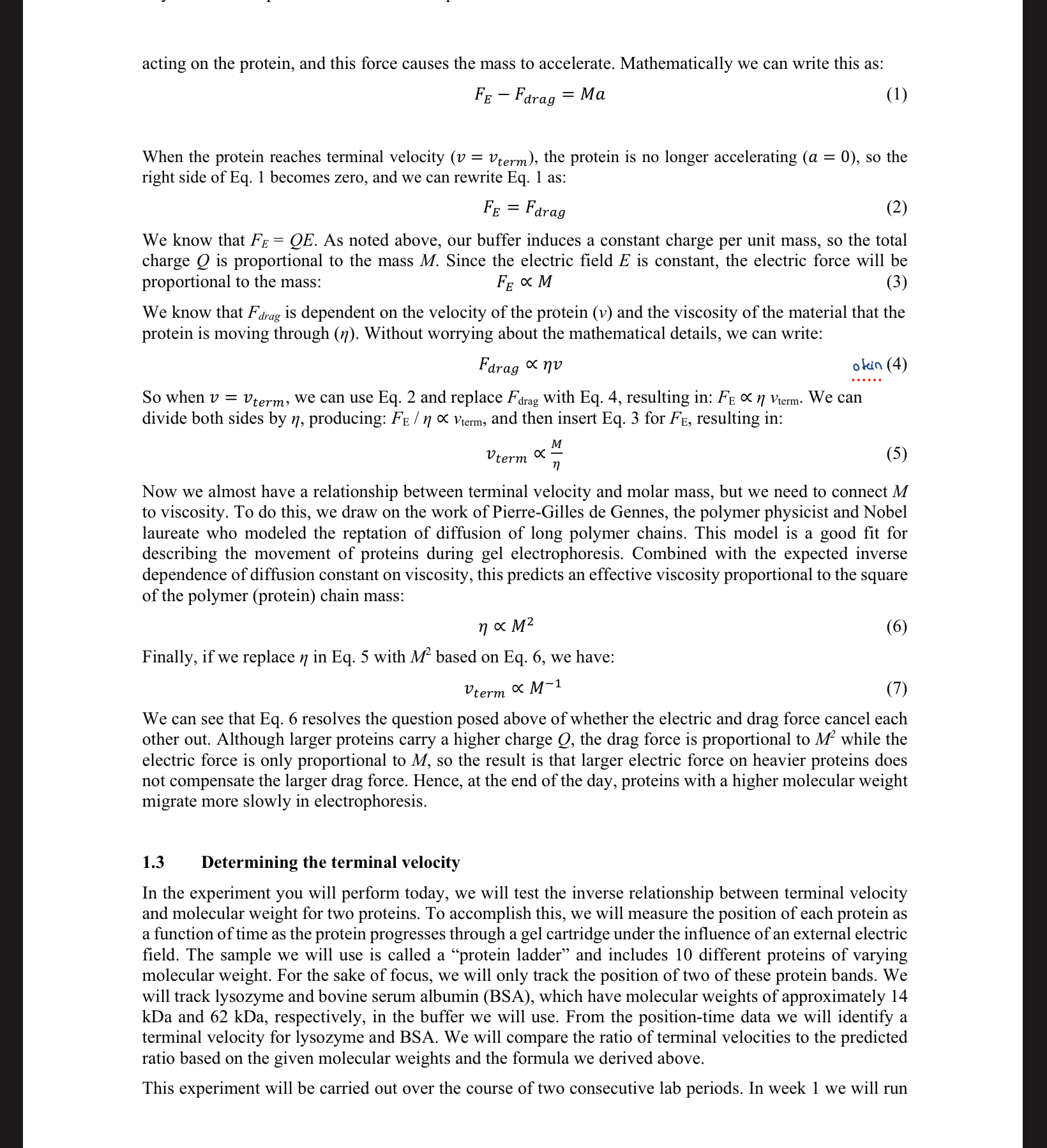
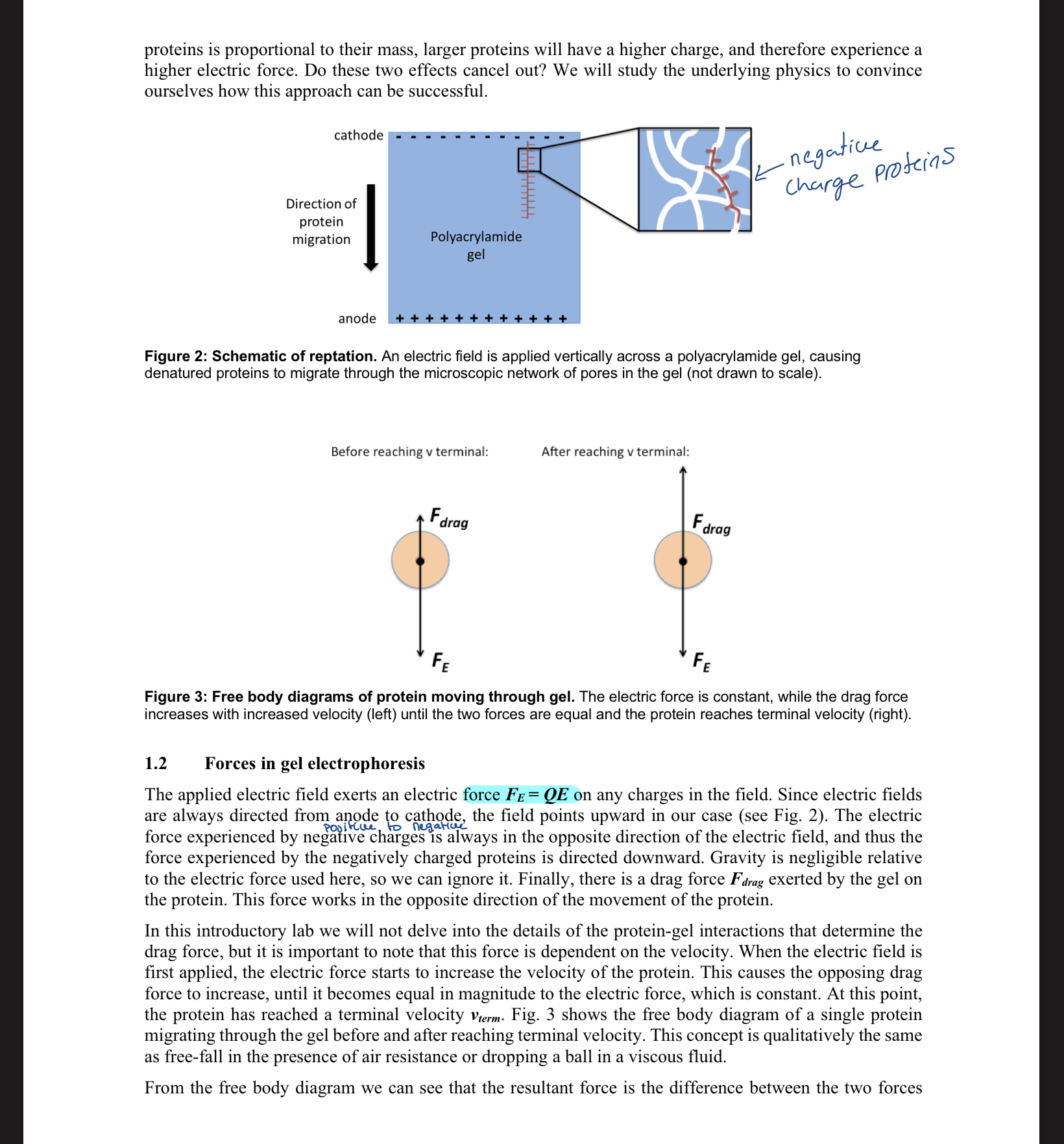
CALCULATIONS 2. +/- R2 = Vterm,BSA +/- R2 = Vterm, lysozyme Vterm,BSA 3. = Vterm,lysozyme M = M 4. % diff = [ratioexp - ratioacc * 100 = * 100 = ratioacc Sratioexp = | ratioexp - ratio acc |= Compare and comment: Physics 172 - Exp 4 - Protein Gel Electrophoresis - Lab Report QUESTIONS 1. A more robust (and labor intensive) way to analyze our data and test the prediction of Eq. 7 would be to obtain the terminal velocity of all the protein bands and graph Vterm versus M for all of them. If we did this, what could we do to linearize the data?1 Introduction 1.1 Protein gel electrophoresis Gel electrophoresis is a well-established molecular biology technique that depends critically on appropriate application of physics principles. The goal of the approach is to separate components of different molecular weight from a mixture of macromolecules in solution (e.g. DNA fragments or mixtures of proteins in a cell lysate) moving through a polymer gel under the influence of an external electric field. In typical implementation, the separation of macromolecules by molecular weight is followed by an immunoblotting procedure in which the protein bands react with an antibody and are visualized via fluorescence or luminescence. At the end of this procedure, the intensity of that band, relative to appropriate controls, can be interpreted as a reporter of the relative concentration of a particular macromolecule in the mixture that is being characterized (e.g. the level of expression of a certain protein relative to a loading control). Here, we focus on the first step of this procedure, the initial separation of macromolecules, which in our case will be a mixture of pre-stained proteins. In this procedure, called protein gel electrophoresis, a small amount of protein mixture is loaded into a polymer gel in a vertical gel tank filled with aqueous buffer solution. The buffer, which contains the detergent sodium dodecyl sulfate (SDS) and a reducing agent, denatures the proteins by breaking non-covalent bonds and causing proteins to unfold from their native three-dimensional conformations into linear chains of negatively charged amino acids (Fig. 1). In this important step, the SDS binds to the polypeptide core in a constant ratio of about one SDS molecule per every three peptide bonds. This imparts a constant negative charge per unit mass, such that the total charge, Q, of each protein is proportional to its molecular weight, M. Extended rod conformation Protein in native Treatment with SDS/ coated with negatively conformation reducing agent charged SDS molecules Figure 1: Schematic of SDS binding to protein. A tightly folded globular protein (left) is treated with SDS and a reducing agent, which causes it to adopt an extended rod conformation with constant negative charge per unit mass (right). When a sufficiently strong electric field is applied vertically across the gel, the negatively charged proteins migrate from the cathode (negative electrode) at the top to the anode (positive electrode) at the bottom (Fig. 2), slowly winding their way down in a snake-like movement (called \"reptation\") through the microscopic network of pores in the polymer gel. Smaller proteins with a lower molecular weight will experience a smaller drag force compared to larger proteins, so smaller proteins will move faster and end further down in the gel. But since the charge on the DATA: # Time (min) Distance Distance # Time (min) Distance Distance BSA (cm) lysozyme BSA (cm) lysozyme (cm (cm 0 13 D 13 1. 4 3.0 1 14 O. 1 0 . 1 14 1.4 3. 1 2 15 2 0. 35 15 1. 45 3. 3 3 16 0.4 0. 8 16 1. 45 3.4 4 17 0 . 6 1 . 1 17 1.5 3.5 5 18 5 0 . 8 1.4 18 1.5 3.7 6 19 6.9 1. 55 1. 55 3.8 7 20 7 1.0 1- 9 20 1. 55 3.9 8 21 1 . 1 2.1 21 1. 6 4.0 9 22 1. 2 2. 3 22 1. 6 1. 2 Physics 172 - Exp 4 - Protein Gel Electrophoresis - Lab Report 10 23 10 1. 25 2. 5 23 1.65 4 . 3 11 24 1 . 3 2.7 24 1. 65 4.4 12 25 12 . 4 2. 8 25 1. 7 4. 5 Name: 1 of 4 Section: Date: TAacting on the protein, and this force causes the mass to accelerate. Mathematically we can write this as: Fg Fgrqg = Ma (1) When the protein reaches terminal velocity (v = v;,,,), the protein is no longer accelerating (a = 0), so the right side of Eq. 1 becomes zero, and we can rewrite Eq. 1 as: Fp = Fdrag (2) We know that Fz = QF. As noted above, our buffer induces a constant charge per unit mass, so the total charge (@ is proportional to the mass M. Since the electric field is constant, the electric force will be proportional to the mass: Fexx M (3) We know that Fy,,, is dependent on the velocity of the protein (v) and the viscosity of the material that the protein is moving through (). Without worrying about the mathematical details, we can write: Fdrag o nv okan (4) So when v = Vg, We can use Eq. 2 and replace Fy., with Eq. 4, resulting in: Fr & # Vierm. We can divide both sides by #, producing: Fg / # & viem, and then insert Eq. 3 for Fg, resulting in: M Vterm % = (5 Now we almost have a relationship between terminal velocity and molar mass, but we need to connect M to viscosity. To do this, we draw on the work of Pierre-Gilles de Gennes, the polymer physicist and Nobel laureate who modeled the reptation of diffusion of long polymer chains. This model is a good fit for describing the movement of proteins during gel electrophoresis. Combined with the expected inverse dependence of diffusion constant on viscosity, this predicts an effective viscosity proportional to the square of the polymer (protein) chain mass: n o M2 (6) Finally, if we replace x in Eq. 5 with M based on Eq. 6, we have: Veerm X M7 (7 We can see that Eq. 6 resolves the question posed above of whether the electric and drag force cancel each other out. Although larger proteins carry a higher charge Q, the drag force is proportional to M? while the electric force is only proportional to M, so the result is that larger electric force on heavier proteins does not compensate the larger drag force. Hence, at the end of the day, proteins with a higher molecular weight migrate more slowly in electrophoresis. 1.3 Determining the terminal velocity In the experiment you will perform today, we will test the inverse relationship between terminal velocity and molecular weight for two proteins. To accomplish this, we will measure the position of each protein as a function of time as the protein progresses through a gel cartridge under the influence of an external electric field. The sample we will use is called a \"protein ladder\" and includes 10 different proteins of varying molecular weight. For the sake of focus, we will only track the position of two of these protein bands. We will track lysozyme and bovine serum albumin (BSA), which have molecular weights of approximately 14 kDa and 62 kDa, respectively, in the buffer we will use. From the position-time data we will identify a terminal velocity for lysozyme and BSA. We will compare the ratio of terminal velocities to the predicted ratio based on the given molecular weights and the formula we derived above. This experiment will be carried out over the course of two consecutive lab periods. In week 1 we will run Imagine that you are running protein gel electrophoresis on an unknown test sample and you are using a protein ladder as a molecular weight standard (i.e., you run the protein ladder with known proteins and molecular weights in the first well, and your sample of interest in the second well). After running the gel, the protein band of your sample of interest is positioned exactly halfway between the phosphorylase and BSA bands on the ladder. A colleague in the lab says your sample must have a molecular weight of 80 kDa, since its band is halfway between 62 and 98 kDa. Do you agree with their reasoning? Why or why not? Physics 172 Exp 4 Protein Gel Electrophoresis Lab Report 3 In this experiment, we ran the protein gel with a potential difference of 200 V across the gel. Estimate the electric field (magnitude and direction) in the gel resulting from this potential difference. Note that the gels we used in this experiment have a height of 8 cm. We ignored the force of gravity acting on the proteins in this experiment. Let's investigate whether this approximation was valid. We know that BSA has 583 amino acids, and that SDS binds to proteins with a constant ratio of about one SDS molecule per three peptide bonds, so BSA binds approximately 200 SDS molecules. Each SDS carries a charge of 1 e (-1.6x10"? C). The molecular weight of BSA in our buffer solution is approximately 62 kDa. Calculate the force of gravity working on a single BSA molecule. Calculate the electric force working on a single BSA molecule using the electric field strength you calculated in the previous question. Compare the two forces. Within the precision of your measurement, is it valid to neglect the force of gravity? proteins is proportional to their mass, larger proteins will have a higher charge, and therefore experience a higher electric force. Do these two effects cancel out? We will study the underlying physics to convince ourselves how this approach can be successful. cathode [ = = = @ = o =@ = = = = . n&{a&\\}l we Direction of protein migration Polyacrylamide gel anode + + ++++++ ++ + + Figure 2: Schematic of reptation. An electric field is applied vertically across a polyacrylamide gel, causing denatured proteins to migrate through the microscopic network of pores in the gel (not drawn to scale). Before reaching v terminal: After reaching v terminal: Fdrag Fn'rag FE 'FE Figure 3: Free body diagrams of protein moving through gel. The electric force is constant, while the drag force increases with increased velocity (left) until the two forces are equal and the protein reaches terminal velocity (right). 1.2 Forces in gel electrophoresis The applied electric field exerts an electric force Fg= @QE on any charges in the field. Since electric fields are always directed from a_q((_)de to cathode, the field points upward in our case (see Fig. 2). The electric : itue 'o o i 3 . : 0 force experienced by negfg?lve charges 1s always in the opposite direction of the electric field, and thus the force experienced by the negatively charged proteins is directed downward. Gravity is negligible relative to the electric force used here, so we can ignore it. Finally, there is a drag force Fang exerted by the gel on the protein. This force works in the opposite direction of the movement of the protein. In this introductory lab we will not delve into the details of the protein-gel interactions that determine the drag force, but it is important to note that this force is dependent on the velocity. When the electric field is first applied, the electric force starts to increase the velocity of the protein. This causes the opposing drag force to increase, until it becomes equal in magnitude to the electric force, which is constant. At this point, the protein has reached a terminal velocity vie... Fig. 3 shows the free body diagram of a single protein migrating through the gel before and after reaching terminal velocity. This concept is qualitatively the same as free-fall in the presence of air resistance or dropping a ball in a viscous fluid. From the free body diagram we can see that the resultant force is the difference between the two forces
Step by Step Solution
There are 3 Steps involved in it
1 Expert Approved Answer
Step: 1 Unlock
Question Has Been Solved by an Expert!
Get step-by-step solutions from verified subject matter experts
Step: 2 Unlock
Step: 3 Unlock
Students Have Also Explored These Related Law Questions!









 Study Help