







Question: a. Use the Intermediate Value Theorem to show that the following equation has a solution on the given interval. b. Use the graphing utility to
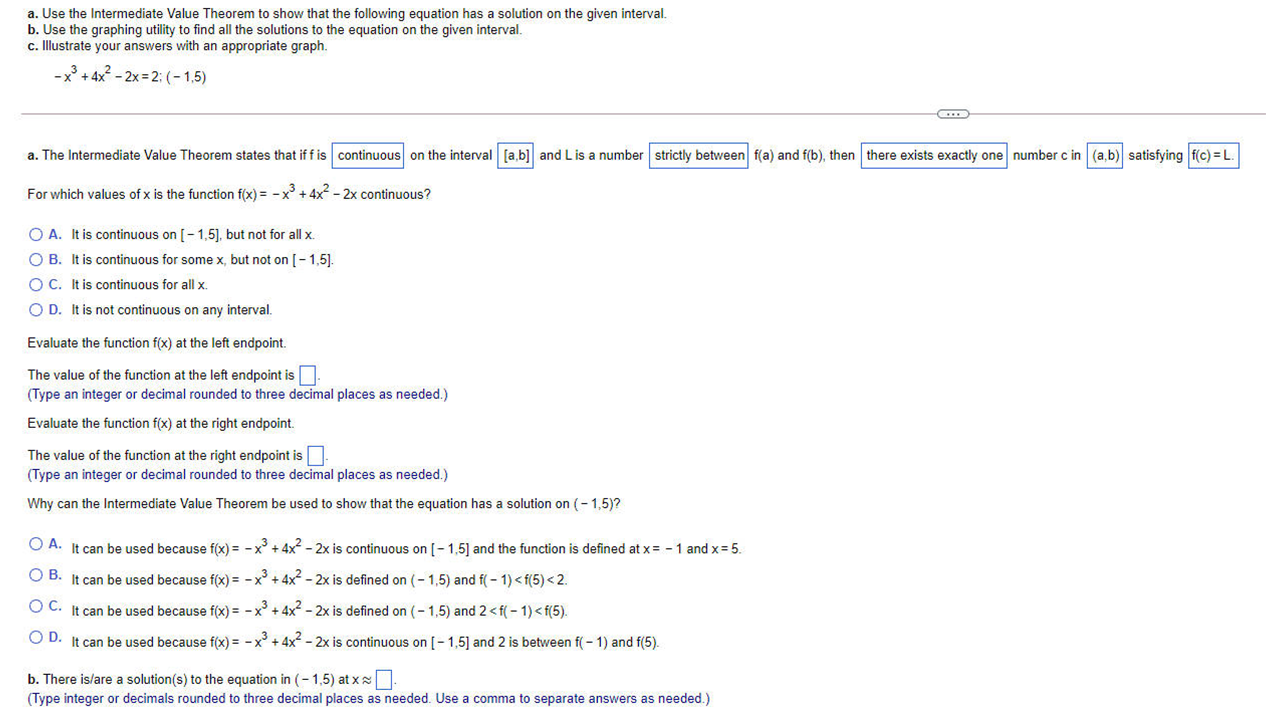
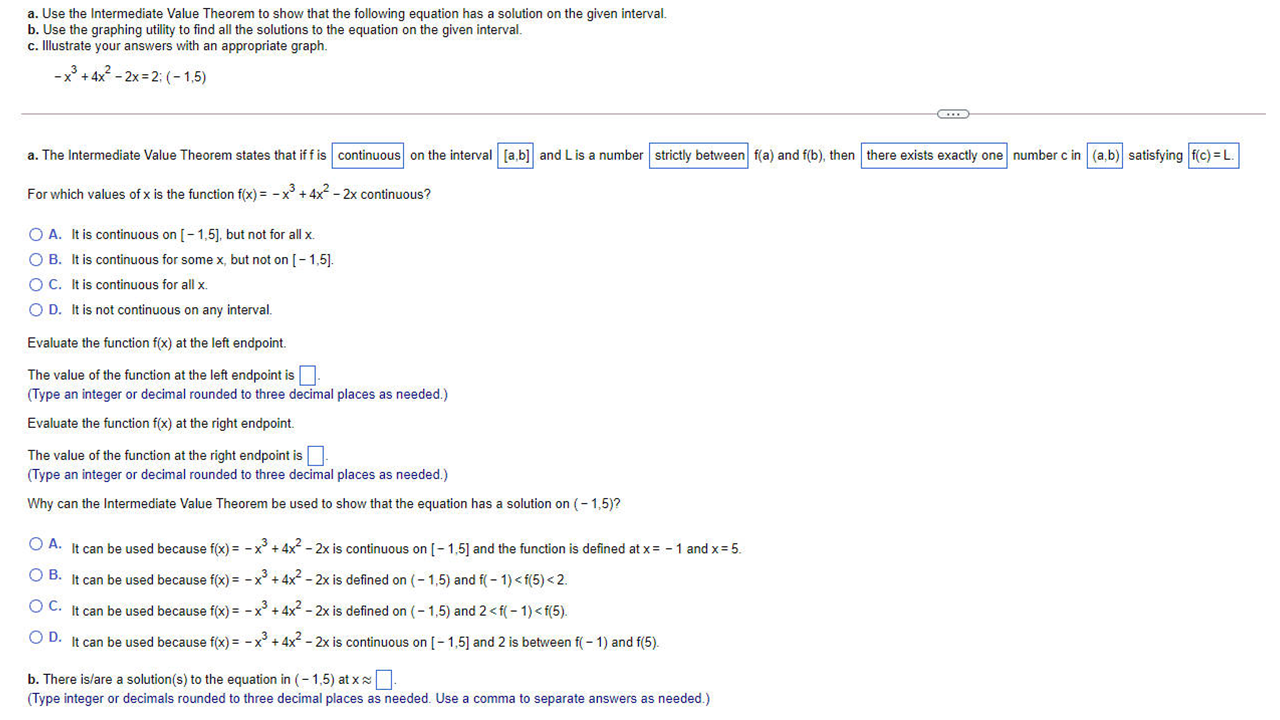
a. Use the Intermediate Value Theorem to show that the following equation has a solution on the given interval. b. Use the graphing utility to find all the solutions to the equation on the given interval. c. Illustrate your answers with an appropriate graph. -x3 + 4x- - 2x = 2; (-1,5) a. The Intermediate Value Theorem states that if f is continuous on the interval [a,b] and L is a number strictly between f(a) and f(b), then there exists exactly one number c in (a,b) satisfying f(c) = L. For which values of x is the function f(x) = - x + 4x2- 2x continuous? O A. It is continuous on [ - 1,5], but not for all x. O B. It is continuous for some x, but not on [ - 1,5]. O C. It is continuous for all x. O D. It is not continuous on any interval. Evaluate the function f(x) at the left endpoint. The value of the function at the left endpoint is (Type an integer or decimal rounded to three decimal places as needed.) Evaluate the function f(x) at the right endpoint. The value of the function at the right endpoint is(]. (Type an integer or decimal rounded to three decimal places as needed.) Why can the Intermediate Value Theorem be used to show that the equation has a solution on ( - 1,5)? O A. It can be used because f(x) = - x + 4x2 - 2x is continuous on [- 1,5] and the function is defined at x = - 1 and x = 5. O B. It can be used because f(x) = - x3+ 4x2 - 2x is defined on ( - 1,5) and f( - 1)
Step by Step Solution
There are 3 Steps involved in it

Get step-by-step solutions from verified subject matter experts
 Study Help