







Question: a) Using only the 16 basic intro/elim rules of Natural Deduction (you may not use logical equivalences), prove that Vx (S(2) AC(2] :: Vx (S(x)
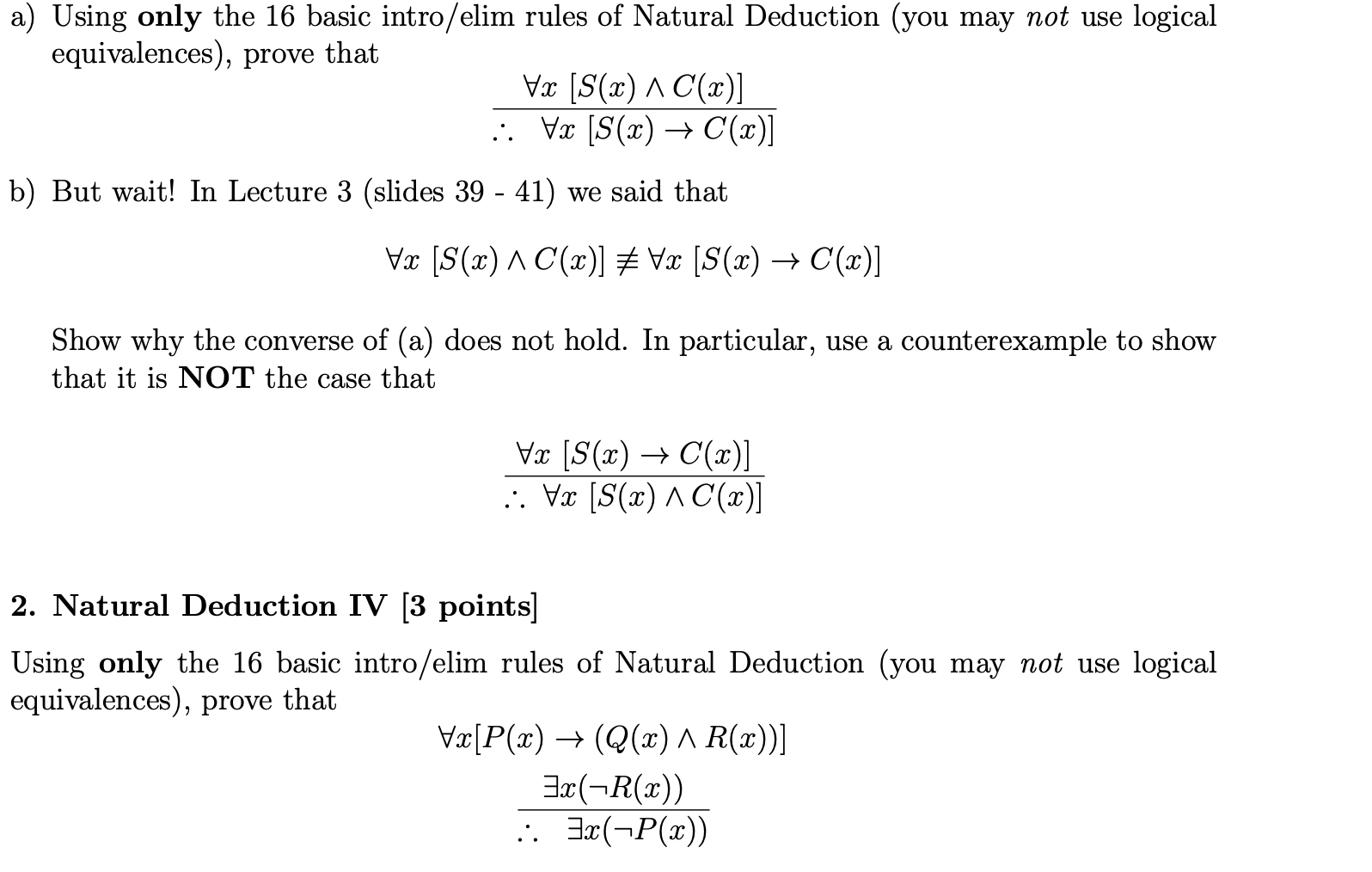
a) Using only the 16 basic intro/elim rules of Natural Deduction (you may not use logical equivalences), prove that Vx (S(2) AC(2] :: Vx (S(x) + C(x)] b) But wait! In Lecture 3 (slides 39 - 41) we said that Vw [S(x) A C(x)] # Vx [S(x) + C(x)] Show why the converse of (a) does not hold. In particular, use a counterexample to show that it is NOT the case that Vx [S(x) + C(x)] :: Vx [S(x) ^ C(x)] 2. Natural Deduction IV [3 points] Using only the 16 basic intro/elim rules of Natural Deduction (you may not use logical equivalences), prove that Vx[P(x) + (Q(x) A R(x))] Ex(-R(2) :. 3.c(-P(x)) a) Using only the 16 basic intro/elim rules of Natural Deduction (you may not use logical equivalences), prove that Vx (S(2) AC(2] :: Vx (S(x) + C(x)] b) But wait! In Lecture 3 (slides 39 - 41) we said that Vw [S(x) A C(x)] # Vx [S(x) + C(x)] Show why the converse of (a) does not hold. In particular, use a counterexample to show that it is NOT the case that Vx [S(x) + C(x)] :: Vx [S(x) ^ C(x)] 2. Natural Deduction IV [3 points] Using only the 16 basic intro/elim rules of Natural Deduction (you may not use logical equivalences), prove that Vx[P(x) + (Q(x) A R(x))] Ex(-R(2) :. 3.c(-P(x))
Step by Step Solution
There are 3 Steps involved in it

Get step-by-step solutions from verified subject matter experts
 Study Help