



Question: Below are the 16 rules to be used for this problem: 1. Natural Deduction III [4 points] a) Using only the 16 basic intro/elim rules
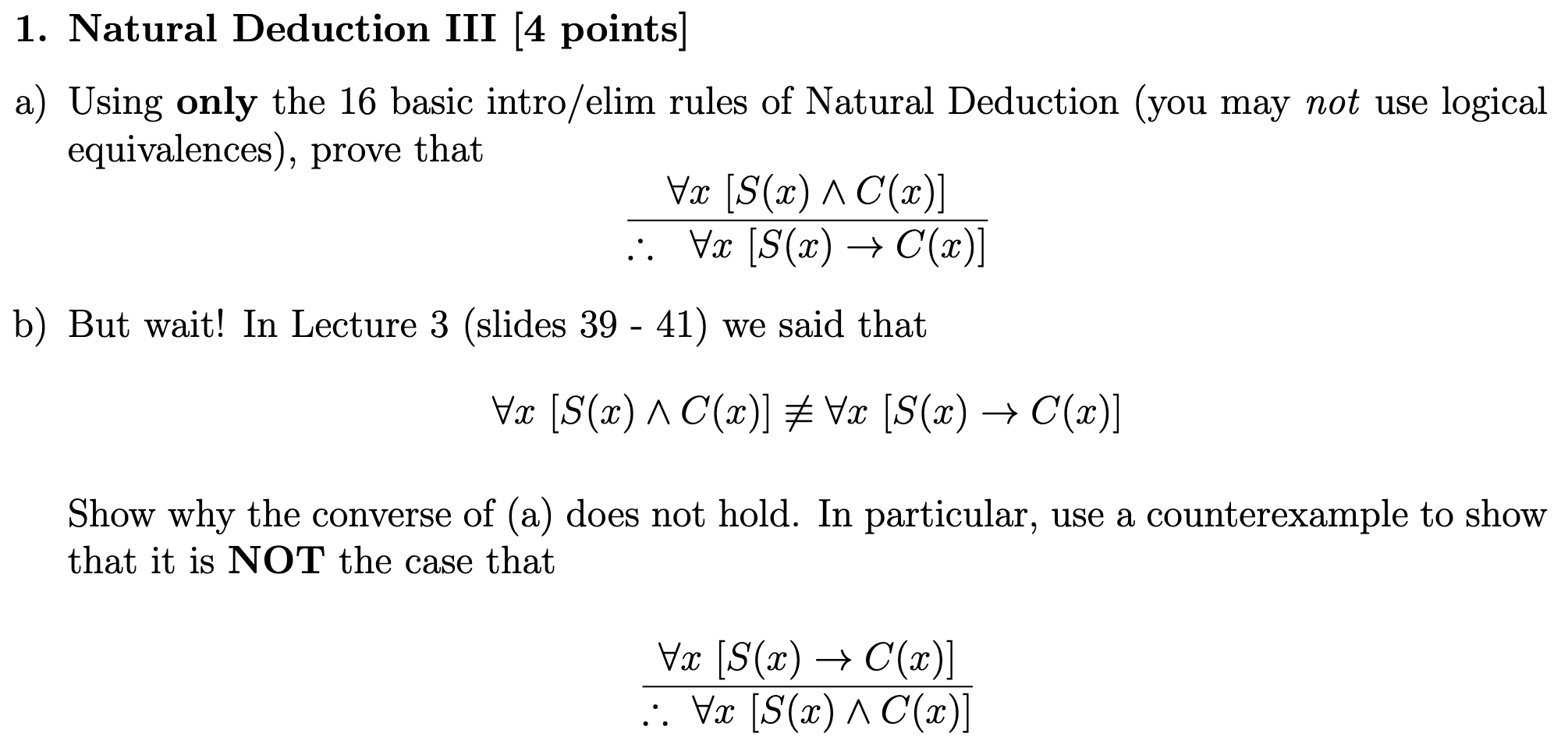 Below are the 16 rules to be used for this problem:
![Natural Deduction III [4 points] a) Using only the 16 basic intro/elim](https://dsd5zvtm8ll6.cloudfront.net/si.experts.images/questions/2024/09/66f4de1bbfac4_67566f4de1b63ac9.jpg)
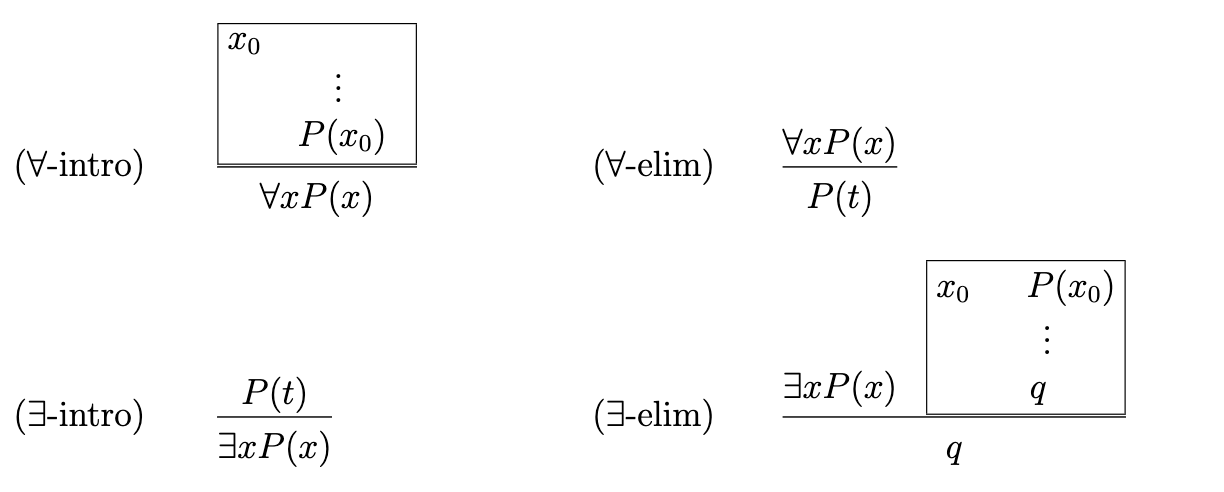
1. Natural Deduction III [4 points] a) Using only the 16 basic intro/elim rules of Natural Deduction (you may not use logical equivalences), prove that Vx (S(X)^C()] ::. Va [S(x) + C(x)] b) But wait! In Lecture 3 (slides 39 - 41) we said that Va [S(2) ^ C(x)] # V2 [S(x) + C(x)] Show why the converse of (a) does not hold. In particular, use a counterexample to show that it is NOT the case that Vx [S(x) + C(x)] :: Va [S(2) A C(x)] pq pq (1-intro) P 9 pq (1-elim) a (V-intro) T al (V-elim) pVq pva pva r p 9 q (--intro) (+-elim) p+9 9 p 9 9 P 4 q p Ha (H-intro) (H-elim) p Ha 9 p . F (--intro) ( --elim) F (elim) F (F-elim) : P(20) VP(2) (V-intro) (V-elim) VxP() P(t) P(X) : a 3.P(1) (3-intro) P(t) 3xP(x) (3-elim) a 1. Natural Deduction III [4 points] a) Using only the 16 basic intro/elim rules of Natural Deduction (you may not use logical equivalences), prove that Vx (S(X)^C()] ::. Va [S(x) + C(x)] b) But wait! In Lecture 3 (slides 39 - 41) we said that Va [S(2) ^ C(x)] # V2 [S(x) + C(x)] Show why the converse of (a) does not hold. In particular, use a counterexample to show that it is NOT the case that Vx [S(x) + C(x)] :: Va [S(2) A C(x)] pq pq (1-intro) P 9 pq (1-elim) a (V-intro) T al (V-elim) pVq pva pva r p 9 q (--intro) (+-elim) p+9 9 p 9 9 P 4 q p Ha (H-intro) (H-elim) p Ha 9 p . F (--intro) ( --elim) F (elim) F (F-elim) : P(20) VP(2) (V-intro) (V-elim) VxP() P(t) P(X) : a 3.P(1) (3-intro) P(t) 3xP(x) (3-elim) a
Step by Step Solution
There are 3 Steps involved in it

Get step-by-step solutions from verified subject matter experts