



Question: a) Using scaling arguments and the mass balance equation (written in cylindrical coordinates), identify the length and velocity scales in the wall layer. b) Using
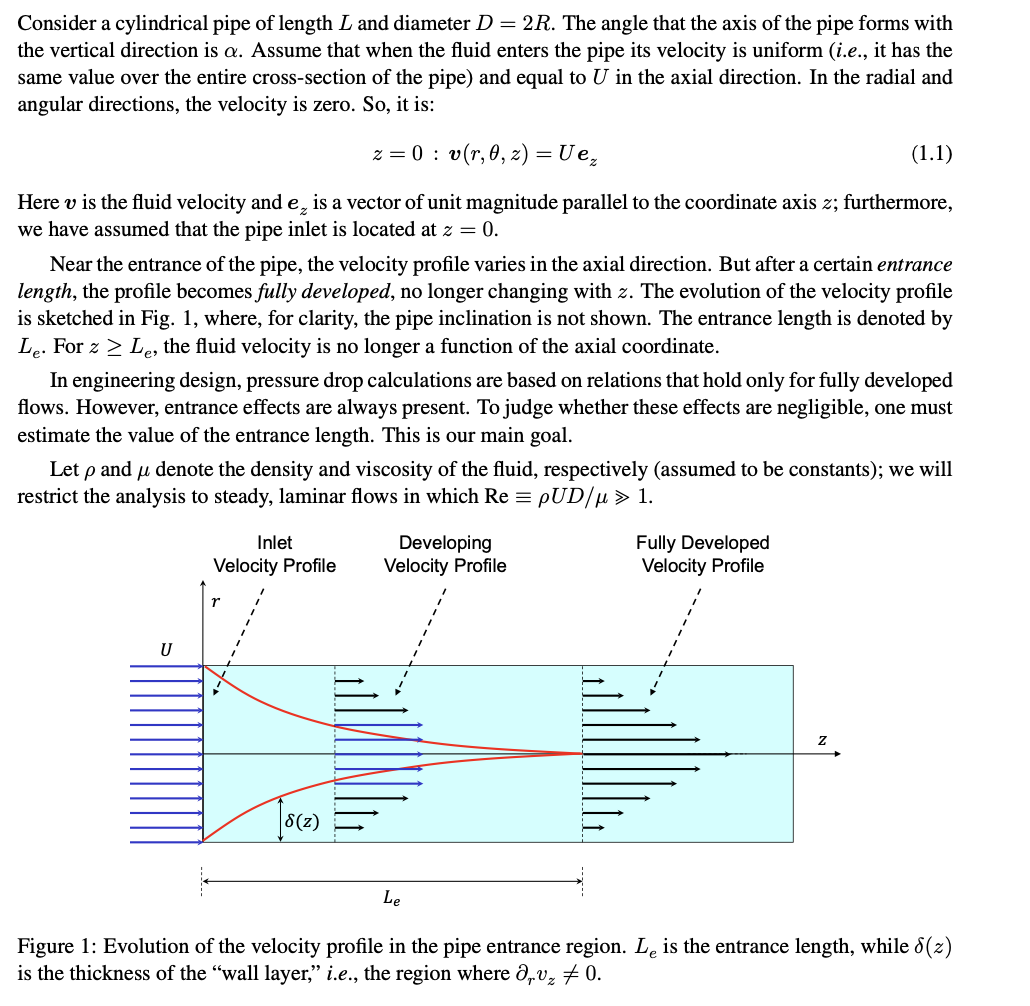
a) Using scaling arguments and the mass balance equation (written in cylindrical coordinates), identify the length and velocity scales in the wall layer.
b) Using scaling arguments and the equation governing the evolution of the velocity component vz , obtain the pressure scale and estimate the order of magnitude of Le.
c) There is an alternative method for estimating Le. First, estimate the (mean) residence time of the fluid in the entrance region; then, use appropriately the results of linear momentum penetration theory (that we obtained when we studied the pure diffusion of linear momentum). Use this method and verify that the result is the same as that found in part b).
d) Using scaling arguments and the equation that governs the evolution of the velocity component vr , show that in the wall layer P is approximately a function of z only.
e) Suggest a criterion for judging whether entrance effects may be neglected. If Re = 1500, R = 2 cm and
L = 250 m, can entrance effects be safely neglected?
f) The estimate you have made for Le is valid for laminar flows. For turbulent flows, do you expect it to be much larger, much shorter or about the same as for the laminar case? That is, for turbulent flows, do you expect the condition for neglecting entrance effects to be more, less or equally demanding compared to the condition holding for the laminar case? Justify your answer.
(g)
 X=4
X=4
Please could you answer as many of these questions as you can, thank you!
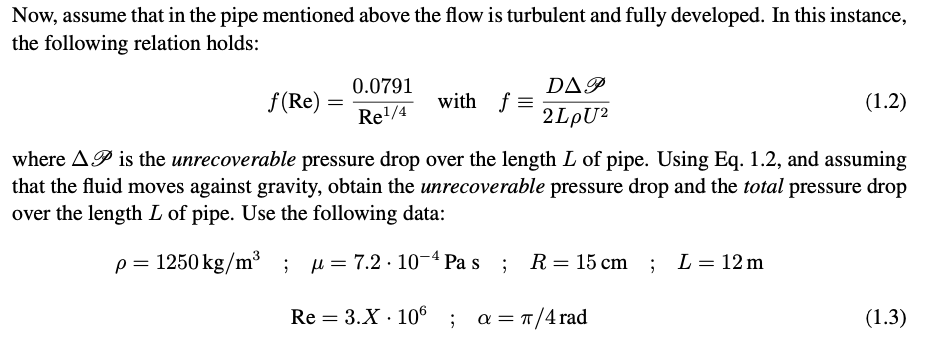
Consider a cylindrical pipe of length L and diameter D=2R. The angle that the axis of the pipe forms with the vertical direction is a. Assume that when the fluid enters the pipe its velocity is uniform (i.e., it has the same value over the entire cross-section of the pipe) and equal to U in the axial direction. In the radial and angular directions, the velocity is zero. So, it is: z=0 : v(r,0, z) = Ue, = (1.1) Here v is the fluid velocity and e, is a vector of unit magnitude parallel to the coordinate axis z; furthermore, we have assumed that the pipe inlet is located at z = 0. Near the entrance of the pipe, the velocity profile varies in the axial direction. But after a certain entrance length, the profile becomes fully developed, no longer changing with z. The evolution of the velocity profile is sketched in Fig. 1, where, for clarity, the pipe inclination is not shown. The entrance length is denoted by Le. For z > Le, the fluid velocity is no longer a function of the axial coordinate. In engineering design, pressure drop calculations are based on relations that hold only for fully developed flows. However, entrance effects are always present. To judge whether these effects are negligible, one must estimate the value of the entrance length. This is our main goal. Let p and u denote the density and viscosity of the fluid, respectively (assumed to be constants); we will restrict the analysis to steady, laminar flows in which Re = PUD/u> 1. Inlet Velocity Profile Developing Velocity Profile Fully Developed Velocity Profile 1 U 8(2) Le Figure 1: Evolution of the velocity profile in the pipe entrance region. Le is the entrance length, while 8(2) is the thickness of the "wall layer, i.e., the region where 0,02 +0. Now, assume that in the pipe mentioned above the flow is turbulent and fully developed. In this instance, the following relation holds: 0.0791 f(Re) = DAP with f= 2 LpU2 (1.2) Re1/4 where AP is the unrecoverable pressure drop over the length L of pipe. Using Eq. 1.2, and assuming that the fluid moves against gravity, obtain the unrecoverable pressure drop and the total pressure drop over the length L of pipe. Use the following data: p= 1250 kg/m3 ; u = 7.2 10-4 Pas ; R= 15 cm; = L = 12 m = Re = 3.X . 106 = ; a = 7/4 rad (1.3) Consider a cylindrical pipe of length L and diameter D=2R. The angle that the axis of the pipe forms with the vertical direction is a. Assume that when the fluid enters the pipe its velocity is uniform (i.e., it has the same value over the entire cross-section of the pipe) and equal to U in the axial direction. In the radial and angular directions, the velocity is zero. So, it is: z=0 : v(r,0, z) = Ue, = (1.1) Here v is the fluid velocity and e, is a vector of unit magnitude parallel to the coordinate axis z; furthermore, we have assumed that the pipe inlet is located at z = 0. Near the entrance of the pipe, the velocity profile varies in the axial direction. But after a certain entrance length, the profile becomes fully developed, no longer changing with z. The evolution of the velocity profile is sketched in Fig. 1, where, for clarity, the pipe inclination is not shown. The entrance length is denoted by Le. For z > Le, the fluid velocity is no longer a function of the axial coordinate. In engineering design, pressure drop calculations are based on relations that hold only for fully developed flows. However, entrance effects are always present. To judge whether these effects are negligible, one must estimate the value of the entrance length. This is our main goal. Let p and u denote the density and viscosity of the fluid, respectively (assumed to be constants); we will restrict the analysis to steady, laminar flows in which Re = PUD/u> 1. Inlet Velocity Profile Developing Velocity Profile Fully Developed Velocity Profile 1 U 8(2) Le Figure 1: Evolution of the velocity profile in the pipe entrance region. Le is the entrance length, while 8(2) is the thickness of the "wall layer, i.e., the region where 0,02 +0. Now, assume that in the pipe mentioned above the flow is turbulent and fully developed. In this instance, the following relation holds: 0.0791 f(Re) = DAP with f= 2 LpU2 (1.2) Re1/4 where AP is the unrecoverable pressure drop over the length L of pipe. Using Eq. 1.2, and assuming that the fluid moves against gravity, obtain the unrecoverable pressure drop and the total pressure drop over the length L of pipe. Use the following data: p= 1250 kg/m3 ; u = 7.2 10-4 Pas ; R= 15 cm; = L = 12 m = Re = 3.X . 106 = ; a = 7/4 rad (1.3)
Step by Step Solution
There are 3 Steps involved in it

Get step-by-step solutions from verified subject matter experts