







Question: a) Using the FCFS (first come, first served ) decision rule for sequencing the jobs, the order is (assume that jobs came in the order
a) Using the FCFS (first come, first served ) decision rule for sequencing the jobs, the order is (assume that jobs came in the order in which they are listed in the table):
| Sequence | Job |
| 1 | A |
| 2 | B |
| 3 | C |
| 4 | D |
| 5 | E |
The average tardiness (job lateness) for the sequence developed using the FCFS rule =
14.8014.80
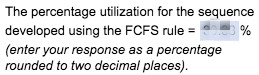
days (round your response to two decimal places).The percentage utilization for the sequence developed using the FCFS rule =
30.3830.38%
(enter your response as a percentage rounded to two decimal places).
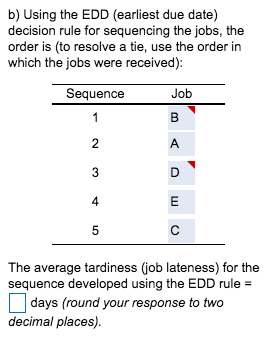
b) Using the EDD (earliest due date) decision rule for sequencing the jobs, the order is (to resolve a tie, use the order in which the jobs were received):
| Sequence | Job |
| 1 | B |
| 2 | A |
| 3 | D |
| 4 | E |
| 5 | C |
The average tardiness (job lateness) for the sequence developed using the EDD rule =
nothing
days (round your response to two decimal places).
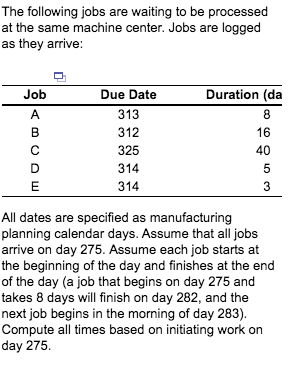
The following jobs are waiting to be processed at the same machine center. Jobs are logged as they arrive:
| Job | Due Date | Duration (days) | |
| Upper AA | 313313 | 88 | |
| Upper BB | 312312 | 1616 | |
| Upper CC | 325325 | 4040 | |
| Upper DD | 314314 | 55 | |
| Upper EE | 314314 | 33 | |
All dates are specified as manufacturing planning calendar days. Assume that all jobs arrive on day
275275.
Assume each job starts at the beginning of the day and finishes at the end of the day (a job that begins on day 275 and takes 8 days will finish on day 282, and the next job begins in the morning of day 283). Compute all times based on initiating work on day
275275.
Step by Step Solution
There are 3 Steps involved in it

Get step-by-step solutions from verified subject matter experts
 Study Help