



Question: a. What is the approximate overall heat transfer coefficient for a shell & tube heat exchanger where sea water is on service fluid side and
a. What is the approximate overall heat transfer coefficient for a shell & tube heat exchanger where sea water is on service fluid side and dilute aqueous is on the process fluid side?
b. Assuming no fouling and thin walls, using heat transfer coefficient values from the same axes, what equation could you use to also calculate the overall heat transfer coefficient? Should you get the same answer? Why or why not?
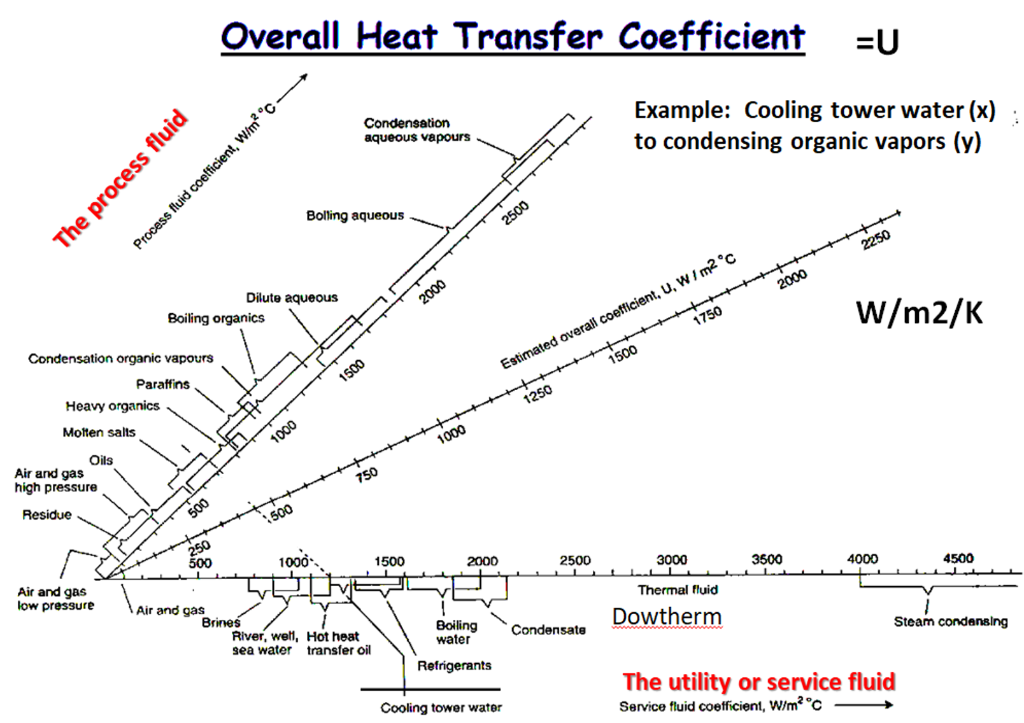
Overall Heat Transfer Coefficient =U Condensation aqueous vapours Example: Cooling tower water (x) to condensing organic vapors (y) The process fluid Process fluid coefficient, W/m2 C Bolling aqueous 2500 2250 2000 Dilute aqueous Boiling organics 2000 1750 W/m2/K Estimated overall coefficient, U, W/m2c 1500 Condensation organic vapours Paraffins Heavy organics 1500 1250 TIT Molten salts 1000 1000 Oils Air and gas high pressure 750 Residue 500 500 250 500 1000 1500 2000 2500 3000 3500 4000 4500 Air and gas low pressure Thermal fluid Dowtherm Air and gas Brines River, well, Hot heat sea water transfer oil Steam condensing Boiling water Condensate Refrigerants The utility or service fluid Service fluid coefficient, W/m2 C Cooling tower water
Step by Step Solution
There are 3 Steps involved in it

Get step-by-step solutions from verified subject matter experts