







Question: A worker is trapped in a mine during a mining accident. He starts at point1 In front of him there are three paths. The first
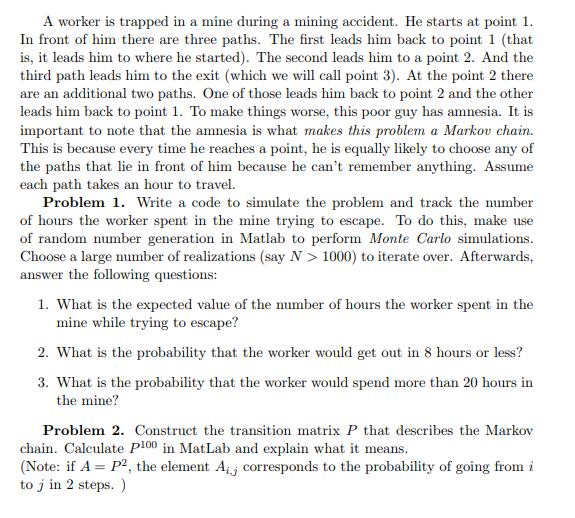
A worker is trapped in a mine during a mining accident. He starts at point1 In front of him there are three paths. The first leads him back to point1 (that is, it leads him to where he started). The second leads him to a point 2. And the third path leads him to the exit (which we will call point 3). At the point 2 there are an additional two paths. One of those leads him back to point 2 and the other leads him back to point 1. To make things worse, this poor guy has amnesia. It is important to note that the amnesia is what makes this problem a Markov chain. This is because every time he reaches a point, he is equally likely to choose any of the paths that lie in front of him because he can't remember anything. Assume each path takes an hour to travel. Problem 1. Write a code to simulate the problem and track the number of hours the worker spent in the mine trying to escape. To do this, make use of random number generation in Matlab to perform Monte Carlo simulations Choose a large number of realizations (say N > 1000) to iterate over. Afterwards answer the following questions 1. What is the expected value of the number of hours the worker spent in the mine while trying to escape 2. What is the probability that the worker would get out in 8 hours or less? 3. What is the probability that the worker would spend more than 20 hours in the mine? Problem 2. Construct the transition matrix P that describes the Markov chain. Calculate P100 in MatLab and explain what it means (Note: if AP2, the element A,, corresponds to the probability of going from i to j in 2 steps.) A worker is trapped in a mine during a mining accident. He starts at point1 In front of him there are three paths. The first leads him back to point1 (that is, it leads him to where he started). The second leads him to a point 2. And the third path leads him to the exit (which we will call point 3). At the point 2 there are an additional two paths. One of those leads him back to point 2 and the other leads him back to point 1. To make things worse, this poor guy has amnesia. It is important to note that the amnesia is what makes this problem a Markov chain. This is because every time he reaches a point, he is equally likely to choose any of the paths that lie in front of him because he can't remember anything. Assume each path takes an hour to travel. Problem 1. Write a code to simulate the problem and track the number of hours the worker spent in the mine trying to escape. To do this, make use of random number generation in Matlab to perform Monte Carlo simulations Choose a large number of realizations (say N > 1000) to iterate over. Afterwards answer the following questions 1. What is the expected value of the number of hours the worker spent in the mine while trying to escape 2. What is the probability that the worker would get out in 8 hours or less? 3. What is the probability that the worker would spend more than 20 hours in the mine? Problem 2. Construct the transition matrix P that describes the Markov chain. Calculate P100 in MatLab and explain what it means (Note: if AP2, the element A,, corresponds to the probability of going from i to j in 2 steps.)
Step by Step Solution
There are 3 Steps involved in it

Get step-by-step solutions from verified subject matter experts
 Study Help