







Question: ABC Consider an economy with two industries, using a common resource to produce two different types of goods and to achieve a certain level
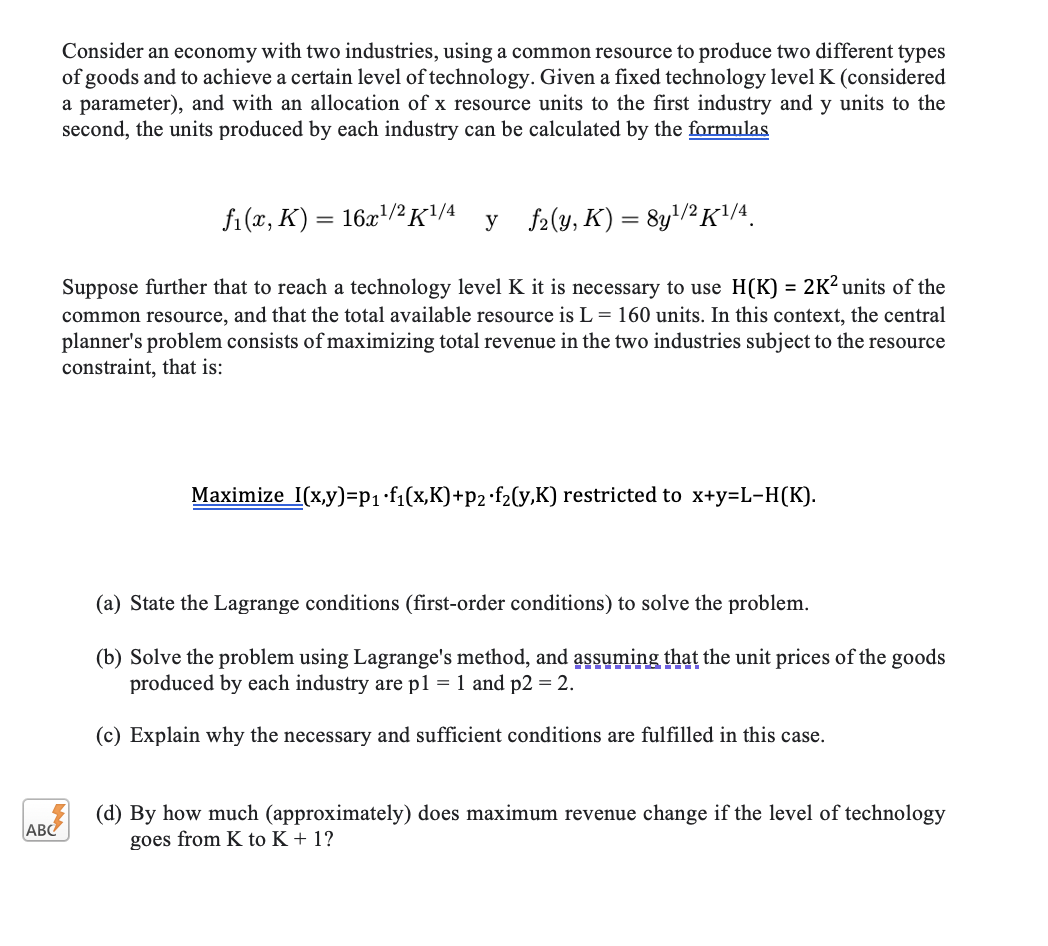
ABC Consider an economy with two industries, using a common resource to produce two different types of goods and to achieve a certain level of technology. Given a fixed technology level K (considered a parameter), and with an allocation of x resource units to the first industry and y units to the second, the units produced by each industry can be calculated by the formulas f(x, K) = 16x/2 K/4 y f2(y, K) = 8y/2 K/4 Suppose further that to reach a technology level K it is necessary to use H(K) = 2K units of the common resource, and that the total available resource is L = 160 units. In this context, the central planner's problem consists of maximizing total revenue in the two industries subject to the resource constraint, that is: Maximize I(x,y)=P f(x,K)+P2 f(y,K) restricted to x+y=L-H(K). (a) State the Lagrange conditions (first-order conditions) to solve the problem. (b) Solve the problem using Lagrange's method, and assuming that the unit prices of the goods produced by each industry are pl = 1 and p2 = 2. (c) Explain why the necessary and sufficient conditions are fulfilled in this case. (d) By how much (approximately) does maximum revenue change if the level of technology goes from K to K + 1?
Step by Step Solution
3.50 Rating (163 Votes )
There are 3 Steps involved in it
a The Lagrange conditions firstorder conditions for solving the problem are 1 partialpartial x Ixy l... View full answer

Get step-by-step solutions from verified subject matter experts
 Study Help