







Question: Suppose TRF = 3%, rm = 13%, and bi 1.3. a. What is ri, the required rate of return on Stock i? Round your
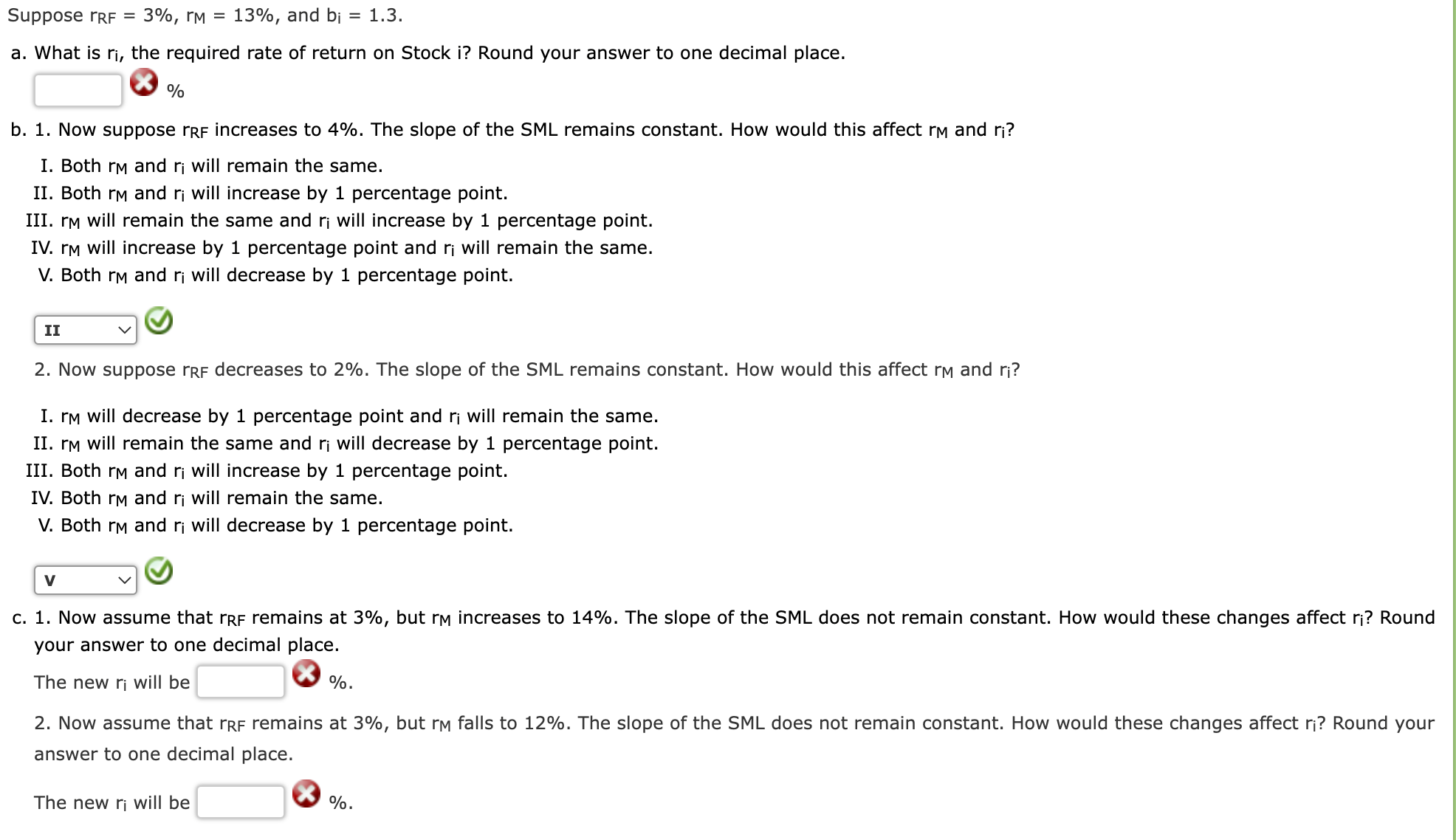
Suppose TRF = 3%, rm = 13%, and bi 1.3. a. What is ri, the required rate of return on Stock i? Round your answer to one decimal place. b. 1. Now suppose TRF increases to 4%. The slope of the SML remains constant. How would this affect rm and ri? I. Both rm and r will remain the same. II. Both rm and r will increase by 1 percentage point. III. rm will remain the same and r will increase by 1 percentage point. IV. rm will increase by 1 percentage point and r will remain the same. V. Both rm and ri will decrease by 1 percentage point. II % 2. Now suppose TRF decreases to 2%. The slope of the SML remains constant. How would this affect r and r? I. rm will decrease by 1 percentage point and r will remain the same. II. rm will remain the same and r will decrease by 1 percentage point. III. Both rm and r will increase by 1 percentage point. IV. Both rm and r will remain the same. V. Both rm and r will decrease by 1 percentage point. V c. 1. Now assume that rRF remains at 3%, but r increases to 14%. The slope of the SML does not remain constant. How would these changes affect r? Round your answer to one decimal place. The new ri will be %. 2. Now assume that rRF remains at 3%, but rm falls to 12%. The slope of the SML does not remain constant. How would these changes affect ri? Round your answer to one decimal place. The new r will be %.
Step by Step Solution
3.52 Rating (152 Votes )
There are 3 Steps involved in it
a To calculate ri the required rate of return on Stock i we can use the formula ri ... View full answer

Get step-by-step solutions from verified subject matter experts
 Study Help