







Question: Above is Question 4. Now I only need Continue to consider the economy defined in Question 4. Now suppose there is another participant 2, whose
Above is Question 4. Now I only need
Continue to consider the economy defined in Question 4. Now suppose there is another participant 2, whose utility function is the same as that of participant 1 but endowment is [1; 100]. (a) Find the optimal consumption/deposit choices of participants 2. (b) Compare the optimal consumption/deposit choices between participants 1 and participant 2. (c) Find the equilibrium interest rate when there are two participants. (d) Calculate the equilibrium interest rate. How is it different from the equilibrium interest rate under the previous condition (the economy has only participants 1)? (e) Prove that the equilibrium portfolio is Pareto optimality.
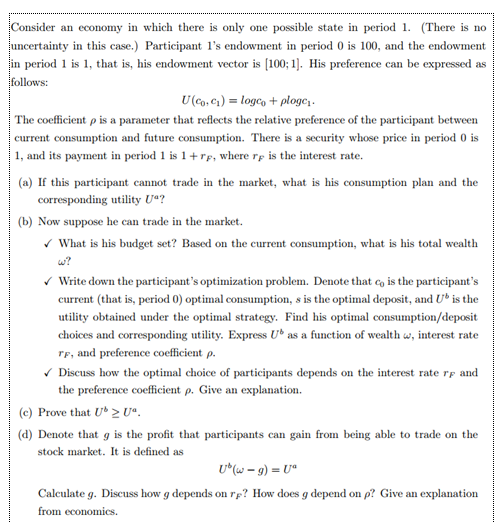
Consider an economy in which there is only one possible state in period 1. (There is no uncertainty in this case.) Participant l's endowment in period 0 is 100, and the endowment in period 1 is 1, that is, his endowment vector is (100; 1). His preference can be expressed as follows: U(,C) = logco + plogen The coefficient p is a parameter that reflects the relative preference of the participant between current consumption and future consumption. There is a security whose price in period 0 is 1, and its payment in period 1 is 1 + rp, where rp is the interest rate. (a) If this participant cannot trade in the market, what is his consumption plan and the corresponding utility U? (b) Now suppose he can trade in the market. What is his budget set? Based on the current consumption, what is his total wealth w? Write down the participant's optimization problem. Denote that co is the participant's current (that is, period 0) optimal consumption, s is the optimal deposit, and U is the utility obtained under the optimal strategy. Find his optimal consumption/deposit choices and corresponding utility. Express U as a function of wealth w, interest rate rf, and preference coefficient p. Discuss how the optimal choice of participants depends on the interest rate rp and the preference coefficient p. Give an explanation. (e) Prove that U U (a) Denote that g is the profit that participants can gain from being able to trade on the stock market. It is defined as Uw - g) = 0 Calculate g. Discuss how g depends on rp? How does g depend on p? Give an explanation from economics
Step by Step Solution
There are 3 Steps involved in it

Get step-by-step solutions from verified subject matter experts
 Study Help