







Question: Above one is a single question and the below are part of the questions Below is the Description for the above question Matlab Write a

Above one is a single question and the below are part of the questions Below is the Description for the above question
![Write a Matlab function [r,p] = ray_mdf(n, sigma) that returns the mdf](https://dsd5zvtm8ll6.cloudfront.net/si.experts.images/questions/2024/09/66f534bc458bf_85166f534bbcd03d.jpg)


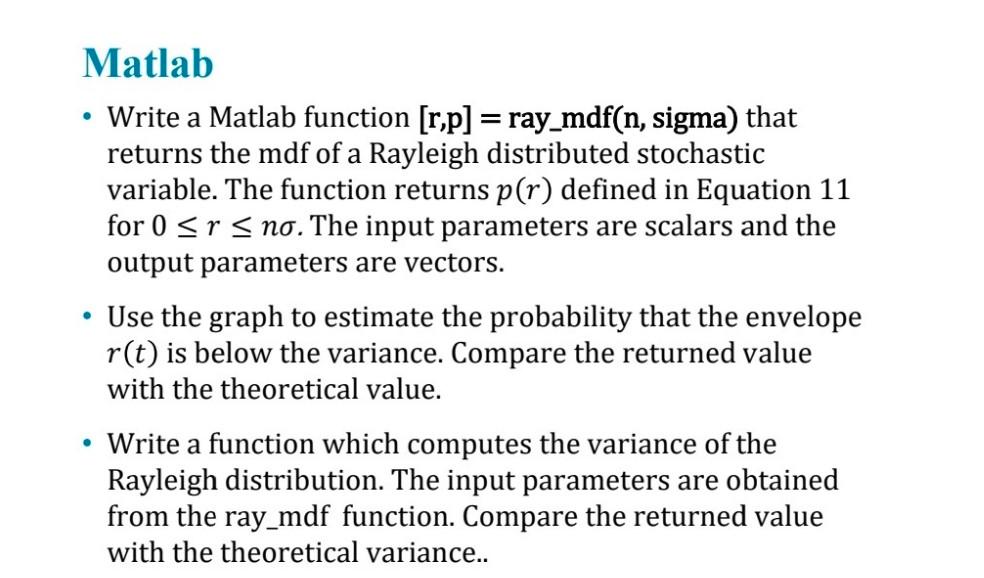
Matlab Write a Matlab function [r,p] = ray_mdf(n, sigma) that returns the mdf of a Rayleigh distributed stochastic variable. The function returns p(r) defined in Equation 11 for 0 Sr sno. The input parameters are scalars and the output parameters are vectors. Use the graph to estimate the probability that the envelope r(t) is below the variance. Compare the returned value with the theoretical value. Write a function which computes the variance of the Rayleigh distribution. The input parameters are obtained from the ray_mdf function. Compare the returned value with the theoretical variance.. . The marginal density function (mdf) of r(t), denoted by p(r) is often called the Rayleigh distribution in the literature: r2 p(r) = e 202 (11) Fading The signal received on path i is characterized by si(t) = A(t)cos(2ffct + 0(t)) i = 0,1,.,N The total signal received by a mobile, s(t), is the sum of the signals received on the different paths, and can be expressed as N s(t) = X 4 (t)cos(27fet + 0;(t)) (1) i=1 The phase 0;(t), depends on the varying path lengths, changing by 2nt when the path length changes by a wavelength. This means that the phases can be modelled by random variables, uniformly distributed over [0 21]. Fading Equation (1) must be modified when there is relative motion between the transmitter and receiver. If the received signal on path i, si(t), arrives at the receiver from an angle di relative to the direction of motion of the mobile, the doppler shift of this signal is given by vfc A fi = Ecos d (2) The received signal s(t) can now be written as ufc N s(t) = {4;(t)cos(29fct + 2n A fit+{t)) (3) i=1 . Fading The received signal can also be expressed as s(t) = Re{z(t)e-j21 ct} (5) where the complex envelope of s(t) is a low-pass signal given by z(t) = x(t) + jy(t) (6) The envelope of the signal z(t) is denoted by r(t) r(t) = 1x2(t) + y2(t) (7) and the phase of the signal is denoted by 0(t) yt) o(t) = = atan (8) The in-phase x(t) and quadrature y(t) become uncorrelated Gaussian processes if the received signal s(t) consists of many components with the same statistical properties. *(t) . Fading The signal received on path i is characterized by si(t) = Aj(t)cos(21tfct + 0;(t)) i = 0,1,..., N The total signal received by a mobile, s(t), is the sum of the signals received on the different paths, and can be expressed as N s(t) = A(t)cos(2nfct +0;(t)) (1) 1) i=1 The phase 0;(t), depends on the varying path lengths, changing by 2nt when the path length changes by a wavelength. This means that the phases can be modelled by random variables, uniformly distributed over [0 21t]. Fading It can be shown that the average power of the received signal y = r2(t) is exponentially distributed with mean Vo = 202 1 p(y) = -e Yo (12) Yo Fading If there is a direct line-of-sight path between the transmitting antenna and the mobile, Equation (3) can be modified to include this effect N s(t) = A.cos(21fct +211 A fot) + A (t)cos(21fet +0:(t)) (13) where the constant A, is the strength of the direct component and Afo is the Doppler shift along the direct path. The envelope r(t) is in this case Nakagami-Rice distributed or just Rican distributed with the mdf _p + (rAo ) ) where lo is the zero-order modified Bessel function
Step by Step Solution
There are 3 Steps involved in it

Get step-by-step solutions from verified subject matter experts
 Study Help