


Question: According to the article, in what ways is Performance Management (PM) broken? What are the prescriptions for the next generation PM approaches? Do you think

According to the article, in what ways is Performance Management (PM) broken? What are the prescriptions for the next generation PM approaches? Do you think these will be

effective? Explain your answer. Which of the new technologies described in the article did you view as impressive? Why?According to the article, in what ways is
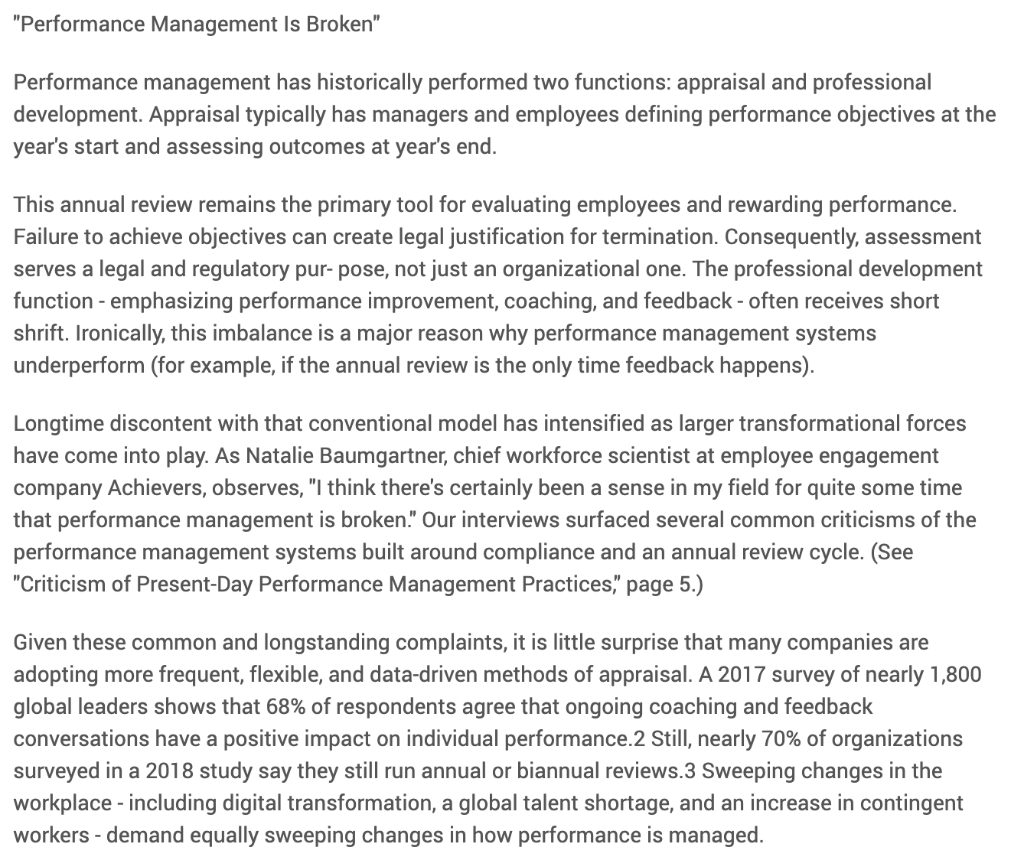
Performance management has historically performed two functions: appraisal and professional development. Appraisal typically has managers and employees defining performance objectives at the year's start and assessing outcomes at year's end. This annual review remains the primary tool for evaluating employees and rewarding performance. Failure to achieve objectives can create legal justification for termination. Consequently, assessment serves a legal and regulatory pur- pose, not just an organizational one. The professional development function - emphasizing performance improvement, coaching, and feedback - often receives short shrift. Ironically, this imbalance is a major reason why performance management systems underperform (for example, if the annual review is the only time feedback happens). Longtime discontent with that conventional model has intensified as larger transformational forces have come into play. As Natalie Baumgartner, chief workforce scientist at employee engagement company Achievers, observes, "I think there's certainly been a sense in my field for quite some time that performance management is broken." Our interviews surfaced several common criticisms of the performance management systems built around compliance and an annual review cycle. (See "Criticism of Present-Day Performance Management Practices," page 5.) Given these common and longstanding complaints, it is little surprise that many companies are adopting more frequent, flexible, and data-driven methods of appraisal. A 2017 survey of nearly 1,800 global leaders shows that 68% of respondents agree that ongoing coaching and feedback conversations have a positive impact on individual performance.2 Still, nearly 70% of organizations surveyed in a 2018 study say they still run annual or biannual reviews.3 Sweeping changes in the workplace - including digital transformation, a global talent shortage, and an increase in contingent workers - demand equally sweeping changes in how performance is managed

Step by Step Solution

There are 3 Steps involved in it

1 Expert Approved Answer
Step: 1 Unlock blur-text-image

Question Has Been Solved by an Expert!

Get step-by-step solutions from verified subject matter experts

Step: 2 Unlock
Step: 3 Unlock

Students Have Also Explored These Related General Management Questions!