







Question: According to the requirement given, write this assignment in Java. Write a general subprogram to perform repeated Aitken extrapolation, given a sequence r1,22,.. . ,TnRous,
According to the requirement given, write this assignment in Java.
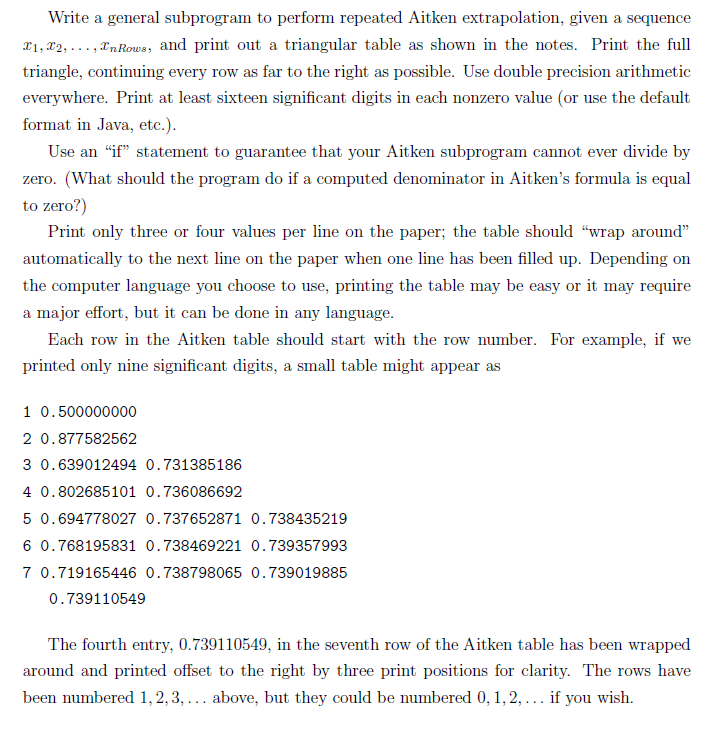
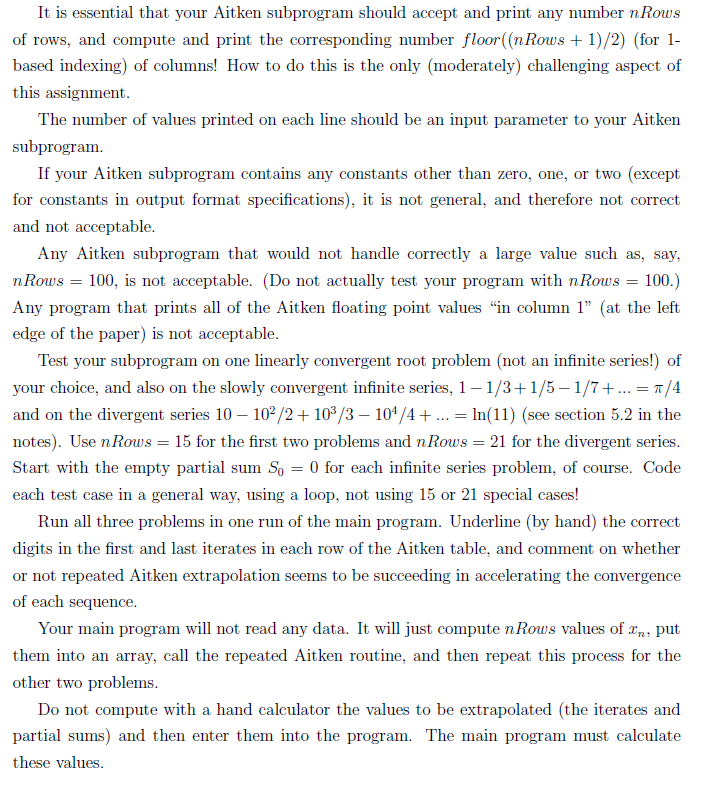
Write a general subprogram to perform repeated Aitken extrapolation, given a sequence r1,22,.. . ,TnRous, and print out a triangular table as shown in the notes. Print the full triangle, continuing every row as far to the right as possible. Use double precision arithmetic everywhere. Print at least sixteen significant digits in each nonzero value (or use the default format in Java, etc Use an "if" statement to guarantee that your Aitken subprogram cannot ever divide by zero. (What should the program do if a computed denominator in Aitken's formula is equal to zero?) Print only three or four values per line on the paper; the table should "wrap around" automatically to the next line on the paper when one line has been filled up. Depending on the computer language you choose to use, printing the table may be easy or it may require a major effort, but it can be done in any language Each row in the Aitken table should start with the row number. For example, if we printed only nine significant digits, a small table might appear as 1 0.500000000 2 0.877582562 3 0.639012494 0.731385186 4 0.802685101 0.736086692 5 0.694778027 0.737652871 0.738435219 6 0.768195831 0.738469221 0.739357993 7 0.719165446 0.738798065 0.739019885 0.739110549 The fourth entry, 0.739110549, in the seventh row of the Aitken table has been wrapped around and printed offset to the right by three print positions for clarity. The rows have been numbered 1, 2,3,... above, but they could be numbered 0,1,2, if you wish. Write a general subprogram to perform repeated Aitken extrapolation, given a sequence r1,22,.. . ,TnRous, and print out a triangular table as shown in the notes. Print the full triangle, continuing every row as far to the right as possible. Use double precision arithmetic everywhere. Print at least sixteen significant digits in each nonzero value (or use the default format in Java, etc Use an "if" statement to guarantee that your Aitken subprogram cannot ever divide by zero. (What should the program do if a computed denominator in Aitken's formula is equal to zero?) Print only three or four values per line on the paper; the table should "wrap around" automatically to the next line on the paper when one line has been filled up. Depending on the computer language you choose to use, printing the table may be easy or it may require a major effort, but it can be done in any language Each row in the Aitken table should start with the row number. For example, if we printed only nine significant digits, a small table might appear as 1 0.500000000 2 0.877582562 3 0.639012494 0.731385186 4 0.802685101 0.736086692 5 0.694778027 0.737652871 0.738435219 6 0.768195831 0.738469221 0.739357993 7 0.719165446 0.738798065 0.739019885 0.739110549 The fourth entry, 0.739110549, in the seventh row of the Aitken table has been wrapped around and printed offset to the right by three print positions for clarity. The rows have been numbered 1, 2,3,... above, but they could be numbered 0,1,2, if you wish
Step by Step Solution
There are 3 Steps involved in it

Get step-by-step solutions from verified subject matter experts
 Study Help