



Question: 1.10. This question asks you to use a Solow-style model to investigate some ideas that have been discussed in the context of Thomas Piketty's

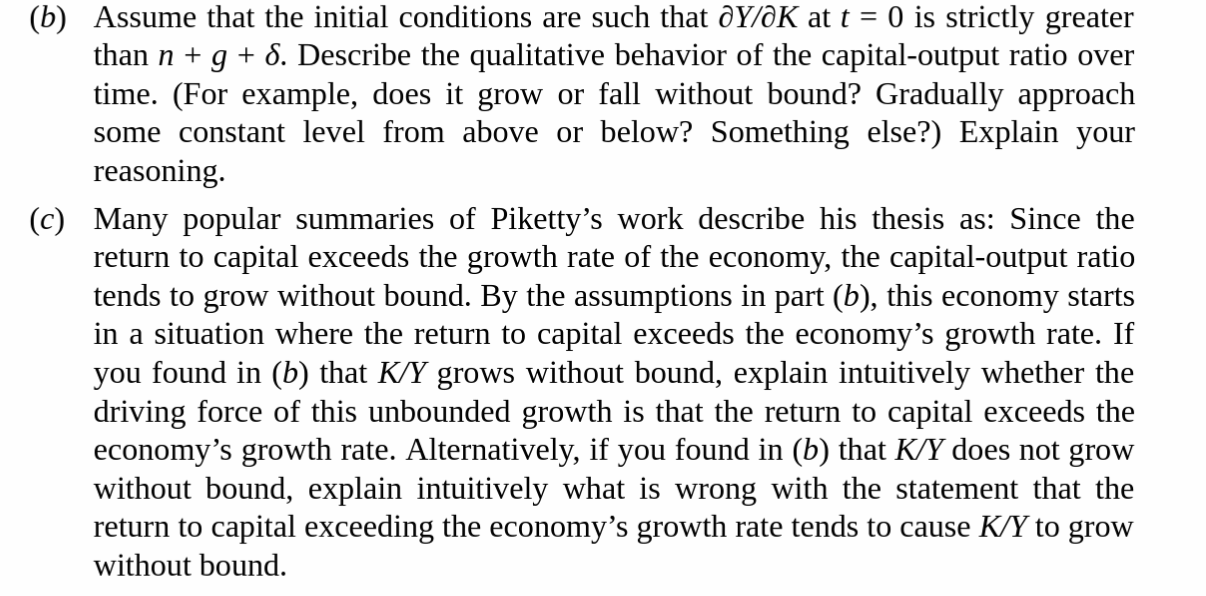
1.10. This question asks you to use a Solow-style model to investigate some ideas that have been discussed in the context of Thomas Piketty's recent work (see Piketty, 2014; Piketty and Zucman, 2014; Rognlie, 2015). Consider an economy described by the assumptions of the Solow model, except that factors are paid their marginal products (as in the previous problem), and all labor income is consumed and all other income is saved. Thus, C(t) = L(t)[@Y(t)/dL(t)]. (b) Assume that the initial conditions are such that @Y/K at t = 0 is strictly greater than n + g + 6. Describe the qualitative behavior of the capital-output ratio over time. (For example, does it grow or fall without bound? Gradually approach some constant level from above or below? Something else?) Explain your reasoning. (c) Many popular summaries Piketty's work describe his thesis as: Since the return to capital exceeds the growth rate of the economy, the capital-output ratio tends to grow without bound. By the assumptions in part (b), this economy starts in a situation where the return to capital exceeds the economy's growth rate. If you found in (b) that K/Y grows without bound, explain intuitively whether the driving force of this unbounded growth is that the return to capital exceeds the economy's growth rate. Alternatively, if you found in (b) that K/Y does not grow without bound, explain intuitively what is wrong with the statement that the return to capital exceeding the economy's growth rate tends to cause K/Y to grow without bound.
Step by Step Solution
3.41 Rating (179 Votes )
There are 3 Steps involved in it
a Show that the properties of the production function and our assumptions about the behavior ... View full answer

Get step-by-step solutions from verified subject matter experts